
-
 Argentina
-
 Australia
-
 Austria
-
 Belgium
-
 Brazil
-
 Canada
-
 China
China
-
 Czech Republic
-
 Denmark
-
 Finland
-
 France
-
 Germany
-
 Greece
-
 Hong Kong
-
 Hungary
-
 Iceland
-
 India
India
-
 Ireland
-
 Israel
-
 Italy
Italy
-
 Japan
Japan
-
 Korea
Korea
-
 Luxembourg
-
 Malaysia
-
 Netherlands
-
 New Zealand
-
 Norway
-
 Poland
-
 Portugal
-
 Qatar
Qatar
-
 Romania
-
 Saudi Arabia
-
 Singapore
-
 Spain
Spain
-
 Sweden
-
 Switzerland
-
 Taiwan
-
 Turkey
-
 United Kingdom
-
 United States
research use only
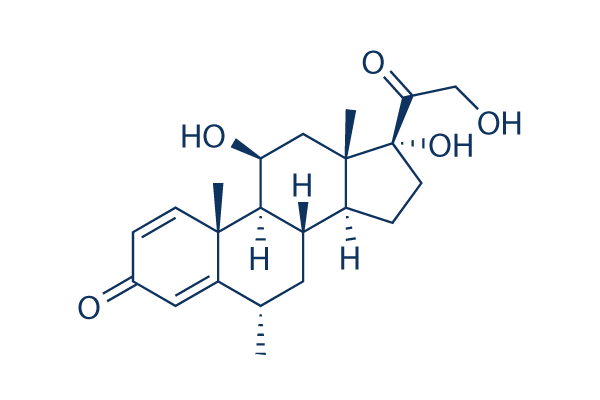
Methylprednisolone Glucocorticoid Receptor agonist
Cat.No.S1733
Quality Control
| Related Targets | Adrenergic Receptor Estrogen/progestogen Receptor GPR Androgen Receptor ACE RAAS Progesterone Receptor Opioid Receptor THR PGES |
|---|---|
| Other Glucocorticoid Receptor Inhibitors | Relacorilant (CORT125134) Corticosterone AL082D06 (20S)-Protopanaxatriol Cortodoxone |
Cell Culture, Treatment & Working Concentration
| Cell Lines | Assay Type | Concentration | Incubation Time | Formulation | Activity Description | PMID |
|---|---|---|---|---|---|---|
| HepG2 cells | Function assay | 24 h | Activation of rat PXR expressed in human HepG2 cells after 24 hrs by luciferase reporter gene based luminescent analysis, EC50=4 μM | |||
| Click to View More Cell Line Experimental Data | ||||||
Solubility
|
In vitro |
DMSO
: 75 mg/mL
(200.28 mM)
Ethanol : 2 mg/mL Water : Insoluble |
Molarity Calculator
|
In vivo |
|||||
In vivo Formulation Calculator (Clear solution)
Step 1: Enter information below (Recommended: An additional animal making an allowance for loss during the experiment)
Step 2: Enter the in vivo formulation (This is only the calculator, not formulation. Please contact us first if there is no in vivo formulation at the solubility Section.)
Calculation results:
Working concentration: mg/ml;
Method for preparing DMSO master liquid: mg drug pre-dissolved in μL DMSO ( Master liquid concentration mg/mL, Please contact us first if the concentration exceeds the DMSO solubility of the batch of drug. )
Method for preparing in vivo formulation: Take μL DMSO master liquid, next addμL PEG300, mix and clarify, next addμL Tween 80, mix and clarify, next add μL ddH2O, mix and clarify.
Method for preparing in vivo formulation: Take μL DMSO master liquid, next add μL Corn oil, mix and clarify.
Note: 1. Please make sure the liquid is clear before adding the next solvent.
2. Be sure to add the solvent(s) in order. You must ensure that the solution obtained, in the previous addition, is a clear solution before proceeding to add the next solvent. Physical methods such
as vortex, ultrasound or hot water bath can be used to aid dissolving.
Chemical Information, Storage & Stability
| Molecular Weight | 374.47 | Formula | C22H30O5 |
Storage (From the date of receipt) | |
|---|---|---|---|---|---|
| CAS No. | 83-43-2 | Download SDF | Storage of Stock Solutions |
|
|
| Synonyms | NSC-19987, U 7532 | SMILES | CC1CC2C3CCC(C3(CC(C2C4(C1=CC(=O)C=C4)C)O)C)(C(=O)CO)O | ||
Read more about storage stability stock solution CAS number SMILES
Mechanism of Action
| Targets/IC50/Ki |
Glucocorticoid receptor
|
|---|---|
| In vitro |
Methylprednisolone (2-10 mg/kg) markedly inhibits TNF production but does not affect serum levels of IL-10, while a high dose of this compound (50 mg/kg) increases LPS-induced IL-10 levels. This chemical (from 0.01 to 100 mg/mL) also increases the biosynthesis of IL-10 by LPS-activated mouse peritoneal macrophages. |
| In vivo |
Methylprednisolone decreases RGC survival in rats with electrophysiologically diagnosed optic neuritis. This compound decreases RGC survival by a nongenomic, calcium-dependent mechanism. Its induced enhancement of RGC degeneration depends on calcium influx through voltage-gated calcium channels. This treatment leads to a significant decrease in the number of ED1-positive cells in both rostral and caudal stumps. It results in a significant reduction in tissue loss in both cord stumps at 2, 4 and 8 week post-injury. This chemical leads to a long-term reduction of ED1-positive cells and spinal tissue loss, reduced dieback of vestibulospinal fibres, and a transient sprouting of vestibulospinal fibres near the lesion at 1 and 2 weeks post-lesion. At a dose of 30 mg/kg which has been shown to be effective in improving functional outcomes in rat SCI models, it suppresses TNF-α expression and NF-kB activation. Its inhibition of NF-kB function is likely mediated by the induction of IkB, which traps NF-kB in inactive cytoplasmic complexes. |
References |
|
Clinical Trial Information
(data from https://clinicaltrials.gov, updated on 2026-07-30)
| NCT Number | Recruitment | Conditions | Sponsor/Collaborators | Start Date | Phases |
|---|---|---|---|---|---|
| NCT07072585 | NOT_YET_RECRUITING | Stage II T Lymphoblastic Leukemia/Lymphoma; Stage III T Lymphoblastic Leukemia/Lymphoma; Stage IV T Lymphoblastic Leukemia/Lymphoma; T Acute Lymphoblastic Leukemia; T Lymphoblastic Lymphoma |
Children's Oncology Group |
2026-08-28 | PHASE2; PHASE3 |
| NCT07478003 | RECRUITING | STEMI - ST Elevation Myocardial Infarction |
Thomas Engstrom |
2026-04-20 | PHASE3 |
| NCT07258771 | RECRUITING | Ulcerative Colitis Acute |
Berinstein, Jeffrey |
2026-01-16 | PHASE4 |
| NCT06970743 | ACTIVE_NOT_RECRUITING | Chronic Lymphocytic Leukemia; Small Lymphocytic Lymphoma |
BeOne Medicines |
2025-05-29 | PHASE3 |
| NCT07703098 | NOT_YET_RECRUITING | Adrenal Insufficiency |
University Medical Centre Ljubljana |
2026-09-01 | PHASE4 |
| NCT07412470 | RECRUITING | Kidney Transplant Rejection |
Sanofi |
2026-03-13 | PHASE2; PHASE3 |
Read more about Clinical Trials
Tech Support
Tel: +1-832-582-8158 Ext:3
If you have any other enquiries, please leave a message.

Products are for research use only. Not for human use. We do not sell to patients.
©Copyright 2013 Selleck Chemicals. All Rights Reserved.