
Why is Akt phosphorylation at Ser473 paradoxically increased after 2 hours of Rapamycin treatment?
Quick Answer
Recommended ApproachTo evaluate genuine pathway suppression, perform extended time-course treatments or co-target upstream compensatory feedback loops such as RTK/IRS-1 or dual PI3K/mTOR inhibition.
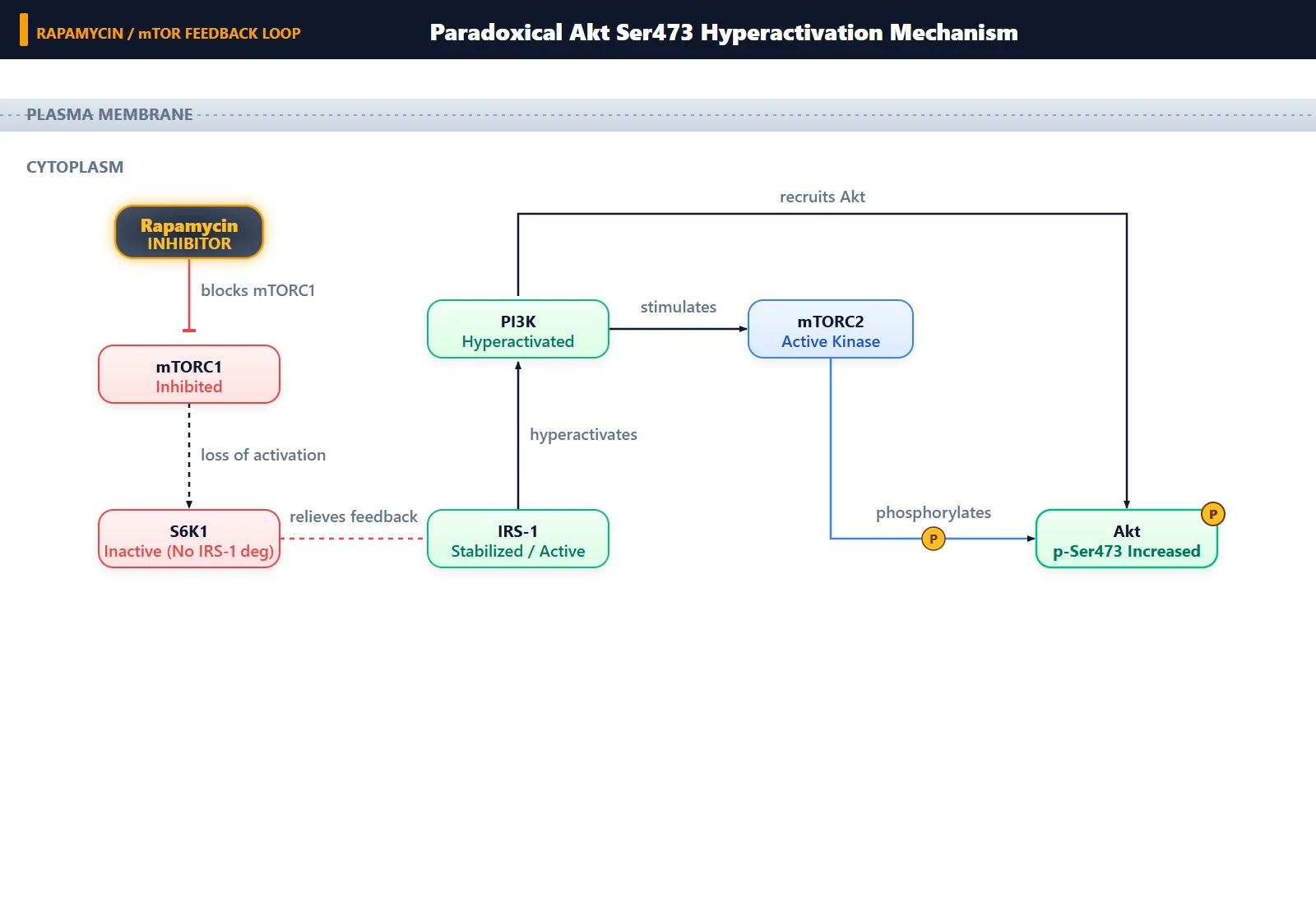
Common CausesAcute rapamycin exposure selectively inhibits mTORC1, which relieves p70S6K-dependent negative feedback and triggers compensatory upstream PI3K and mTORC2 activation to hyperphosphorylate Akt at Ser473.
How Should It Be Done Correctly?
Systematic Regimen for Dissecting mTOR Pathway Dynamics
When probing the downstream effects of mTOR inhibition, experimental setups must differentiate between acute feedback loops and steady-state complex disruption [1, 2, 3].
| Inhibitor Strategy | Target Specificity | Evaluated Time Window | Expected p-Akt (Ser473) Response | S6K/RPS6 Phosphorylation |
|---|---|---|---|---|
| Acute Rapamycin | mTORC1 (selective) | 1 to 4 hours | Paradoxically Increased / Elevated | Completely Inhibited |
| Chronic Rapamycin | mTORC1 + mTORC2 (cell-dependent) | 24 to 72 hours | Suppressed / Decreased | Suppressed |
| Dual PI3K/mTOR (e.g., NVP-BEZ235) | p110 subunits + mTOR | 1 to 24 hours | Suppressed / Abolished | Completely Inhibited |
| ATP-competitive mTOR kinase inhibitor (e.g., Torin1) | mTORC1 + mTORC2 | 0.5 to 24 hours | Completely Blocked | Completely Inhibited |
| Rapamycin + Upstream/RTK Inhibitor | mTORC1 + Upstream Driver | 2 to 24 hours | Abrogated / Normalized | Completely Inhibited |
Experimental Execution and Western Blot Timing Protocol
- Reconstitute and store rapamycin according to strict standards: Dissolve rapamycin powder in anhydrous DMSO to prepare a standard 10 mM stock solution. Aliquot into small, single-use volumes to prevent repeated freeze-thaw cycles, storing stock solutions at -80°C for up to 1 year or -20°C for up to 1 month.
- Establish a multipoint kinetic profile: Do not rely solely on a 2-hour single time point. Seed cells and treat them in parallel across a time gradient (0.5 h, 2 h, 6 h, 12 h, 24 h, and 48 h) alongside appropriate vehicle controls [1, 4].
- Assess target engagement versus feedback activation: Lyse cells rapidly in chilled RIPA or NP-40 lysis buffer supplemented with protease and phosphatase inhibitor cocktails. Include both target engagement markers (phospho-S6 ribosomal protein Ser235/236 or phospho-p70S6K Thr389) and upstream/feedback markers (phospho-Akt Ser473, phospho-Akt Thr308, and total Akt) [1, 2, 4].
- Counteract feedback when Akt suppression is required: If the experimental endpoint requires complete silencing of pro-survival Akt signaling, implement dual PI3K/mTOR catalytic inhibition (such as NVP-BEZ235) or combine mTORC1 inhibition with RTK, Akt, or histone deacetylase inhibitors to abrogate rebound phosphorylation [3, 4, 5].
What Went Wrong?
Copy code to add this image to your page Copy Code
Erroneous Assumption of Complete Axis Silencing by Acute Exposure
The primary flaw in experimental design or interpretation is treating rapamycin as an instantaneous global suppressor of the entire PI3K/Akt/mTOR axis [1, 2]. Measuring phospho-Akt Ser473 at an acute 2-hour window while expecting down-regulation fails to account for the differential kinetics between allosteric mTORC1 inhibition and complex-dependent feedback regulation [2, 6].
Proximate Cause of the Transient Ser473 Hyperphosphorylation
The proximate cause of elevated p-Akt Ser473 after 2 hours is the rapid loss of downstream mTORC1 signaling while mTOR complex 2 (mTORC2) remains catalytically intact [2, 6]. Rapamycin binds FKBP12 to acutely inhibit mTORC1, causing immediate cessation of downstream ribosomal protein S6 kinase (p70S6K) activity [1, 2, 4]. Under acute conditions, rapamycin cannot physically access or disrupt preformed mTORC2 complexes, leaving mTORC2 fully competent to phosphorylate Akt at Ser473 [2, 6].
Molecular Disruption of the Negative Feedback Loop
Under baseline conditions, active mTORC1 drives p70S6K, which phosphorylates and marks insulin receptor substrate-1 (IRS-1) for proteasomal degradation and disrupts Grb2/Sos coupling, serving as a physiological rheostat that restricts upstream PI3K activation. Within 2 hours of rapamycin exposure, complete shutoff of mTORC1 abolishes this negative feedback loop. Stabilized IRS-1 and active receptor tyrosine kinases recruit PI3K, generating PIP3 at the plasma membrane [3]. This facilitates recruitment of Akt alongside mTORC2 (comprising mTOR, Rictor, and mLST8), which serves as the hydrophobic motif kinase that phosphorylates Akt at Ser473 [2, 3, 6]. Prolonged (chronic) treatment over 24 to 48 hours is required before rapamycin progressively sequesters newly synthesized mTOR molecules away from Rictor to diminish mTORC2 assembly and reduce Akt Ser473 phosphorylation [1, 6]. In contrast, dual PI3K/mTOR inhibitors or catalytic mTOR inhibitors directly suppress both PI3K/mTORC2 and prevent this rebound phosphorylation even at early time points [3, 4, 7].
How Can I Avoid This in Future Experiments?
Always incorporate phospho-p70S6K (Thr389) or phospho-RPS6 (Ser235/236) alongside phospho-Akt (Ser473 and Thr308) to independently confirm whether mTORC1 shutoff has occurred [1, 2, 4]. Include a catalytic pan-mTOR or dual PI3K/mTOR inhibitor (such as NVP-BEZ235 or Torin1) as a mechanistic control to directly demonstrate how uncoupling or co-suppressing mTORC2 prevents feedback-driven Akt rebound [3, 4, 7].
References
- [1]Fu Y, et al. Zhonghua xueyexue zazhi. 2015 Sep;36(9):780-4.
- [2]Yano T, et al. Circulation research. 2014 Apr;114(8):1268-80.[IF: 11.019]
- [3]Lin A, et al. Cancer research. 2014 Mar;74(6):1682-93.[IF: 9.329]
- [4]Li C, et al. Cancer cell international. 2015 Jan;15:65.[IF: 2.884]
- [5]Morgan SS, et al. BMC research notes. 2014 Nov;7:812.[IF: 1.8]
- [6]Kořánová T, et al. Pharmacological reports : PR. 2024 Dec;76(6):1390-1402.[IF: 3.8]
- [7]Zanfardino P, et al. Acta myologica : myopathies and cardiomyopathies : official journal of the Mediterranean Society of Myology. 2022 Jan;41(4):201-206.