
Why do polystyrene plates cause a significant loss of Rapamycin in low-serum cell culture?
Quick Answer
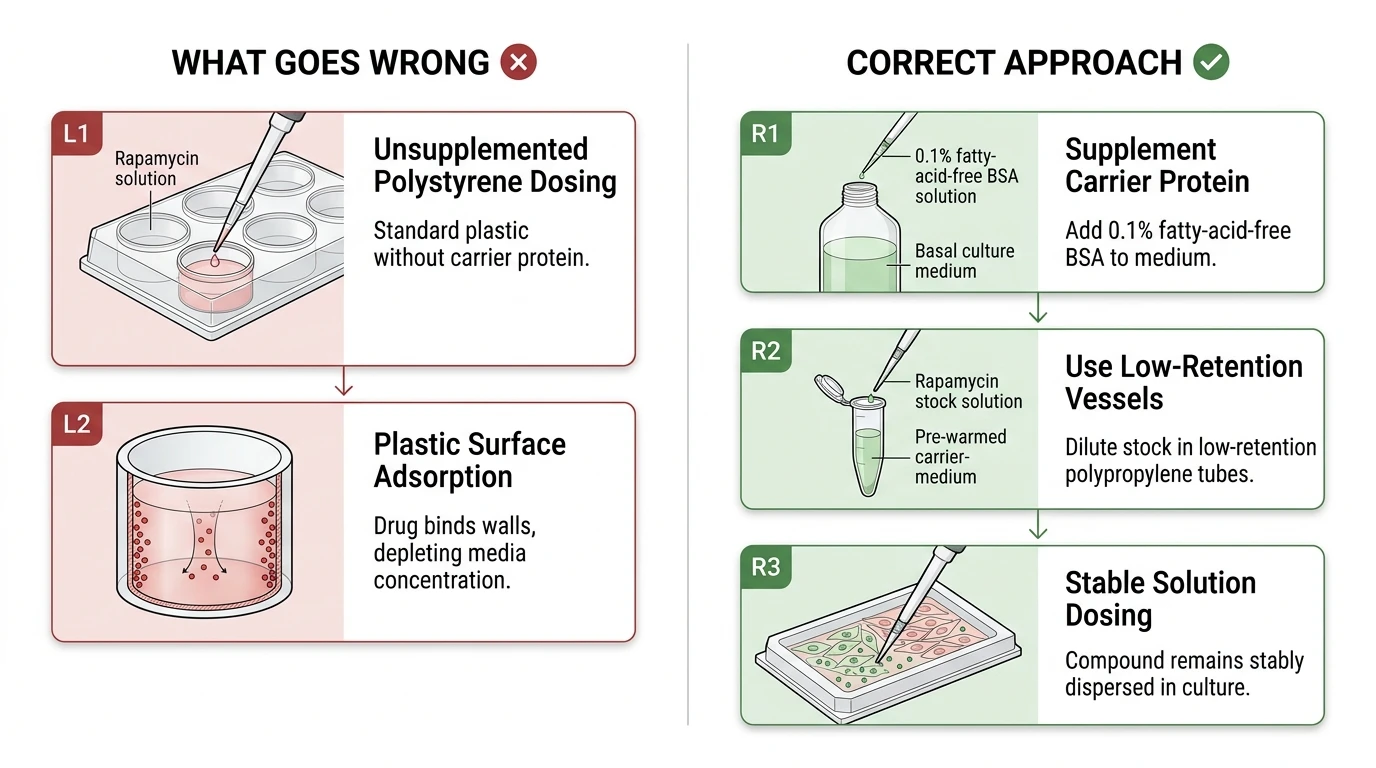
Recommended ApproachTo prevent rapid loss of rapamycin in low-serum culture, supplement the starvation medium with a non-interfering carrier protein such as fatty-acid-free BSA and prepare serial dilutions in low-retention vessels immediately before dosing.
Common CausesRapamycin is a highly hydrophobic macrolide that rapidly adsorbs onto the non-polar polystyrene vessel surfaces when protective serum carrier proteins like albumin are depleted.
How Should It Be Done Correctly?
Copy code to add this image to your page Copy Code
Optimized Handling Parameters for Low-Serum Assays
Reference matrix of operational conditions and plasticware selections to minimize non-specific adsorption of rapamycin during serum-reduced culture.
Standard Operating Procedure for Serum-Restricted Dosing
-
Stock Reconstitution and Storage: Dissolve solid rapamycin in pure anhydrous DMSO to prepare the standard 10 mM stock solution following manufacturer specifications. Dispense single-use working aliquots into low-retention tubes and freeze immediately. Discard thawed single-use aliquots rather than subjecting them to repeated thermal cycles.
-
Carrier-Enhanced Medium Preparation: Prepare low-serum or serum-free treatment media by dissolving fatty-acid-free bovine serum albumin (BSA) into basal medium. Filter-sterilize through a low-protein-binding 0.22 µm PES (polyethersulfone) membrane and pre-warm the solution to physiological culture temperature in a water bath before compound addition.
-
Intermediate Working Dilution: Using low-retention pipette tips and low-binding polypropylene microcentrifuge tubes, perform an intermediate pre-dilution of the DMSO stock into the pre-warmed, carrier-supplemented medium. Vortex vigorously for five seconds immediately upon liquid transfer to ensure homogeneous dispersion without creating localized concentration spikes.
-
Plating and Direct Dispensation: Aspirate existing culture medium from the cells cultured in low-binding or optimized multiwell plates. Immediately apply the freshly diluted rapamycin-containing formulation onto the cells, ensuring the liquid evenly covers the entire growth monolayer. Avoid allowing pipette tips to drag along the dry well walls.
-
Replenishment Strategy: In serum-starvation protocols spanning more than 24 hours, perform a complete medium exchange with freshly prepared intermediate dilutions rather than administering a concentrated top-up spike directly into old culture wells.
| Operational Parameter | High-Adsorption Condition (To Avoid) | Optimized Protocol Recommendation | Primary Functional Benefit |
|---|---|---|---|
| Culture Plate Surface | Untreated / Standard TC polystyrene | Low-binding surface or fluoropolymer | Minimizes surface contact energy |
| Dilution Vessel | Standard polystyrene or bulk glass tubes | Low-retention polypropylene (LoBind) | Pre-incubation surface loss prevented |
| Carrier Supplement | Unsupplemented basal medium (0% serum) | 0.1% (w/v) Fatty-Acid-Free BSA | Provides solubilizing hydrophobic pockets |
| Primary Stock Vehicle | Aqueous reconstitution | Anhydrous 100% DMSO (10 mM) | Complete dissolution of solid solute |
| Intermediate Mixing | Direct dropwise addition into cold media | Rapid stepwise mixing in pre-warmed media | Eliminates localized micro-precipitation |
| Dosing Schedule | Single dose over extended culture (>48 h) | Fresh medium replacement every 24 h | Counters progressive non-specific depletion |
What Went Wrong?
Depletion of Liquid-Phase Carrier Reservoirs
In standard cell culture environments supplemented with 10% fetal bovine serum, high concentrations of serum albumin and native lipophilic transport proteins provide abundant hydrophobic binding pockets. These carrier proteins act as a thermodynamic buffer, sequestering hydrophobic molecules such as rapamycin in dynamic equilibrium and holding them stably within the aqueous suspension. When serum is withdrawn or reduced (<1% FBS) for cell-cycle synchronization, autophagy induction, or metabolic starvation studies, this protective protein sink is eliminated. The aqueous phase becomes energetically unfavorable for naked hydrophobic drugs, compelling them to partition toward any available solid hydrophobic boundary.
Non-Specific Adsorption to Polystyrene Matrices
Standard cell culture vessels are fabricated from polystyrene—an aromatic synthetic polymer rich in hydrophobic benzene rings. While tissue culture (TC) treatment introduces oxygen-containing polar functional groups (such as carboxyl and hydroxyl moieties) onto the bottom surface to facilitate cell adhesion, substantial hydrophobic microdomains remain exposed across the well floor and untreated vertical sidewalls. In the absence of competitive serum proteins covering these plastic surfaces, rapamycin rapidly binds non-specifically to the vessel walls via extensive hydrophobic interactions and van der Waals forces. Quantitative bioassays frequently detect an acute drop in nominal media concentration within hours of dispensing into polystyrene plates under serum-free conditions.
Physicochemical Lipophilicity and Precipitation Trapping
Rapamycin possesses a large molecular mass (MW 914.18) and a complex macrocyclic lactone core characterized by an extremely poor aqueous solubility (<1 mg/mL). Due to this pronounced hydrophobicity, rapamycin behaves as a poorly soluble xenobiotic when introduced from organic solvents into physiological saline or aqueous buffers. In an unsupplemented aqueous column, individual molecules self-aggregate and form sub-micron colloidal clusters or film-like monolayers along the liquid-plastic interface. Once deposited onto the polystyrene surface, the drug is functionally sequestered away from target receptors in the cell monolayer, significantly attenuating downstream target engagement such as mTOR inhibition and downstream autophagy activation [1, 2].
How Can I Avoid This in Future Experiments?
To permanently eliminate non-specific vessel loss in serum-restricted assays, replace standard polystyrene culture plates with certified ultra-low attachment (ULA) plates or vessels with covalently bonded neutral hydrogel surfaces. These hydrophilic surfaces establish an energetic hydration barrier that prevents hydrophobic small molecules from partitioning out of solution onto the plastic wall.
Always incorporate a dedicated carrier supplement, such as 0.1% fatty-acid-free BSA or 0.01%–0.05% non-ionic pluronic surfactant (e.g., Pluronic F-68), whenever completely serum-free starvation is required. These inert additives supply sufficient amphiphilic shielding to stabilize low concentrations of rapamycin without introducing unwanted growth factors or hormones that compromise serum-starvation readouts.