
Why did Rapamycin fail to induce FKBP-FRB dimerization in cells overexpressing FKBP12?
Quick Answer
Recommended ApproachBalance the expression ratio of FKBP- and FRB-tagged constructs near equimolar levels and titrate rapamycin to prevent ligand saturation or competitive decoy complex formation.
Common CausesExcessive untagged or uncoupled FKBP12 sequesters rapamycin into binary complexes that competitively cap the FRB interface, preventing functional reporter dimerization.
How Should It Be Done Correctly?
Stoichiometric and Assay Parameter Guidelines
| Parameter | Optimized Value / Window | Key Functional Role | Failure Risk Under Deviation |
|---|---|---|---|
| Rapamycin Working Concentration | 10–100 nM (titrated to expression) | Induces cooperative ternary complex assembly [1][2] | >1 µM induces two-site hook effect; <1 nM insufficient engagement |
| Expression Construct Stoichiometry | 1:1 molar plasmid ratio (FKBP:FRB) | Equalizes binding partners to maximize bridge formation | Skewed ratios yield unproductive binary intermediate sinks |
| Endogenous FKBP12 Background | CRISPR knockout or low-expression cell line | Eliminates untagged competitive decoy binders [3] | Excess wild-type FKBP12 consumes ligand and caps FRB sites |
| Promoter Driving FKBP Fusion | Moderate (e.g., UbC, truncated CMV) | Prevents intracellular accumulation exceeding ligand capacity | Strong viral promoters cause severe molecular crowding and competition |
| Post-Induction Incubation Time | 30–120 min (kinetic readouts) | Captures peak ternary dimerization before adaptation [2] | Extended incubation (>16 h) increases metabolic clearance or toxicity |
Optimized Protocol for Chemically Induced Dimerization
- Cell Line Selection and Background Optimization: Select a cellular host with moderate or profiled endogenous FKBP12 expression. For ultra-sensitive split-reporter or translocation readouts, utilize an FKBP12-knockout line (or apply targeted shRNA/siRNA knockdown) to prevent native FKBP12 from acting as an invisible decoy [3].
- Transient or Stable Expression Tuning: Transfect the FKBP- and FRB-fusion plasmids using equal molar amounts. Avoid high-strength CMV/CAG promoters that generate massive cytoplasmic protein pools; utilize moderate-strength promoters to keep intracellular construct levels within the low-to-mid nanomolar range.
- Stock Reconstitution and Fresh Working Solution: Prepare rapamycin stock solutions in anhydrous DMSO at 10 mM. On the day of induction, perform serial dilutions in pre-warmed complete culture medium immediately prior to use to prevent compound precipitation.
- Ligand Dose Titration: Apply rapamycin across an optimized dose-response matrix (typically 1 nM to 500 nM) rather than a single excessive micromolar bolus [2]. This titration identifies the peak dimerization plateau and detects whether high-dose suppression occurs.
- Assay Execution and In-Process Assessment: Allow dimerization to proceed in imaging medium at 37°C. Measure the complementation signal, membrane translocation, or downstream effector activation across early time points (15, 30, 60, and 120 minutes) to verify rapid ternary assembly before secondary regulatory events intervene [4][2].
What Went Wrong?
Copy code to add this image to your page Copy Code
Excessive Expression of Non-Productive FKBP12 Species
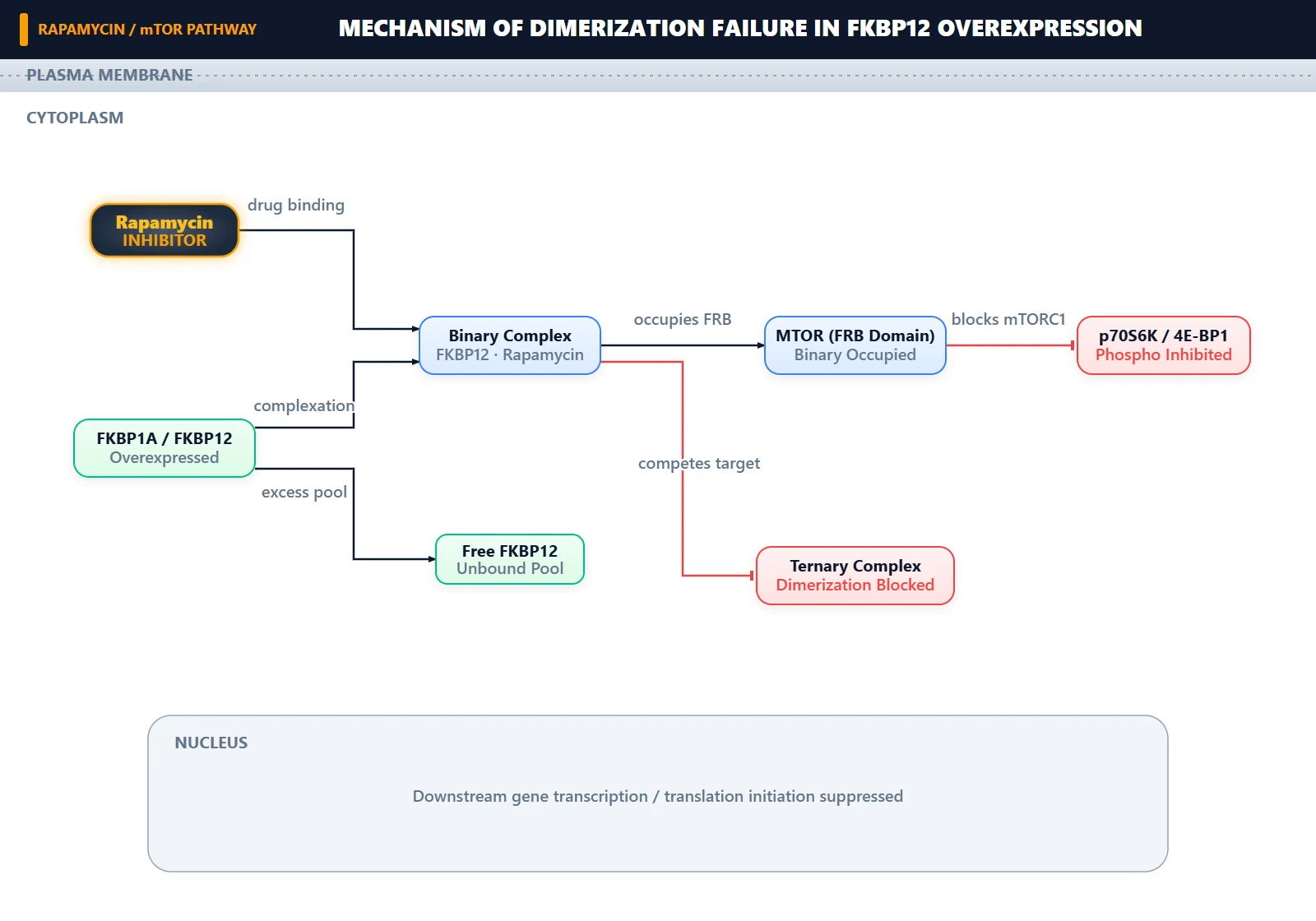
In chemically induced dimerization (CID) systems, rapamycin acts as an obligate bivalent chemical inducer [1]. The protocol failed because cells contained an overwhelming molar excess of FKBP12 relative to both the FRB-fusion partner and the available rapamycin ligand. This condition frequently occurs when researchers overexpress an unfused FKBP12 control, introduce an FKBP12-tagged construct driven by an excessively strong promoter, or neglect high endogenous levels of host immunophilins [3].
Competitive Decoy Sequestration and FRB Capping
The fundamental failure stems from competitive displacement and site saturation. Rapamycin binds tightly to the FK506-binding domain of FKBP12 with sub-nanomolar to low-nanomolar affinity (dissociation constant Kd ≈ 0.2--1 nM) [4][5]. In contrast, rapamycin alone has negligible affinity for the isolated FRB domain; it requires prior formation of a composite surface formed by the FKBP12–rapamycin complex to bind FRB with high affinity [1][2]. When FKBP12 is present in vast molar excess over rapamycin, virtually every rapamycin molecule is captured by an isolated FKBP12 monomer.
If the overexpressed FKBP12 includes untagged or non-reporter molecules, these binary FKBP12–rapamycin complexes bind and saturate all available FRB-fusion partners, effectively capping FRB domains and shielding them from interacting with the intended FKBP-fusion reporter [1][3]. Dimerization of the intended target constructs drops to zero because the overexpressed FKBP12 functions as a potent competitive inhibitor.
Molecular Assembly Dynamics and the Biphasic Hook Effect
The physics of crosslinker-mediated ternary complex assembly dictates that maximum complex formation occurs exclusively when the concentrations of the two binding domains and the chemical inducer remain within balanced stoichiometric windows. When FKBP12 is present in massive excess, the equilibrium of the reaction: $FKBP + Rapamycin + FRB rightleftharpoons FKBP·Rapamycin·FRB$ is shifted away from productive tripartite complexes. Instead, uncomplexed FKBP12 binds free rapamycin, and the resulting abundant binary complexes compete with any reporter-tagged FKBP for a limiting pool of FRB domains. Furthermore, if high concentrations of rapamycin are added in an attempt to overcome this, the biphasic "hook effect" (prozone phenomenon) is triggered, wherein excess ligand saturates binding sites independently into monomeric complexes, preventing bridge formation [2].
How Can I Avoid This in Future Experiments?
To prevent competitive inhibition in future dimerization experiments, verify the baseline expression of native FKBP12 in your cell line by Western blotting before choosing an expression system. Always co-transfect FKBP- and FRB-tagged constructs from a dual-promoter single plasmid or a bicistronic vector containing a 2A self-cleaving peptide (e.g., P2A or T2A) to enforce strict 1:1 stoichiometric synthesis. When testing new construct variants, always run a rapamycin titration curve spanning 0.1 nM to 1 µM; this immediately reveals the bell-shaped dimerization response and prevents working in an inhibitory prozone regime.
References
- [1]Passannante R, et al. Biomedicines. 2023 Jan;11(2).[IF: 3.9]
- [2]Groseclose TM, et al. Scientific reports. 2025 Nov;15(1):40798.[IF: 4.9]
- [3]Guo Z, et al. Nature chemistry. 2019 Mar;11(3):254-263.[IF: 21.687]
- [4]Sekhon H, et al. Frontiers in molecular biosciences. 2023 Jan;10:1114756.[IF: 3.9]
- [5]Joshi DC, et al. Frontiers in molecular biosciences. 2022 Jan;9:879000.[IF: 5.0]