
Why does Rapamycin precipitate immediately when diluted from a 10 mM DMSO stock into PBS?
Quick Answer
Recommended ApproachTo prevent precipitation, perform a staged intermediate dilution in pre-warmed aqueous buffer containing a carrier protein or surfactant, or dilute the 10 mM DMSO stock into cell culture medium to achieve sub-micromolar working concentrations under vigorous mixing.
Common CausesDirectly spiking a concentrated 10 mM DMSO stock into aqueous PBS triggers severe solvent shock and immediate phase separation because rapamycin is practically insoluble in water and its aqueous solubility threshold is drastically exceeded.
How Should It Be Done Correctly?
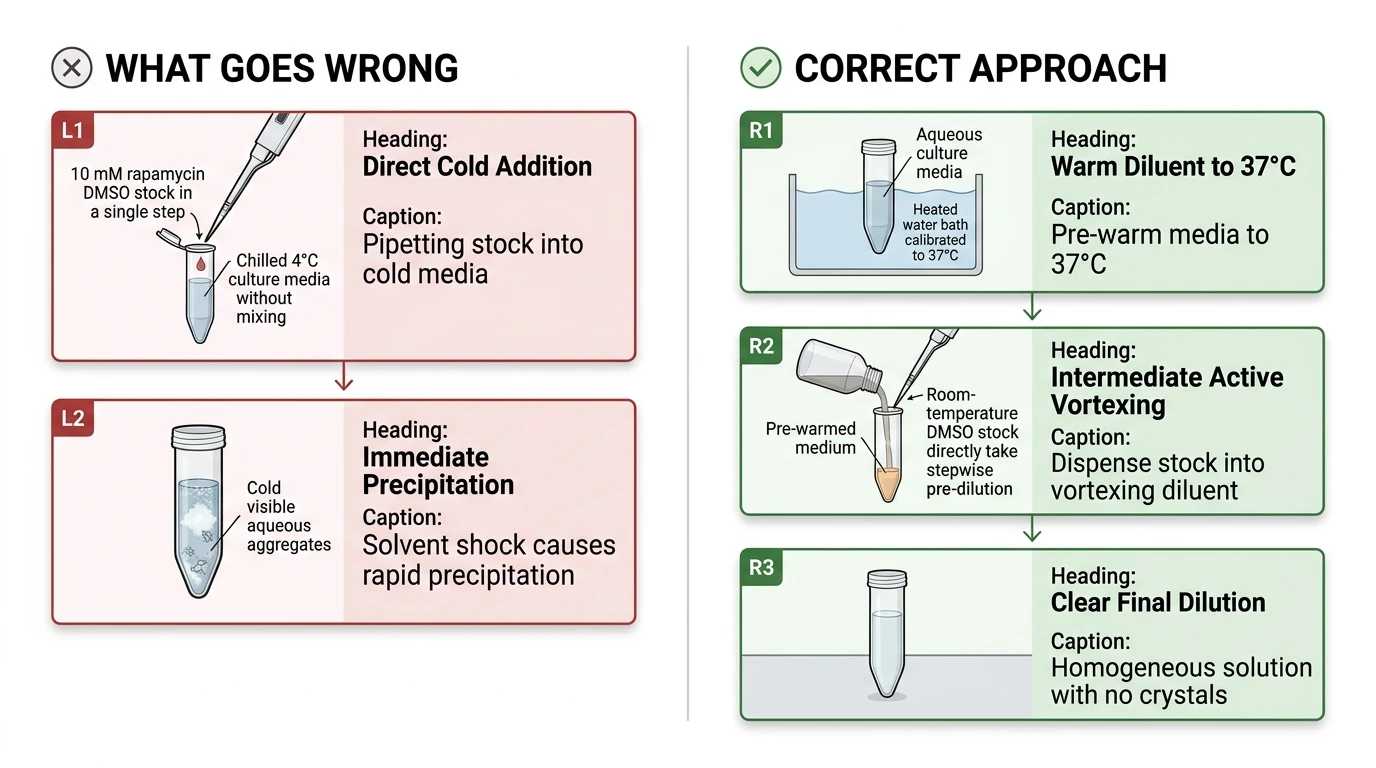
Copy code to add this image to your page Copy Code
Physicochemical Specifications and Dilution Parameters
Rapamycin (sirolimus; MW 914.18) exhibits pronounced lipophilic properties and negligible aqueous solubility, requiring strict control over vehicle composition, dilution factors, and mixing dynamics during working solution preparation [1].
Validated Working Solution Preparation Protocol
To prepare crystal-free rapamycin working solutions for cellular or biochemical assays without precipitation:
- Equilibrate Reagents: Remove a single-use 10 mM rapamycin DMSO aliquot from -80°C or -20°C and allow it to equilibrate completely to room temperature (20–25°C) in a desiccated container to avoid moisture condensation. Ensure the PBS or target culture medium is pre-warmed to 37°C, as cold aqueous buffers drastically accelerate macrolide crystallization.
- Determine Target Concentration: Confirm that the final concentration required does not exceed rapamycin's functional aqueous threshold. In vitro experimental concentrations typically span 100 pM to 100 nM [2], though some models use higher ranges [3].
- Perform a Two-Step Intermediate Dilution: Instead of dispensing the 10 mM DMSO stock directly into a large volume of plain PBS, perform an intermediate pre-dilution in DMSO (e.g., 100 µM or 1 mM in DMSO), or pre-dilute 1:100 into medium containing 0.1–1% bovine serum albumin (BSA) or fetal bovine serum (FBS) under active vortexing [Source: ResearchGate].
- Submerged Micro-Spiking: When introducing the intermediate stock into the final aqueous buffer, place the pipette tip submerged directly into the center of the vortexing liquid vortex rather than dropping the stock onto the meniscus or the plastic wall.
- Inspect for Micro-Crystallization: Immediately examine the prepared solution under phase-contrast or brightfield microscopy at 100× magnification. The mixture must appear completely homogenous with zero visible birefringent needles, amorphous flakes, or Tyndall light scattering.
| Medium / Vehicle System | Solubility Limit | Target Concentration Range | Handling & Mixing Instructions |
|---|---|---|---|
| 100% Anhydrous DMSO | 183 mg/mL (~200 mM) | 10 mM (9.14 mg/mL) | Prepare stock in dry solvent; store aliquots at -80°C (up to 1 year) or -20°C (1 month). |
| Pure PBS / Saline (No Carrier) | <1 mg/mL (<2.8 µM effective limit) | <1 µM (experimental dependent) | Direct spiking causes immediate crash-out; avoid preparing aqueous stock >2 µM without solubilizers. |
| Aqueous Buffer + 0.1% BSA | ~10–20 µM (metastable dispersion) | 1–10 µM intermediate | Carrier albumin stabilizes lipophilic macrolide molecules; mix immediately upon addition. |
| Complete Culture Medium (10% FBS) | >10 µM (serum-assisted) | 10 nM–1 µM [2] | Pipette while continuously swirling; serum lipids and globulins prevent crystal nucleation. |
| MCT Oil / Lipid Vehicle | Miscible / stable formulation [1] | 10 mg/L (approx. 11 µM) | Suitable for oral, topical, or specialized lipophilic in vivo delivery vehicles [1]. |
What Went Wrong?
Direct Spiking of High-Molarity Organic Stock into Neat Buffer
The immediate precipitation occurred because a concentrated 10 mM rapamycin DMSO stock was injected directly into neat, carrier-free phosphate-buffered saline (PBS). In standard biological experiments, researchers frequently attempt a 1:100 or 1:1,000 single-step dilution of a 10 mM stock to achieve 100 µM or 10 µM in PBS, neglecting the absolute thermodynamic solubility threshold of the drug.
Local Solvent Shock and Microenvironment De-solvation
When a droplet of dimethyl sulfoxide enters an aqueous buffer, DMSO diffuses and miscible water molecules immediately penetrate the organic droplet. DMSO has an exceptionally high affinity for water, forming strong hydrogen bonds. Consequently, the DMSO solvent shell surrounding the rapamycin molecules strips away in milliseconds. Because the local mixing rate at the pipette tip is slower than the rate of DMSO diffusion into water, a localized zone of extreme supersaturation forms around the droplet. Deprived of its organic solvent matrix before global dilution can occur, the solute crashes out into amorphous aggregates or crystalline precipitates.
Severe Macrolide Lipophilicity and Low Aqueous Tolerance
Rapamycin is a massive, highly hydrophobic 31-membered macrolide triene (MW 914.18) with extensive hydrocarbon structures and very few polar hydrogen-bonding groups [1]. While its solubility in neat DMSO reaches 183 mg/mL, its official equilibrium solubility in water is classified as <1 mg/mL, with actual thermodynamic solubility in saline lying below 2–3 µg/mL (~2.2–3.3 µM). In pure aqueous electrolytes such as PBS, water molecules form a rigid, energetically unfavorable clathrate-like cage around the hydrophobic macrolide core. The thermodynamic driving force to minimize interfacial surface energy causes rapamycin molecules to self-associate immediately via hydrophobic interactions and van der Waals packing, generating visible precipitate within seconds.
References
- [1]Brown M, et al. The journal of pediatric pharmacology and therapeutics : JPPT : the official journal of PPAG. 2022 Jan;27(4):379-383.
- [2]Namba DR, et al. Otolaryngology--head and neck surgery : official journal of American Academy of Otolaryngology-Head and Neck Surgery. 2015 May;152(5):881-8.[IF: 2.021]
- [3]Wei P, et al. Zhonghua shaoshang zazhi = Chinese journal of burns. 2021 Dec;37(12):1175-1184.