
Why does 20 nM Rapamycin block p-S6K1 but fail to inhibit 4E-BP1 phosphorylation?
Quick Answer
Recommended ApproachTo achieve comprehensive inhibition of both S6K1 and 4E-BP1 phosphorylation, replace or combine allosteric rapamycin with an ATP-competitive catalytic mTOR kinase inhibitor such as PP242.
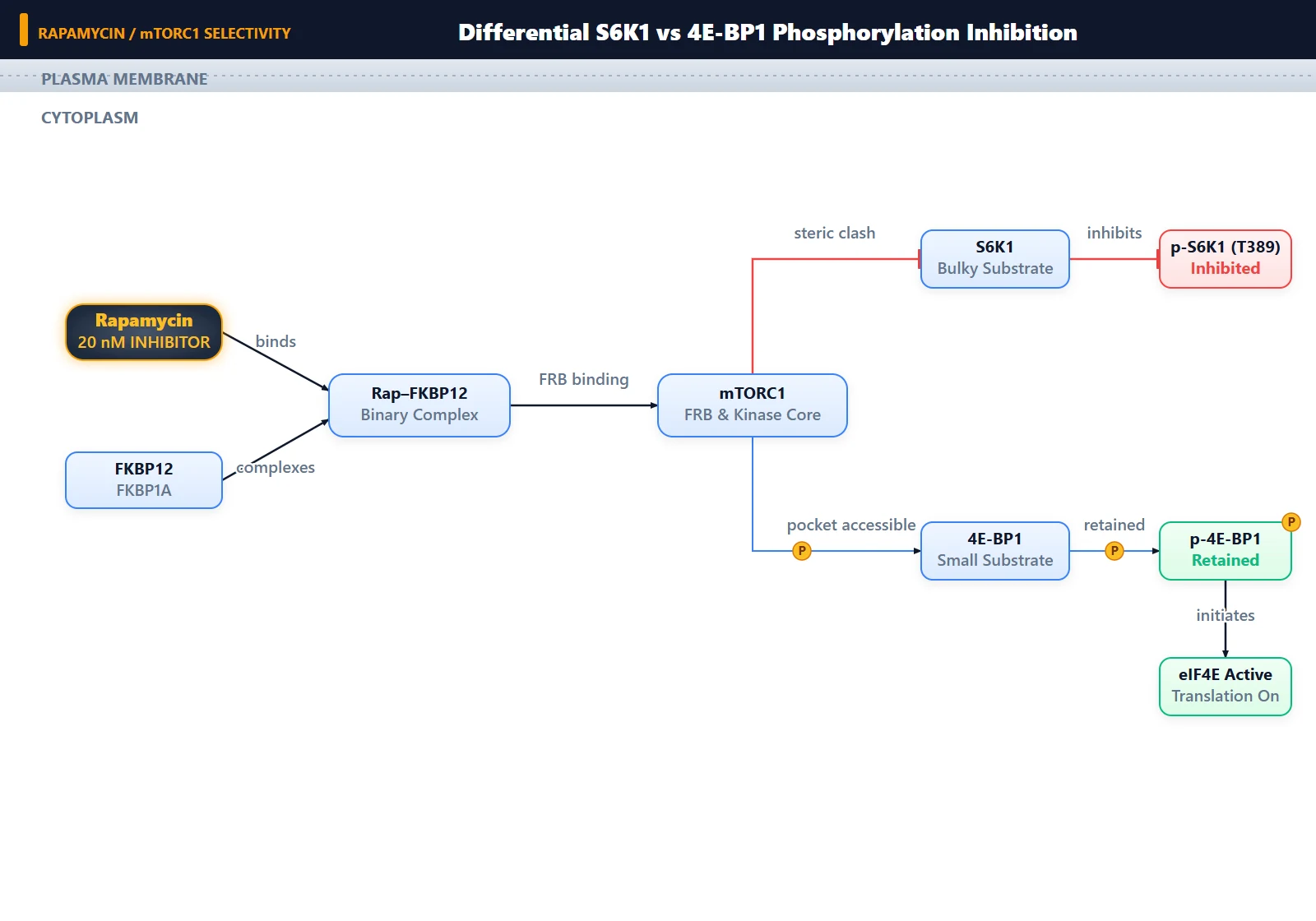
Common CausesRapamycin at 20 nM selectively abolishes S6K1 phosphorylation but spares 4E-BP1 because it acts as an allosteric FKBP12-dependent partial inhibitor whose steric clash restricts S6K1 recruitment while leaving the mTOR catalytic pocket accessible to 4E-BP1.
How Should It Be Done Correctly?
Inhibitor Class and Substrate Phosphorylation Profile Matrix
| Inhibitor Class | Representative Agent | Target Complex | Effect on p-S6K1 (Thr389) | Effect on p-4E-BP1 (Thr37/46, Ser65, Thr70) | Mechanism of Action |
|---|---|---|---|---|---|
| Allosteric mTORC1 Inhibitor | Rapamycin | mTORC1 [1, 2, 3] | Complete inhibition at 10–20 nM [3, 4] | Largely resistant / residual phosphorylation [3] | Forms ternary gain-of-function complex with FKBP12 and mTOR FRB domain |
| ATP-Competitive Kinase Inhibitor (TORKi) | PP242 | mTORC1 & mTORC2 [3] | Complete inhibition at 0.5–1 µM [3] | Robust, dose-dependent dephosphorylation [3] | Occupies ATP catalytic pocket to ablate kinase phosphotransferase activity |
| Upstream Kinase / Metabolic Modulator | Cryptotanshinone (CPT) | AMPK-TSC2 axis [1] | Dose-dependent suppression [1] | Moderate-to-strong suppression [1] | Indirect mTORC1 repression via AMPK activation and Rheb-GTP depletion [1] |
| Dual PI3K/mTOR Inhibitor | Dactolisib (NVP-BEZ235) | PI3K, mTORC1, mTORC2 | Complete ablation at 100–500 nM | Complete dephosphorylation across all sites | Competitively occupies both PI3K and mTOR ATP-binding clefts |
Experimental Workflow for Differential mTORC1 Substrate Phosphorylation Profiling
- Compound Selection and Parallel Dosing Setup: When complete suppression of mTORC1 translational output is required, set up parallel treatment cohorts comparing allosteric inhibition (rapamycin, 10–100 nM) against active-site mTOR catalytic inhibitors (e.g., PP242 at 1 µM) [3]. Include vehicle-treated controls (final DMSO concentration ≤ 0.1% v/v) to exclude non-specific solvent artifacts.
- Serum Starvation and Re-stimulation Protocol: Grow cells to 70–80% confluence. Deplete exogenous growth factors by serum-starving in basal medium for 4 to 16 hours depending on cell line sensitivity [1, 3, 4]. Pre-treat cultures with rapamycin or active-site inhibitors for 30–120 minutes prior to acute stimulation [1, 3, 4].
- Mitogen or Nutrient Challenge: Stimulate starved cells with recombinant human IGF-1 (10 ng/mL) [1], insulin (100 nM), or amino acid replenishment (e.g., 5 mM L-arginine or L-leucine) [4] for 15 to 60 minutes to induce robust canonical mTORC1 downstream phosphorylation.
- Protein Extraction and Lysate Preservation: Terminate stimulation by immediately aspirating medium and washing monolayers twice with ice-cold PBS. Lyse cells rapidly on ice using standard RIPA or non-denaturing lysis buffer supplemented with broad-spectrum protease inhibitor cocktails and dual Ser/Thr and Tyr phosphatase inhibitors (e.g., 10 mM sodium fluoride, 1 mM sodium orthovanadate, and 10 mM β-glycerophosphate).
- Polyacrylamide Gel Electrophoresis and Western Blot Analysis: Resolve 20–40 µg total protein per lane using SDS-PAGE. For 4E-BP1 analysis, run a high-percentage resolving gel (15% acrylamide or 4–20% gradient) to distinguish differential mobility shifts corresponding to hypophosphorylated (α, β) and hyperphosphorylated (γ) forms [4]. Electrotransfer to 0.2 µm PVDF membranes and probe with site-specific antibodies: p-p70 S6K1 (Thr389), total S6K1, p-4E-BP1 (Thr37/46), p-4E-BP1 (Thr70), p-4E-BP1 (Ser65), and total 4E-BP1 [1, 3, 4].
What Went Wrong?
Copy code to add this image to your page Copy Code
Equating S6K1 Dephosphorylation with Complete mTORC1 Inactivation
The fundamental misconception was assuming that p-S6K1 and p-4E-BP1 respond symmetrically to allosteric mTORC1 inhibition [2, 3]. In pharmacological assays, 10–20 nM rapamycin is frequently employed as a surrogate for total mTORC1 shutdown because it rapidly eliminates p70 S6K1 phosphorylation at Thr389 [3, 4]. However, rapamycin is an incomplete, substrate-selective allosteric modulator rather than a catalytic silencer; observing loss of p-S6K1 does not indicate that cap-dependent translation initiation factors like 4E-BP1 are simultaneously dephosphorylated [2, 3].
Substrate-Specific Affinity and Phosphorylation Site Hierarchy
Proximate failure to inhibit 4E-BP1 phosphorylation stems from the differential sensitivity of specific phosphorylation motifs on 4E-BP1 compared to the hydrophobic motif (Thr389) of S6K1. Phosphorylation of 4E-BP1 proceeds through an ordered multi-site cascade: initial "priming" phosphorylations occur at Thr37 and Thr46, followed by subsequent modifications at Thr70 and Ser65 that ultimately dissociate 4E-BP1 from eukaryotic translation initiation factor 4E (eIF4E) [1, 2]. The priming sites (Thr37/46) exhibit exceptionally high catalytic turnover by mTORC1 and remain efficiently phosphorylated even when mTORC1 kinase activity is substantially attenuated by allosteric perturbation. S6K1 phosphorylation at Thr389, in contrast, requires a highly accessible TOR signaling (TOS) motif interaction that is profoundly vulnerable to allosteric disruption [3].
Allosteric FRB Obstruction Versus Catalytic Pocket Accessibility
At the molecular level, rapamycin does not interact with the catalytic kinase domain of mTOR; rather, it enters the cell and forms an obligate high-affinity binary complex with the 12 kDa FK506-binding protein (FKBP12). This FKBP12-rapamycin complex then docks specifically onto the FKBP12-rapamycin-binding (FRB) domain situated adjacent to the catalytic kinase cleft of mTOR within mTORC1 [1, 3].
This binding creates a bulky steric barrier rather than locking the kinase domain in an inactive conformation. S6K1 is a large, multidomain kinase that depends strictly on docking via its raptor-interacting TOS motif to position its bulky C-terminal hydrophobic loop (Thr389) into the active site [2, 3]. The presence of FKBP12-rapamycin directly clashes with S6K1 recruitment, leading to rapid and complete suppression of p-S6K1 at doses as low as 10–20 nM [3, 4]. In contrast, 4E-BP1 is a compact, intrinsically disordered protein. Even when FKBP12-rapamycin is seated on the FRB domain, 4E-BP1 can still thread its peptide chain into the catalytic pocket, permitting mTORC1 to sustain Thr37/46 and residual Thr70 phosphorylation [1, 3]. Only ATP-competitive active-site inhibitors (e.g., PP242) physically occupy the catalytic pocket, universally silencing kinase phosphotransferase activity toward both S6K1 and 4E-BP1 alike [3].
How Can I Avoid This in Future Experiments?
When designing signaling studies to dissect mTORC1-dependent translation, never rely on a single substrate readout or an exclusively allosteric pharmacological tool. Always assay both arms of the pathway—using p-S6K1 (Thr389) as an index of rapamycin-sensitive signaling and p-4E-BP1 (specifically Thr37/46 alongside resolving electrophoretic mobility shifts) to monitor true catalytic activity.
To demonstrate that an observed biological phenotype is strictly mTORC1-dependent, implement a pharmacological matrix that includes 20 nM rapamycin alongside 500–1000 nM of an ATP-competitive mTOR inhibitor (such as PP242 or Torin1) [3]. If a cellular response requires full dephosphorylation of 4E-BP1 and subsequent sequestration of eIF4E, it will remain insensitive to rapamycin alone but will show robust suppression under catalytic mTOR inhibition, preventing misinterpretation of experimental negative results.