
Why does mTORC1 signaling remain inhibited even after extensive washout of Rapamycin?
Quick Answer
Recommended ApproachTo rapidly restore mTORC1 activity in washout experiments, deploy an FKBP12-binding competitor such as FK506 or use reversible ATP-competitive mTOR kinase inhibitors rather than passive media exchange.
Common CausesPassive buffer exchange failed to relieve mTORC1 suppression because rapamycin forms an extraordinarily stable, slowly dissociating ternary complex with intracellular FKBP12 and the mTOR FRB domain while partitioning heavily into cellular lipid stores.
How Should It Be Done Correctly?
Physicochemical and Reversibility Comparison of mTOR Inhibition Regimens
| Inhibitor / Regimen | Target Complex | Dissociation Mechanism | Washout Reversibility Strategy | Recovery Half-Time | Practical Application Note |
|---|---|---|---|---|---|
| Rapamycin (standard) | FKBP12–mTORC1 (allosteric) | Extremely slow non-covalent unbinding (kₒff < 10⁻⁴ s⁻¹) | Ineffective via media exchange alone; requires FK506 chase | > 24–48 h (passive wash) | Exhibits sustained "rapamycin memory" effects on downstream effectors [1] |
| Rapamycin + FK506 Chase | FKBP12 | Competitive displacement of free/unbound intracellular FKBP12 | Add 1–5 µM FK506 during sequential wash steps | ~ 2–4 h | Displaces rapamycin from cytosolic FKBP12 reservoir without activating calcineurin |
| Torin1 / Torin2 | mTORC1 & mTORC2 (catalytic) | Reversible ATP-competitive active site dissociation | Standard multi-step serum-containing media exchange | ~ 30–60 min | Broad-spectrum kinase inhibition; clears rapidly post-washout [2, 3] |
| AZD2014 / AZD8055 | mTORC1 & mTORC2 (catalytic) | Rapid ATP-competitive active site unbinding | 3× warm complete medium washes (10 min each) | < 1–2 h | Does not maintain long-lasting suppression following drug withdrawal [1, 4] |
| RMC-6272 / Bi-steric mTORC1 | mTORC1 (active site + FRB) | High-affinity cooperative dual-site engagement | Irreversible over standard assay timeframes | > 48 h | Reverses rapamycin-resistant translatome alterations [4] |
Systematic Protocol for Reversing mTORC1 Target Engagement
- Pre-Wash Evaluation and Inhibitor Selection: Determine whether your downstream biological readout specifically requires allosteric mTORC1 blockade or general catalytic shutoff. If reversible kinetic pulsing is required, use ATP-competitive active-site inhibitors (e.g., AZD2014 or Torin2) rather than rapamycin, as catalytic site inhibitors dissociate promptly upon media depletion [1, 2].
- Competitive Decoy Washing (FK506 Pulse): When allosteric rapamycin must be used, prepare complete culture medium pre-warmed to 37°C containing a 10- to 50-fold molar excess (typically 1–5 µM) of the structural analog FK506 (tacrolimus). FK506 engages intracellular FKBP12 with high affinity, competitively blocking rebinding of dissociated rapamycin.
- Sequential Media Exchanges: Aspirate the rapamycin-containing conditioned medium completely. Wash the monolayer three times consecutively with warm PBS or serum-free basal medium, incubating each wash for 5 minutes at 37°C to promote passive diffusional efflux from the plasma membrane.
- Serum Sink Incubation: Incubate cells in full growth medium supplemented with 10%–20% fetal bovine serum (FBS) or 1% bovine serum albumin (BSA) containing the FK506 competitor for 60 to 120 minutes. Extracellular serum lipids and albumin act as a thermodynamic sink to extract lipophilic rapamycin molecules emerging from intracellular membranes.
- Functional Target Monitoring: Following the competitive chase, refresh with regular growth medium and monitor recovery kinetics at 2, 4, 8, and 24 hours. Assess canonical mTORC1 downstream targets by Western blot, specifically checking phospho-p70S6K (Thr389), phospho-S6 ribosomal protein (Ser235/236), and phospho-4E-BP1 (Thr37/46) to verify functional complex reactivation [2, 5, 6].
What Went Wrong?
Copy code to add this image to your page Copy Code
Erroneous Assumption of Fast Diffusion and Complete Washout
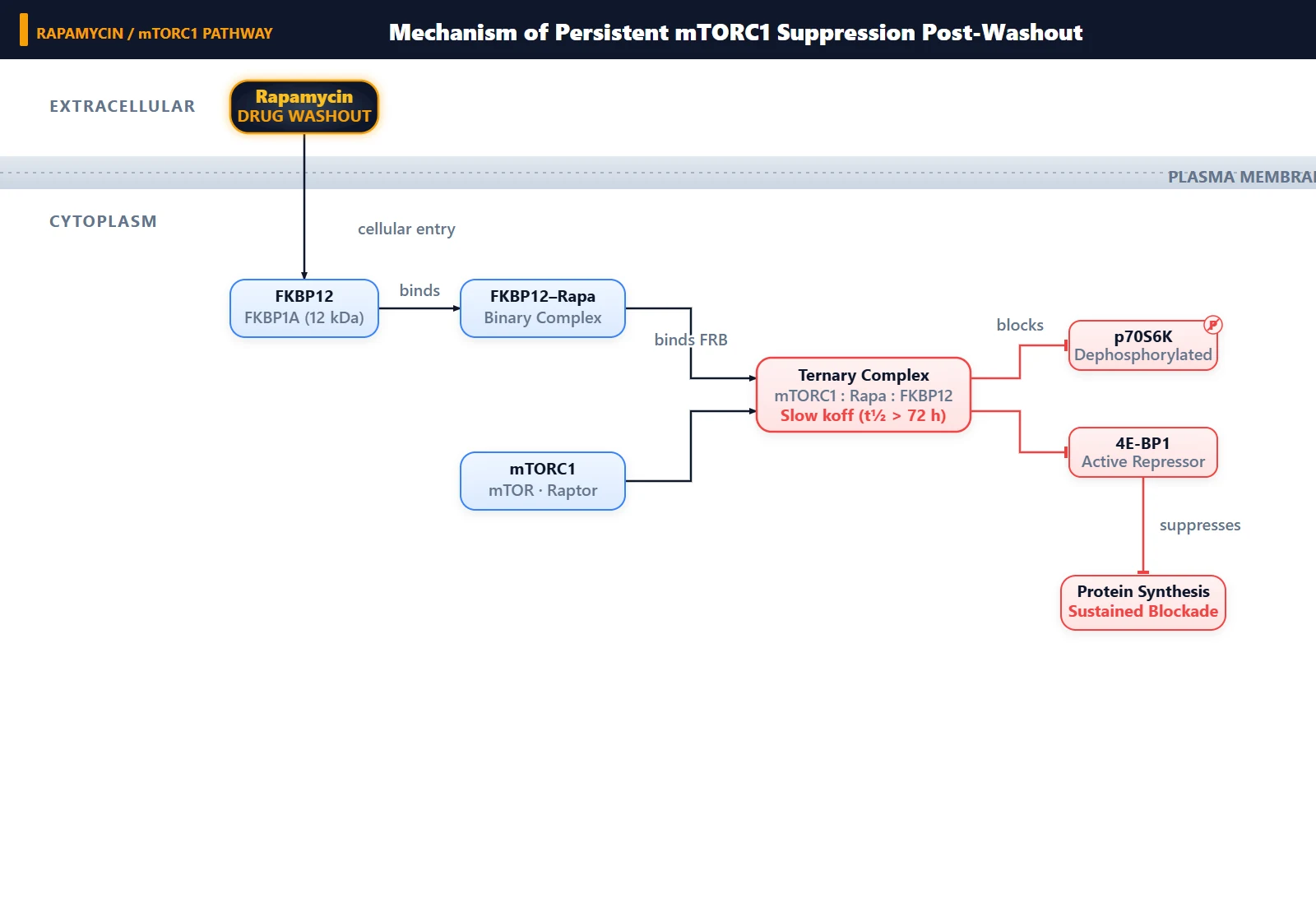
The fundamental operational error was treating rapamycin as a freely diffusible, rapidly clearing small-molecule inhibitor that could be removed by simply rinsing cells with fresh media. Standard cell-culture washout protocols assume that removing the drug from the bulk extracellular medium rapidly reduces the intracellular free drug concentration below the half-maximal inhibitory concentration (IC₅₀), thereby releasing the target enzyme within minutes to an hour. However, applying this simple exchange protocol to rapamycin fails to displace the intracellular inhibitor pool, resulting in prolonged suppression of downstream phosphorylation cascades despite multiple volume changes [1, 6].
High-Affinity Trapping and Pseudo-Irreversible Target Engagement
The immediate cause of persistent pathway suppression is the pseudo-irreversible stability of the FKBP12–rapamycin complex bound to mTORC1. In aqueous culture medium, rapamycin crosses the plasma membrane and binds to the ubiquitous cytosolic prolyl isomerase FKBP12 with sub-nanomolar affinity (Kd ≈ 0.2–1.0 nM). Unlike classic competitive inhibitors that freely exchange with ATP in the kinase pocket [3, 4], the FKBP12–rapamycin composite surface binds to the FKBP12-rapamycin-binding (FRB) domain of the mTOR kinase subunit in mTORC1 [2, 5]. This interaction generates an exceptionally low unbinding rate constant (kₒff), resulting in a complex residence time that spans tens of hours. Extracellular liquid replacement cannot force the dissociation of preformed intracellular ternary complexes.
Molecular Shielding and Intracellular Hydrophobic Sequestration
The underlying physicochemical and molecular mechanisms involve three interconnected phenomena: slow allosteric dissociation, intracellular ligand sequestration, and severe hydrophobic retention.
First, rapamycin binds within a deep hydrophobic pocket formed at the interface between FKBP12 and the mTOR FRB domain, inducing steric occlusion of substrate recruitment to the kinase cleft without directly competing with ATP [2, 3]. Because the drug is sterically buried within this ternary structure, thermal dissociation occurs at a negligible rate under physiological conditions. Dissociation does not lead directly to drug clearance; rather, abundant intracellular FKBP12 (expressed at micromolar concentrations in mammalian cells) acts as an intracellular buffering reservoir that immediately re-captures free rapamycin before it can diffuse across the plasma membrane.
Second, rapamycin is a macrolide with high lipophilicity (calculated log P ≈ 4.3). Upon entering the cell, excess drug partitions extensively into intracellular lipid droplets, the endoplasmic reticulum, and the plasma membrane. When fresh aqueous medium is introduced during a washout, the release of rapamycin from these intracellular membrane reservoirs into the water-based medium is thermodynamically disfavored and rate-limited. The continuous, slow leaching of sequestered compound from intracellular membranes maintains an effective local concentration high enough to re-engage FKBP12 and mTORC1 indefinitely, establishing the prolonged "rapamycin memory" phenomenon observed in mammalian tissues and cultured lines [1, 4].
How Can I Avoid This in Future Experiments?
To avoid persistent target suppression in studies requiring reversible mTORC1 modulation, replace rapamycin with small-molecule ATP-competitive catalytic inhibitors such as Torin1, Torin2, or AZD2014 [1, 2, 3]. These active-site kinase inhibitors do not rely on high-affinity cofactor sequestration, possess faster off-target unbinding kinetics, and clear from intracellular compartments within 30 to 60 minutes after standard media exchange [1]. If experimental conditions mandate the specific allosteric inhibition profile of rapamycin (e.g., to preserve mTORC2 integrity or selectively inhibit S6K1 without entirely blocking 4E-BP1) [3, 4, 5], always incorporate an FKBP12 competitor like FK506 into the washout buffers to trap dissociating molecules and prevent rebinding to mTORC1.
References
- [1]Al-Diab O, et al. Biology of sex differences. 2024 Sep;15(1):72.[IF: 5.1]
- [2]Ibrahim YH, et al. The Journal of biological chemistry. 2023 May;299(5):104644.[IF: 4.0]
- [3]Centonze G, et al. Cells. 2022 Mar;11(7).[IF: 6.0]
- [4]Aksoylu IS, et al. Molecular autism. 2023 Oct;14(1):39.[IF: 6.3]
- [5]Patel A, et al. Biomedicines. 2024 Oct;12(10).[IF: 3.9]
- [6]Hussain I, et al. Cells. 2023 Jun;12(12).[IF: 5.1]