
Why did my Rapamycin DMSO stock lose potency after being stored at -20°C for six months?
Quick Answer
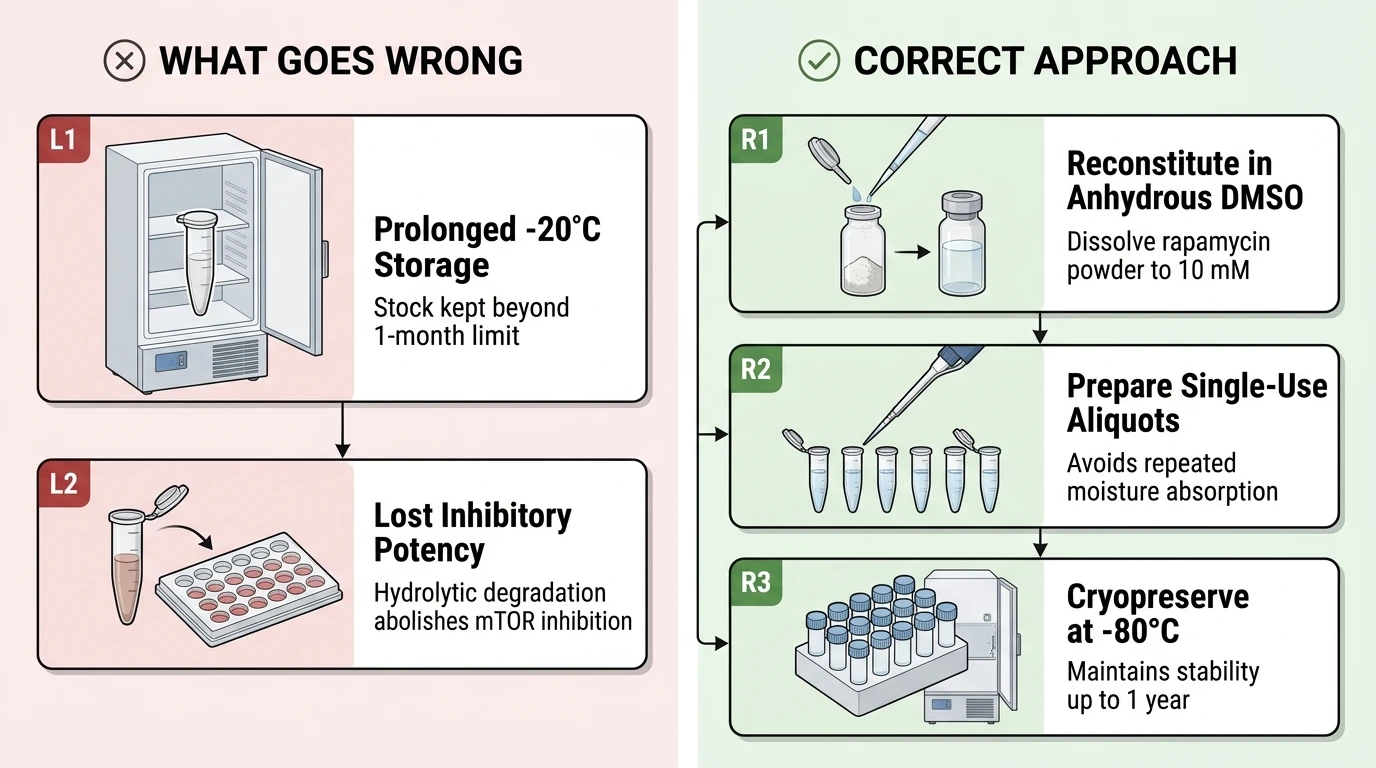
Recommended ApproachPrepare a 10 mM rapamycin stock in anhydrous DMSO, aliquot into single-use airtight vials, and store at -80°C for up to 1 year or strictly limit -20°C storage to at most 1 month.
Common CausesThe DMSO stock was kept at -20°C for six months, substantially exceeding the manufacturer's rated 1-month stability limit for solutions at -20°C and causing hydrolytic chemical degradation.
How Should It Be Done Correctly?
Copy code to add this image to your page Copy Code
Recommended Stock Parameters and Storage Limits
To ensure reliable biological activity and reproducible experimental outcomes, rapamycin (sirolimus) must be prepared and preserved in strict accordance with validated physicochemical stability parameters. Rapamycin is a lipophilic macrolide that exerts potent biological effects, such as inhibiting cell proliferation and migration in vitro [1, 2], but its lactone and polyene framework requires stringent storage control.
Official storage lifetimes and preparation parameters for Rapamycin solutions and powders.
Step-by-Step Reconstitution and Aliquoting Protocol
- Equilibrate Solid Reagent: Remove the commercial vial of rapamycin powder from the -20°C freezer and place it in a desiccator cabinet at room temperature for 20–30 minutes before opening. Opening cold vials introduces ambient atmospheric moisture, which rapidly condenses on the dry cake and accelerates hydrolytic degradation.
-
Solubilization in Anhydrous DMSO: Add high-purity, anhydrous DMSO (moisture content <0.005%) directly to the powder to reach the standard 10 mM target concentration (9.14 mg per mL). Vortex the vial vigorously for 30–60 seconds. DMSO provides superior solubility (up to 183 mg/mL) compared to ethanol (4 mg/mL) or aqueous buffers (<1 mg/mL), yielding an immediately clear, colorless solution.
-
Immediate Single-Use Aliquoting: Subdivide the freshly dissolved stock into small, single-use aliquots (typically 10–25 µL) inside sterile, polypropylene, screw-cap vials with silicone O-rings. Minimizing tube headspace limits exposure to trapped atmospheric oxygen and ambient humidity.
- Temperature-Designated Storage: Archive the aliquots at -80°C for long-term use (stable for up to 1 year). If only a -20°C freezer is accessible, date-stamp each tube and strictly enforce disposal after 1 month. Avoid frost-free manual freezers, which cycle heating elements to prevent ice buildup and subject stock solutions to detrimental thermal oscillations.
- Thawing and Working Dilution Preparation: Immediately prior to cell treatment, thaw a single aliquot at room temperature. Once thawed, invert briefly to mix and immediately dilute into pre-warmed culture medium (e.g., reaching final experimental concentrations such as 10⁻¹⁰ M to 10⁻⁹ M) [1]. Never refreeze residual solution; discard unused remnants immediately.
| Parameter | Specification | Practical Handling Requirement |
|---|---|---|
| Recommended Stock Concentration | 10 mM in DMSO | Dissolve 9.1418 mg powder per 1.0 mL anhydrous solvent |
| Maximum DMSO Solubility | 183 mg/mL | High operational margin above the 10 mM working stock |
| Solution Storage at -80°C | Up to 1 year | Requires desiccated, airtight, light-shielded microcentrifuge tubes |
| Solution Storage at -20°C | Up to 1 month | Never extend dissolved stock storage beyond this 30-day ceiling |
| Solid Powder at -20°C | Up to 3 years | Desiccate container thoroughly prior to opening to prevent condensation |
What Went Wrong?
Storage Far Exceeding Recommended Shelf Life
The primary procedural error was storing the dissolved rapamycin DMSO solution at -20°C for six months. According to official manufacturer stability guidelines, rapamycin dissolved in solvent remains stable at -20°C for only 1 month. Maintaining the solution at -20°C for six times longer than its validated window inevitably led to product degradation and loss of pharmacological potency. While the intact dry powder maintains stability at -20°C for 3 years, the active core becomes vulnerable upon dissolution.
Solvent Hygroscopicity and Thermal Cycling
Pure DMSO possesses a freezing point of approximately 18.4°C and freezes into a solid matrix at -20°C. However, standard laboratory -20°C upright freezers frequently undergo periodic auto-defrost heating cycles, causing micro-thawing events within the sample tubes. Furthermore, DMSO is exceptionally hygroscopic. Over a six-month duration, ambient atmospheric moisture penetrates standard microcentrifuge tube caps, gradually depressing the freezing point of the DMSO-water mixture and introducing free water molecules directly into contact with the dissolved compound. If the same stock vial was repeatedly removed, opened, thawed, and refrozen over six months, this moisture absorption and thermal stress accelerated dramatically.
Hydrolytic Cleavage and Chemical Inactivation
Rapamycin is a macrocyclic triene lactone featuring chemically sensitive ester linkages, a pipecolic acid moiety, and a hemiketal group. Under prolonged storage in the presence of absorbed moisture and fluctuating temperatures, rapamycin undergoes spontaneous ring-opening hydrolysis of its ester bond, cleavage of the hemiketal group, and epimerization at functional chiral centers. These structural rearrangements dismantle the precise 3D conformation required for binding to FK506-binding protein 12 (FKBP12) and the downstream mammalian target of rapamycin (mTOR) complex. Consequently, even though the visual appearance of the solution remains clear and unprecipitated, the concentration of intact, bioactive rapamycin drops below the threshold required to elicit its characteristic antiproliferative and functional responses [1, 3].
How Can I Avoid This in Future Experiments?
To ensure consistent assay potency, adopt a strict batch-labeling and inventory rule: any small-molecule solution prepared in DMSO and placed at -20°C must be labeled with an expiration date exactly 30 days from reconstitution. Reserve -80°C ultra-low storage for long-term reserves, which reliably preserves 10 mM rapamycin DMSO aliquots for up to 1 year.
Standardize tube selection by switching from snap-cap microcentrifuge tubes to airtight, screw-cap cryovials equipped with silicone gaskets. When preparing aliquots, flush the vial headspace with an inert gas (such as dry nitrogen or argon) before sealing to completely exclude atmospheric moisture and oxygen [Source: r/labrats].
Before launching a large experimental campaign, verify stock integrity by testing a reference batch in a rapid biological readout (such as monitoring cell proliferation or running a Western blot for downstream mTOR substrates like phosphorylated S6 ribosomal protein or 4E-BP1) [1, 2]. If a stock solution has been stored under questionable conditions or past its rated shelf life, discard it and reconstitute a fresh vial from dry powder.
References
- [1]Namba DR, et al. Otolaryngology--head and neck surgery : official journal of American Academy of Otolaryngology-Head and Neck Surgery. 2015 May;152(5):881-8.[IF: 2.021]
- [2]Guo W, et al. British journal of pharmacology. 2020 Jul;177(14):3327-3341.[IF: 8.739]
- [3]Gillen JR, et al. The Annals of thoracic surgery. 2013 May;95(5):1768-75.[IF: 3.631]