
-
 Argentina
-
 Australia
-
 Austria
-
 Belgium
-
 Brazil
-
 Canada
-
 China
China
-
 Czech Republic
-
 Denmark
-
 Finland
-
 France
-
 Germany
-
 Greece
-
 Hong Kong
-
 Hungary
-
 Iceland
-
 India
India
-
 Ireland
-
 Israel
-
 Italy
Italy
-
 Japan
Japan
-
 Korea
Korea
-
 Luxembourg
-
 Malaysia
-
 Netherlands
-
 New Zealand
-
 Norway
-
 Poland
-
 Qatar
Qatar
-
 Romania
-
 Saudi Arabia
-
 Singapore
-
 Spain
Spain
-
 Sweden
-
 Switzerland
-
 Taiwan
-
 Turkey
-
 United Kingdom
-
 United States
research use only
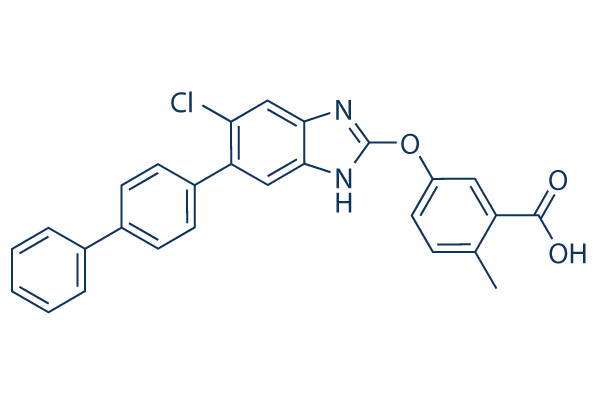
MK-3903 AMPK activator
Cat.No.S8803
Quality Control
| Related Targets | PI3K Akt mTOR GSK-3 ATM/ATR DNA-PK PDPK1 PTEN PI4K PP2A |
|---|---|
| Other AMPK Inhibitors | Dorsomorphin Dihydrochloride Dorsomorphin (Compound C) AICAR (Acadesine) A-769662 GSK621 WZ4003 Ex229 (Compound 991) Phenformin HCl BAY-3827 HTH-01-015 |
Solubility
|
In vitro |
4-Methylpyridine : 23 mg/mL
DMSO
: 5.6 mg/mL
(12.31 mM)
Water : Insoluble |
Molarity Calculator
|
In vivo |
|||||
In vivo Formulation Calculator (Clear solution)
Step 1: Enter information below (Recommended: An additional animal making an allowance for loss during the experiment)
Step 2: Enter the in vivo formulation (This is only the calculator, not formulation. Please contact us first if there is no in vivo formulation at the solubility Section.)
Calculation results:
Working concentration: mg/ml;
Method for preparing DMSO master liquid: mg drug pre-dissolved in μL DMSO ( Master liquid concentration mg/mL, Please contact us first if the concentration exceeds the DMSO solubility of the batch of drug. )
Method for preparing in vivo formulation: Take μL DMSO master liquid, next addμL PEG300, mix and clarify, next addμL Tween 80, mix and clarify, next add μL ddH2O, mix and clarify.
Method for preparing in vivo formulation: Take μL DMSO master liquid, next add μL Corn oil, mix and clarify.
Note: 1. Please make sure the liquid is clear before adding the next solvent.
2. Be sure to add the solvent(s) in order. You must ensure that the solution obtained, in the previous addition, is a clear solution before proceeding to add the next solvent. Physical methods such
as vortex, ultrasound or hot water bath can be used to aid dissolving.
Chemical Information, Storage & Stability
| Molecular Weight | 454.90 | Formula | C27H19ClN2O3 |
Storage (From the date of receipt) | 3 years -20°C powder |
|---|---|---|---|---|---|
| CAS No. | 1219737-12-8 | -- | Storage of Stock Solutions |
|
|
| Synonyms | N/A | SMILES | CC1=C(C=C(C=C1)OC2=NC3=C(N2)C=C(C(=C3)C4=CC=C(C=C4)C5=CC=CC=C5)Cl)C(=O)O | ||
Read more about storage stability stock solution CAS number SMILES
Mechanism of Action
| Targets/IC50/Ki |
AMPK
8 nM(EC50)
|
|---|---|
| In vitro |
MK-3903 activates 10 of the 12 pAMPK complexes with EC50 values in the range of 8-40 nM and maximal activation >50%. This compound partially activates pAMPK5 (36% max), which is only a minor component of human and mouse liver, and it does not activate pAMPK6, which is not detected in liver. It is a weak reversible inhibitor of CYP3A4 and 2D6 in human liver microsomes (apparent IC50 > 50 μM) and does not exhibit time-dependent inhibition of CYP3A4 activity. This chemical is not a potent PXR agonist. |
| In vivo |
The pharmacokinetics of MK-3903 in C57BL/6 mice, Sprague–Dawley rats, and beagle dogs were characterized by moderate systemic plasma clearance (5.0–13 mL/min/kg), a volume of distribution at steady state of 0.6–1.1 L/kg, and a terminal half-life of ∼2 h. It has low oral bioavailability (8.4%) in C57BL/6 mice, but the oral exposure is later improved using other vehicles. Oral bioavailabilities in rats and dogs are improved (27-78%). Chronic oral administration of this compound robustly increased ACC phosphorylation in liver with more modest effects in skeletal muscle. Treatment of various mouse models with this chemical results in expected alterations in lipid metabolism and improvements in a measure of insulin sensitization. |
References |
Tech Support
Tel: +1-832-582-8158 Ext:3
If you have any other enquiries, please leave a message.
Signaling Pathway Map

Products are for research use only. Not for human use. We do not sell to patients.
©Copyright 2013 Selleck Chemicals. All Rights Reserved.