
-
 Argentina
-
 Australia
-
 Austria
-
 Belgium
-
 Brazil
-
 Canada
-
 China
China
-
 Czech Republic
-
 Denmark
-
 Finland
-
 France
-
 Germany
-
 Greece
-
 Hong Kong
-
 Hungary
-
 Iceland
-
 India
India
-
 Ireland
-
 Israel
-
 Italy
Italy
-
 Japan
Japan
-
 Korea
Korea
-
 Luxembourg
-
 Malaysia
-
 Netherlands
-
 New Zealand
-
 Norway
-
 Poland
-
 Qatar
Qatar
-
 Romania
-
 Saudi Arabia
-
 Singapore
-
 Spain
Spain
-
 Sweden
-
 Switzerland
-
 Taiwan
-
 Turkey
-
 United Kingdom
-
 United States
research use only
Tazarotene Retinoid Receptor agonist
Cat.No.S1569
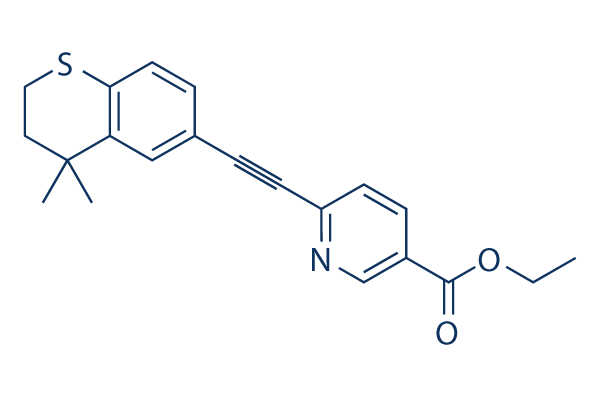
Chemical Structure
Molecular Weight: 351.46
Quality Control
| Related Targets | Dehydrogenase HSP Transferase P450 (e.g. CYP17) PDE phosphatase PPAR Vitamin Carbohydrate Metabolism Mitochondrial Metabolism |
|---|---|
| Other Retinoid Receptor Inhibitors | TTNPB (Arotinoid acid) Tamibarotene AM580 Fenretinide BMS493 SR 11237 UVI 3003 AR7 Palovarotene CD1530 |
Solubility
|
In vitro |
DMSO
: 10 mg/mL
(28.45 mM)
Ethanol : 10 mg/mL Water : Insoluble |
Molarity Calculator
|
In vivo |
|||||
In vivo Formulation Calculator (Clear solution)
Step 1: Enter information below (Recommended: An additional animal making an allowance for loss during the experiment)
Step 2: Enter the in vivo formulation (This is only the calculator, not formulation. Please contact us first if there is no in vivo formulation at the solubility Section.)
Calculation results:
Working concentration: mg/ml;
Method for preparing DMSO master liquid: mg drug pre-dissolved in μL DMSO ( Master liquid concentration mg/mL, Please contact us first if the concentration exceeds the DMSO solubility of the batch of drug. )
Method for preparing in vivo formulation: Take μL DMSO master liquid, next addμL PEG300, mix and clarify, next addμL Tween 80, mix and clarify, next add μL ddH2O, mix and clarify.
Method for preparing in vivo formulation: Take μL DMSO master liquid, next add μL Corn oil, mix and clarify.
Note: 1. Please make sure the liquid is clear before adding the next solvent.
2. Be sure to add the solvent(s) in order. You must ensure that the solution obtained, in the previous addition, is a clear solution before proceeding to add the next solvent. Physical methods such
as vortex, ultrasound or hot water bath can be used to aid dissolving.
Chemical Information, Storage & Stability
| Molecular Weight | 351.46 | Formula | C21H21NO2S |
Storage (From the date of receipt) | |
|---|---|---|---|---|---|
| CAS No. | 118292-40-3 | Download SDF | Storage of Stock Solutions |
|
|
| Synonyms | AGN190168 | Smiles | CCOC(=O)C1=CN=C(C=C1)C#CC2=CC3=C(C=C2)SCCC3(C)C | ||
Mechanism of Action
| Targets/IC50/Ki |
RAR
|
|---|---|
| In vitro |
Tazarotene causes ERK activation, RB tumor suppressor protein hypophosphorylation, G0 arrest, and myeloid differentiation in HL-60 human myeloblastic leukemia cells. This compound could propel either early or late portions of the period leading to differentiation and G0 arrest and is interchangeable with an RARalpha-selective ligand. It regulates gene transcription via interaction with specific nuclear retinoic acid receptors (RARs), thereby modulating the three key pathogenic factors in psoriasis. This chemical inhibits the proliferation of fibroblasts and synthesis of DNA and collagen. It down-regulates markers of keratinocyte differentiation, keratinocyte proliferation, and inflammation. This agent also up-regulates three novel genes TIG-1 (tazarotene-induced gene-1), TIG-2, and TIG-3, which may mediate an antiproliferative effect. It causes growth suppression in retinoid-responsive breast cancer cell lines by up-regulating TIG3.
|
| In vivo |
Tazarotene treatment reduces the number and size of microscopic basal cell carcinomas (BCCs) in UV-treated Ptch1+/− mice. This compound also reduces the number and size of microscopic basal cell carcinomas (BCCs) in ionizing radiation-treated Ptch1+/− mice.
|
References |
|
Clinical Trial Information
(data from https://clinicaltrials.gov, updated on 2024-05-22)
| NCT Number | Recruitment | Conditions | Sponsor/Collaborators | Start Date | Phases |
|---|---|---|---|---|---|
| NCT06015152 | Completed | Scalp Psoriasis |
Jinnah Postgraduate Medical Centre |
August 1 2022 | Not Applicable |
| NCT03988439 | Recruiting | Psoriasis |
Bausch Health Americas Inc. |
March 24 2021 | Phase 4 |
| NCT02620813 | Completed | Acne Vulgaris |
University of California Davis |
October 2015 | Early Phase 1 |
Tech Support
Tel: +1-832-582-8158 Ext:3
If you have any other enquiries, please leave a message.

Products are for research use only. Not for human use. We do not sell to patients.
©Copyright 2013 Selleck Chemicals. All Rights Reserved.