
-
 Argentina
-
 Australia
-
 Austria
-
 Belgium
-
 Brazil
-
 Canada
-
 China
China
-
 Czech Republic
-
 Denmark
-
 Finland
-
 France
-
 Germany
-
 Greece
-
 Hong Kong
-
 Hungary
-
 Iceland
-
 India
India
-
 Ireland
-
 Israel
-
 Italy
Italy
-
 Japan
Japan
-
 Korea
Korea
-
 Luxembourg
-
 Malaysia
-
 Netherlands
-
 New Zealand
-
 Norway
-
 Poland
-
 Qatar
Qatar
-
 Romania
-
 Saudi Arabia
-
 Singapore
-
 Spain
Spain
-
 Sweden
-
 Switzerland
-
 Taiwan
-
 Turkey
-
 United Kingdom
-
 United States
research use only
1-Azakenpaullone GSK-3 inhibitor
Cat.No.S7193
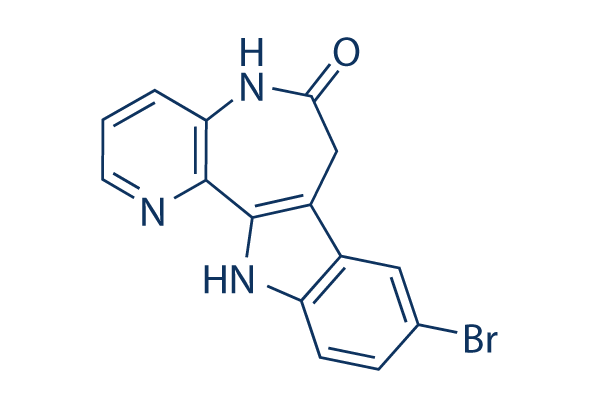
Chemical Structure
Molecular Weight: 328.16
Quality Control
| Related Targets | PI3K Akt mTOR ATM/ATR DNA-PK AMPK PDPK1 PTEN PI4K PP2A |
|---|---|
| Other GSK-3 Inhibitors | CHIR-99021 (Laduviglusib) Laduviglusib (CHIR-99021) Hydrochloride SB216763 TWS119 CHIR-98014 GSK-3 Inhibitor IX (BIO) LY2090314 Tideglusib AR-A014418 SB415286 |
Solubility
|
In vitro |
DMSO
: 66 mg/mL
(201.12 mM)
Water : Insoluble Ethanol : Insoluble |
Molarity Calculator
|
In vivo |
|||||
In vivo Formulation Calculator (Clear solution)
Step 1: Enter information below (Recommended: An additional animal making an allowance for loss during the experiment)
Step 2: Enter the in vivo formulation (This is only the calculator, not formulation. Please contact us first if there is no in vivo formulation at the solubility Section.)
Calculation results:
Working concentration: mg/ml;
Method for preparing DMSO master liquid: mg drug pre-dissolved in μL DMSO ( Master liquid concentration mg/mL, Please contact us first if the concentration exceeds the DMSO solubility of the batch of drug. )
Method for preparing in vivo formulation: Take μL DMSO master liquid, next addμL PEG300, mix and clarify, next addμL Tween 80, mix and clarify, next add μL ddH2O, mix and clarify.
Method for preparing in vivo formulation: Take μL DMSO master liquid, next add μL Corn oil, mix and clarify.
Note: 1. Please make sure the liquid is clear before adding the next solvent.
2. Be sure to add the solvent(s) in order. You must ensure that the solution obtained, in the previous addition, is a clear solution before proceeding to add the next solvent. Physical methods such
as vortex, ultrasound or hot water bath can be used to aid dissolving.
Chemical Information, Storage & Stability
| Molecular Weight | 328.16 | Formula | C15 H10 Br N3 O |
Storage (From the date of receipt) | |
|---|---|---|---|---|---|
| CAS No. | 676596-65-9 | -- | Storage of Stock Solutions |
|
|
| Synonyms | 1-Akp | Smiles | C1C2=C(C3=C(C=CC=N3)NC1=O)NC4=C2C=C(C=C4)Br | ||
Mechanism of Action
| Targets/IC50/Ki |
GSK-3α
GSK-3β
(Cell-free assay) 18 nM
|
|---|---|
| In vitro |
1-Azakenpaullone inhibits the CDK1/cyclin B, CDK5/p25, and GSK-3β effectively, with IC50 of 0.018 μM, 4.2 μM, and 2.0 μM, respectively. In human islets, this compound (5 mM) in combination with glucose (8 mM) stimulates the β-cell proliferation. It effectively stimulates INS-1E cells replication and protects INS-1E cells against glucolipotoxicity-induced cell death. |
| Kinase Assay |
Kinase preparations and assays
|
|
GSK-3β is assayed, following a 1/100 dilution in 1 mg BSA per mL 10 mM dithiothreitol, with 5 μL 40 μM GS-1 peptide as a substrate, in buffer A, in the presence of 15 μM [γ-32P]ATP (3000 Ci·mmol-1; 1 mCi·mL-1 ) in a final volume of 30 μL. After 30 min incubation at 30℃, 25 μL aliquots of supernatant are spotted onto 2.5×3 cm pieces of Whatman P81 phosphocellulose paper, and 20 s later, the filters are washed five times in a solution of 10 mL phosphoric acid per L of water. The wet filters are counted in the presence of 1 mL ACS scintillation fluid. The kinase activity of CDK1/cyclin B is assayed in buffer C, with 1 mg/mL histone H1, in the presence of 15 μM [γ-32P]ATP (3000 Ci·mmol-1; 1 mCi·mL-1 ) in a final volume of 30 μL. After 10 min incubation at 30℃, 25 μL aliquots of supernatant are spotted onto P81 phosphocellulose papers and treated as described above. The activity of CDK5/p25 is assayed in buffer C as described for CDK1/cyclin B. (Buffer A: 10 mM MgCl2 , 1 mM EGTA, 1 mM dithiothreitol, 25 mM Tris/HCl pH 7.5. Buffer C: homogenization buffer but 5 mM EGTA, no NaF and no protease inhibitors.)
|
|
| In vivo |
Pretreatment with 1-Azakenpaullone (10 or 100 pmol, i.c.v.) attenuates the induced locomotor hyperactivity, disruption of PPI and cognitive deficits, and improves the induced motor incoordination in rotarod test. |
References |
|
Tech Support
Tel: +1-832-582-8158 Ext:3
If you have any other enquiries, please leave a message.
Signaling Pathway Map

Products are for research use only. Not for human use. We do not sell to patients.
©Copyright 2013 Selleck Chemicals. All Rights Reserved.