
-
 Argentina
-
 Australia
-
 Austria
-
 Belgium
-
 Brazil
-
 Canada
-
 China
China
-
 Czech Republic
-
 Denmark
-
 Finland
-
 France
-
 Germany
-
 Greece
-
 Hong Kong
-
 Hungary
-
 Iceland
-
 India
India
-
 Ireland
-
 Israel
-
 Italy
Italy
-
 Japan
Japan
-
 Korea
Korea
-
 Luxembourg
-
 Malaysia
-
 Netherlands
-
 New Zealand
-
 Norway
-
 Poland
-
 Portugal
-
 Qatar
Qatar
-
 Romania
-
 Saudi Arabia
-
 Singapore
-
 Spain
Spain
-
 Sweden
-
 Switzerland
-
 Taiwan
-
 Turkey
-
 United Kingdom
-
 United States
research use only
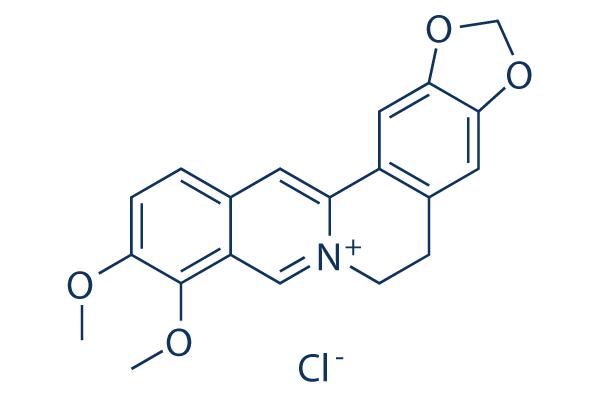
Berberine chloride Anti-infection chemical
Cat.No.S2271
Quality Control
Cell Culture, Treatment & Working Concentration
| Cell Lines | Assay Type | Concentration | Incubation Time | Formulation | Activity Description | PMID |
|---|---|---|---|---|---|---|
| MRC5 cells | Function assay | Antiviral activity against HCMV in MRC5 cells by plaque reduction assay, IC50=0.68 μM | ||||
| MRC5 cells | Proliferation assay | 10 μM | 54 hrs | Inhibition of HCMV proliferation in MRC5 cells after 54 hrs post-infection at 10 uM by plaque assay | ||
| MRC5 cells | Proliferation assay | 10 μM | 24 h | Inhibition of HCMV proliferation in MRC5 cells after 24 hrs post-infection at 10 uM by plaque assay | ||
| Bel7402 cells | Function assay | 12 h | Induction of LDLR protein in human Bel7402 cells after 12 hrs by RT-PCR assay relative to control | |||
| HepG2 cells | Function assay | 10 ug/mL | 12 h | Induction of LDLR protein expression in human HepG2 cells at 10 ug/mL after 12 hrs by flow cytometry | ||
| KB cells | Cytotoxicity assay | 72 h | Cytotoxicity against human KB cells after 72 hrs, IC50=7.32 μM | |||
| HL60 cells | Apoptosis assay | 48 hrs | Induction of apoptosis in human HL60 cells after 48 hrs using annexin V-propidium iodide staining by FACS analysis | |||
| A549 cells | Cytotoxicity assay | Cytotoxicity against human A549 cells by SRB assay, IC50=6.27 μM | ||||
| SKOV3 cells | Cytotoxicity assay | Cytotoxicity against human SKOV3 cells by SRB assay, IC50=16.44 μM | ||||
| SK-MEL-2 cells | Cytotoxicity assay | Cytotoxicity against human SK-MEL-2 cells by SRB assay, IC50=13.76 μM | ||||
| HCT15 cells | Cytotoxicity assay | Cytotoxicity against human HCT15 cells by SRB assay, IC50=16.59 μM | ||||
| CEM cells | Cytotoxicity assay | 48 hrs | Cytotoxicity against human CEM cells expressing green fluorescent protein after 48 hrs by MTT assay, CC50=2.09 μM | |||
| human CEM cells | Function assay | 7 days | Antiviral activity against 0.05 MOI Human immunodeficiency virus 1 NL4.3 infected in human CEM cells expressing green fluorescent protein assessed as p24 antigen production measured 7 days post infection by ELISA, EC50=0.13 μM | |||
| SKN cells | Growth inhibition assay | 72 h | Growth inhibition against human SKN cells after 72 hrs by MTT assay, GI50=15.88 μM | |||
| RKN cells | Growth inhibition assay | 48 hrs | Growth inhibition against human RKN cells after 48 hrs by MTT assay, GI50=49.6 μM | |||
| G402 cells | Growth inhibition assay | 48 hrs | Growth inhibition against human G402 cells after 48 hrs by MTT assay, GI50=11.87 μM | |||
| A10 cells | Function assay | 30 μM | 24 hrs | Downregulation of Scd2 mRNA expression in rat A10 cells at 30 uM after 24 hrs by quantitative RT-PCR analysis | ||
| A10 cells | Function assay | 30 μM | 24 hrs | Down regulation of Prim2 mRNA expression in rat A10 cells at 30 uM after 24 hrs by quantitative RT-PCR analysis | ||
| A10 cells | Function assay | 30 μM | 24 hrs | Downregulation of Impk mRNA expression in rat A10 cells at 30 uM after 24 hrs by quantitative RT-PCR analysis | ||
| HepG2-A16-CD81 cells | Function assay | 10 μM | NOVARTIS: Antimalarial liver stage activity measured as a greater than 50% reduction in Plasmodium yoelii schizont area in HepG2-A16-CD81 cells at 10uM compound concentration, determined by immuno-fluorescence. | |||
| HepG2-A16-CD81 cells | Function assay | 10 μM | NOVARTIS: Antimalarial liver stage activity measured as reduction in Plasmodium yoelii schizont area in HepG2-A16-CD81 cells by immuno-fluorescence, and median schizont size at 10uM compound concentration, IC50=0.548 μM | |||
| HepG2 cells | Function assay | 10 μM | 4 h | Increase in AMPKalpha phosphorylation in human HepG2 cells at 10 uM after 4 hrs by Western blot analysis relative to untreated control | ||
| HepG2 cells | Function assay | 10 μM | 4 h | Increase in total AMPKalpha level in human HepG2 cells at 10 uM after 4 hrs by Western blot analysis relative to untreated control | ||
| HepG2 cells | Function assay | 20 μM | 24 hrs | Induction of apoptosis in human HepG2 cells assessed as morphological changes at 20 uM after 24 hrs using Hoechst 33258 staining by fluorescence microscopic analysis | ||
| HT-29 cells | Cytotoxicity assay | 48 hrs | Cytotoxicity against human HT-29 cells after 48 hrs by MTT assay, IC50=8.45 μM | |||
| HepG2 cells | Cytotoxicity assay | 24 hrs | Cytotoxicity against human HepG2 cells after 24 hrs by MTT assay, IC50=11.22 μM | |||
| HepG2 cells | Cytotoxicity assay | 48 hrs | Cytotoxicity against human HepG2 cells after 48 hrs by MTT assay, IC50=8.32 μM | |||
| Click to View More Cell Line Experimental Data | ||||||
Solubility
|
In vitro |
DMSO
: 25 mg/mL
(67.23 mM)
Water : Insoluble Ethanol : Insoluble |
Molarity Calculator
|
In vivo |
|||||
In vivo Formulation Calculator (Clear solution)
Step 1: Enter information below (Recommended: An additional animal making an allowance for loss during the experiment)
Step 2: Enter the in vivo formulation (This is only the calculator, not formulation. Please contact us first if there is no in vivo formulation at the solubility Section.)
Calculation results:
Working concentration: mg/ml;
Method for preparing DMSO master liquid: mg drug pre-dissolved in μL DMSO ( Master liquid concentration mg/mL, Please contact us first if the concentration exceeds the DMSO solubility of the batch of drug. )
Method for preparing in vivo formulation: Take μL DMSO master liquid, next addμL PEG300, mix and clarify, next addμL Tween 80, mix and clarify, next add μL ddH2O, mix and clarify.
Method for preparing in vivo formulation: Take μL DMSO master liquid, next add μL Corn oil, mix and clarify.
Note: 1. Please make sure the liquid is clear before adding the next solvent.
2. Be sure to add the solvent(s) in order. You must ensure that the solution obtained, in the previous addition, is a clear solution before proceeding to add the next solvent. Physical methods such
as vortex, ultrasound or hot water bath can be used to aid dissolving.
Chemical Information, Storage & Stability
| Molecular Weight | 371.81 | Formula | C20H18NO4.Cl |
Storage (From the date of receipt) | |
|---|---|---|---|---|---|
| CAS No. | 633-65-8 | Download SDF | Storage of Stock Solutions |
|
|
Read more about storage stability stock solution CAS number
Mechanism of Action
| Targets/IC50/Ki |
Caspase-3
Caspase-8
PARP
cytochrome c
cIAP1
Bcl-2
Bcl-xL
JNK
p38 MAPK
ROS
Topo I
Topo II
|
|---|---|
| In vitro |
Compared with regorafenib alone, the combined treatment of Berberine (BBR) and regorafenib significantly inhibits the proliferation of hepatocellular carcinoma (HCC) cells and induces cellular apoptosis. |
| In vivo |
The combined treatment group with Berberine (BBR) and regorafenib has a dramatic inhibitory effect on the growth of hepatocellular carcinoma (HCC) xenograft tumors in nude mice. The increased apoptosis of xenograft tumors is seen in the combined treatment group. |
References |
|
Clinical Trial Information
(data from https://clinicaltrials.gov, updated on 2024-05-22)
| NCT Number | Recruitment | Conditions | Sponsor/Collaborators | Start Date | Phases |
|---|---|---|---|---|---|
| NCT06273241 | Not yet recruiting | Pharmacokinetic Study in Healthy Volunteers |
University Medicine Greifswald |
2024-03-04 | Not Applicable |
| NCT05845931 | Recruiting | Pharmacokinetic Study in Healthy Volunteers |
University Medicine Greifswald |
2023-05-05 | Not Applicable |
| NCT05947370 | COMPLETED | Diabetes Mellitus |
Beijing Tongren Hospital |
2022-10-12 | EARLY_PHASE1 |
| NCT05480670 | Completed | Polycystic Ovary Syndrome |
Ayub Teaching Hospital |
2022-11-01 | Not Applicable |
| NCT05463003 | Completed | Pharmacokinetic Study in Healthy Volunteers |
University Medicine Greifswald |
2022-07-19 | Not Applicable |
| NCT03972215 | COMPLETED | Diabetes Mellitus |
Jin-Kui Yang |
2019-10-01 | EARLY_PHASE1 |
Read more about Clinical Trials
Tech Support
Tel: +1-832-582-8158 Ext:3
If you have any other enquiries, please leave a message.

Products are for research use only. Not for human use. We do not sell to patients.
©Copyright 2013 Selleck Chemicals. All Rights Reserved.