The 70 kDa ribosomal protein S6 kinase (p70 S6K) is a serine/threonine kinase. Two members of S6K family are named as S6K1 and S6K2, respectively. As the downstream target of PI3K/Akt/mTOR signaling pateway, S6K could be activated in response to many stimulus such as growth factors, cytokines and nutrients. [show the full text]

-
 Australia
-
 Austria
-
 Belgium
-
 Brazil
-
 Canada
-
 China
China
-
 Czech Republic
-
 Denmark
-
 Finland
-
 France
-
 Germany
-
 Greece
-
 Hong Kong
-
 Hungary
-
 Iceland
-
 India
India
-
 Ireland
-
 Israel
-
 Italy
Italy
-
 Japan
Japan
-
 Korea
Korea
-
 Luxembourg
-
 Malaysia
-
 Netherlands
-
 New Zealand
-
 Norway
-
 Poland
-
 Qatar
Qatar
-
 Romania
-
 Saudi Arabia
-
 Singapore
-
 Spain
Spain
-
 Sweden
-
 Switzerland
-
 Taiwan
-
 Turkey
-
 United Kingdom
-
 United States
S6 Kinase inhibitors
| Cat.No. | Product Name | Information | Product Use Citations | Product Validations |
|---|---|---|---|---|
| S1421 | Staurosporine (STS) | Staurosporine (STS) is a potent PKC inhibitor for PKCα, PKCγ and PKCη with IC50 of 2 nM, 5 nM and 4 nM, less potent to PKCδ (20 nM), PKCε (73 nM) and little active to PKCζ (1086 nM) in cell-free assays. This compound also shows inhibitory activities on other kinases, such as PKA, PKG, S6K, CaMKII, etc. Phase 3. |
|

|
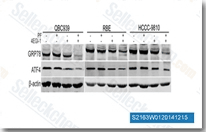
| S2163 | PF-4708671 | PF-4708671 is a cell-permeable inhibitor of p70 ribosomal S6 kinase (S6K1 isoform) with Ki/IC50 of 20 nM/160 nM in cell-free assays, 400-fold greater selectivity for S6K1 than S6K2, and 4- and >20-fold selectivity for S6K1 than MSK1 and RSK1/2, respectively. This compound induces autophagy. It is the first S6K1-specific inhibitor to be reported. |
|
|
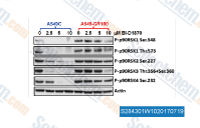
| S2843 | BI-D1870 | BI-D1870 is an ATP-competitive inhibitor of S6 ribosome for RSK1/2/3/4 with IC50 of 31 nM/24 nM/18 nM/15 nM in cell-free assays, respectively; 10- to 100-fold selectivity for RSK than MST2, GSK-3β, MARK3, CK1 and Aurora B. This compound exhibits anticancer attributes including the generation of reactive oxygen species (ROS) and increases in endoplasmic reticulum (ER) stress and autophagy. |
|
|
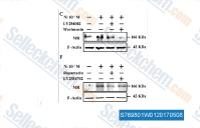
| S7698 | LY2584702 | LY2584702 is a selective, ATP-competitive p70S6K inhibitor with IC50 of 4 nM. |
|
|
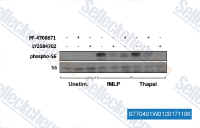
| S7704 | LY2584702 Tosylate | LY2584702 Tosylate is a selective, ATP-competitive p70S6K inhibitor with IC50 of 4 nM. Phase 1. |
|
|
| S7870 | LJH685 | LJH685 is a potent pan-RSK inhibitor with IC50 of 6 nM, 5 nM and 4 nM for RSK1, RSK2, and RSK3, respectively. |
|
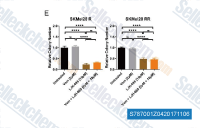
|
| S7871 | LJI308 | LJI308 is a potent, and pan-RSK (p90 ribosomal S6 kinase) inhibitor with IC50 of 6 nM, 4 nM, and 13 nM for RSK1, RSK2, and RSK3, respectively. |
|
|
| S0385 | S6K-18 | S6K-18 is a highly selective inhibitor of ribosomal protein S6 kinase beta-1 (S6K1, p70S6K, p70-S6K). |
|
|
| S3940 | 3'-Hydroxypterostilbene | 3'-Hydroxypterostilbene (3'-HPT) is one of the active constituents of Sphaerophysa salsula and Pterocarpus marsupium which may be useful in treating different types of haematological malignancies. This compound, a natural pterostilbene analogue, effectively inhibits the growth of human colon cancer cells (IC50s of 9.0, 40.2, and 70.9 µM for COLO 205, HCT-116, and HT-29 cells, respectively) by inducing apoptosis and autophagy. It inhibits the PI3K/Akt/mTOR/p70S6K, and p38MAPK pathways and activates the ERK1/2, JNK1/2 MAPK pathways. |
|
|
| E1754 | BRD7389 | BRD7389 is an inhibitor of RSK family kinases with IC50 of 1.5 μM, 2.4 μM, and 1.2 μM for RSK1, RSK2, and RSK3, respectively. This compound also increases β-cell–specific gene expression in primary human islet cells. | ||
Signaling Pathway Map
The 70 kDa ribosomal protein S6 kinase (p70 S6K) is a serine/threonine kinase. There are two highly homologous members in S6K family, which are named as S6K1 and S6K2, respectively. Both S6Ks belong to the AGC family of serine/threonine kinases and they could be activated in response to many stimulus, like growth factors, insulin and cytokines. In turn, S6Ks phosphorylate its substrates including the ribosomal protein S6, elF4B, and SKAR. It was found that the activity of S6Ks could be controlled by mammalian target of rapamycin (mTOR) [2]. And then, direct phosphorylation of S6K1 by mTOR was confirmed [3; 4]. Therefore, the activity of S6K presented sensitive to rapamycin [8]. However, the sensitivity of S6Ks to rapamycin was found always changing. S6Ks became insensitive to rapamycin when the site T412 was phosphorylated [9]. Until recently, raptor has been proved to be responsible for T412 phosphorylation [6]. Besides, S6K−/− animals showed short-lived and were much smaller than wild type animals. A study suggested that this phenomenon was due to the control of S6K on cell growth rather than proliferation [5]. To date, S6Ks are also related to many serious diseases. For example, S6K1 showed overexpression in breast cancer patients [1]. With the understanding of the importance of S6K in human diseases, the demand for S6K-specific inhibitors increased rapidly. Fortunately, a novel inhibitor specific for S6K1, PF-4708671, was developed to facilitate the study of the functions of S6K1, at the same time, and S6K2 [7].

Products are for research use only. Not for human use. We do not sell to patients.
©Copyright 2013 Selleck Chemicals. All Rights Reserved.