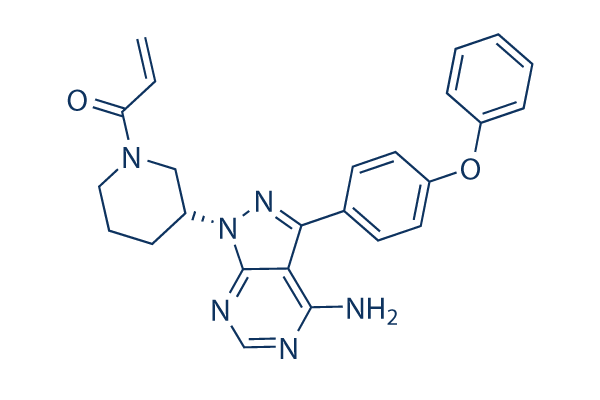
Ibrutinib (PCI-32765)
Catalog No.S2680
Molecular Weight(MW): 440.5
Ibrutinib (PCI-32765) is a potent and highly selective Brutons tyrosine kinase (Btk) inhibitor with IC50 of 0.5 nM in cell-free assays, modestly potent to Bmx, CSK, FGR, BRK, HCK, less potent to EGFR, Yes, ErbB2, JAK3, etc.
8 Customer Reviews
-
BTK C481S and C481T variants show resistance to ibrutinib. (a and b) COS-7 cells were transfected with wild-type BTK or the two variants. Thirty-six hours post transfection, the cells were serum starved and treated with ibrutinib overnight followed by activation with serum and pervanadate for 5 min at room temperature. The cell lysates were immunoblotted for pY223 BTK and pY753 PLCγ2.
Leukemia, 2017, 31(1):177-185. Ibrutinib (PCI-32765) purchased from Selleck.
Identification of Btk as a potent kinase for WIP tyrosine phosphorylation. Total protein lysates were prepared from THP-1 cells that were stably transfected with wild-type WIP-EGFP and treated with PCI-32765 at the concentration specified on the blots for 2h before pervanadate treatment for 30 min. In all cases WIP-EGFP was immunoprecipitated from cell lysates using anti-EGFP antibody and membranes subsequently blotted with the pY (4G10) antibody, EGFP antibody and β-Tubulin.
J Cell Sci 2015 128(2), 251-65. Ibrutinib (PCI-32765) purchased from Selleck.
-
Phosphorylation of ERK1/2 and AKT, but not BTK, was inhibited in sensitive but not resistant MCL cells. Western blotting of BTK phosphorylation. Mantle cell lymphoma (MCL) cells were treated with indicated doses of ibrutinib, cell lysates were collected at 1 or 4 h, and subjected to Western blotting analysis using phosphorylated BTK (p-BTK) (Y223) and total BTK (t-BTK) antibodies.
Br J Haematol 2014 166(6), 849-61. Ibrutinib (PCI-32765) purchased from Selleck.
Effect of Ibrutinib on CLEC-2-mediated platelet activation and signaling in humans. Washed human platelets were incubated with Ibrutinib (5 nM) for 5 min followed by stimulation with convulxin (100 ng/ml) or rhodocytin (30 nM) under stirred conditions. Platelet proteins were separated by SDS-PAGE, Western-blotted, and probed for phospho Syk (Tyr525/526) and PLCγ2 (Tyr759). β-actin was used as a lane loading control.
J Biol Chem 2015 290(18), 11557-68. Ibrutinib (PCI-32765) purchased from Selleck.
-
BTK is expressed by malignant plasma cells and ibrutinib induces cytotoxicity in MM patient cells. (A) BTK mRNA and protein expression in control B-cells and MM patient cells and MM cell lines as measured by real-time PCR and Western blotting. (B) MM cells (n = 11) were treated with two doses of ibrutinib (1 and 10 μM), bortezomib (10 and 20 nM) and lenalidomide (1 and 10 μM) for 48 h and then assessed for cell death/proliferation by Cell Titer GLO assay. (C and D) MM cell lines were analysed for cell death in response to ibrutinib (1 and 10 μM), bortezomib (10 and 20 nM) and lenalidomide.
Cell Signal 2013 25, 106-12. Ibrutinib (PCI-32765) purchased from Selleck.
Ibrutinib induces increased cytotoxicity in combination with lenalidomide and bortezomib in MM patient cells. (A) MM patient cells were treated wit h various combinations of ibrutinib (1 and 10 μM), bortezomib (10 and 20 nM) and lenalidomide (1 and 10 μM) for 48 h and then assessed for cell death/proliferation by Cell Titer GLO assay. (B) MM cell lines were analysed for cell death in response to various combinations of ibrutinib (1 and 10μM), bortezomib (10 and 20 nM) and lenalidomide. (C) RPMI8226 cells were analysed for cell death in response to ibrutinib (1 and 10μM), bortezomib (20 nM) and lenalidomide (10μM) and combinations thereof, and then analysed for apoptosis using annexin-V/propidium iodide staining and flow cytometry. (D) Primary human monocytes were treated with two doses of ibrutinib (1 and 10 μM) and then in combination with bortezomib (20 nM) and lenalidomide (10 μM) for 48 h and then assessed for cell death/proliferation by Cell Titer GLO assay.
Cell Signal 2013 25, 106-12. Ibrutinib (PCI-32765) purchased from Selleck.
-
Ibrutinib downregulates anti-apoptotic proteins and induces caspase mediated apoptosis in MM cells. (A) FLIPL , survivin and Bcl- xL mRNA expression was determined in MM patient cells and MM cell lines treated with ibrutinib (10 μM) and bortezomib (20 nM) both alone and in combination. (B) FLIPL protein expression was measured by Western blotting in extracts from RPMI8226 cells treated with ibrutinib (10μM) and bortezomib (20 nM) both alone and in combination for 8 hours. (C) The MM cell line RPMI8226 was treated with the pan caspase inhibitor zVAD-fmk (10 μM) before treatment with ibrutinib (10 μM) and borte zomib (20 nM) both alone and in combination for 48 h and then assessed for cell death/prolife ration by Cell Titer GLO assay.
Cell Signal 2013 25, 106-12. Ibrutinib (PCI-32765) purchased from Selleck.
Cell lines were exposed to 0, 50 and 150 mM Ibrutinib for 4 h. The level of phosphorylated ERK1/2 (p-ERK1/2) was reduced in TCF3-rearranged MHH-CALL3 compared with non-TCF3-rearranged Nalm6 and MHH-CALL4 cell lines. b-Actin served as a loading control. P-ERK/b-actin: ratio of the intensities. See Supplementary Materials and methods document for more information.
Blood Cancer J 2014 4, e181. Ibrutinib (PCI-32765) purchased from Selleck.
Purity & Quality Control
Choose Selective BTK Inhibitors
Biological Activity
| Description | Ibrutinib (PCI-32765) is a potent and highly selective Brutons tyrosine kinase (Btk) inhibitor with IC50 of 0.5 nM in cell-free assays, modestly potent to Bmx, CSK, FGR, BRK, HCK, less potent to EGFR, Yes, ErbB2, JAK3, etc. | |||||||||||||||||||||||||||||||||||||||||||||||||||||||||||||||||
|---|---|---|---|---|---|---|---|---|---|---|---|---|---|---|---|---|---|---|---|---|---|---|---|---|---|---|---|---|---|---|---|---|---|---|---|---|---|---|---|---|---|---|---|---|---|---|---|---|---|---|---|---|---|---|---|---|---|---|---|---|---|---|---|---|---|---|
| Targets |
|
|||||||||||||||||||||||||||||||||||||||||||||||||||||||||||||||||
| In vitro |
Ibrutinib shows the potent and irreversible inhibitory effect and selectivity for Btk enzymatic activity. In BCR pathway-activated DOHH2 cell line, Ibrutinib inhibits autophosphorylation of Btk, phosphorylation of Btk's physiological substrate PLCγ, and phosphorylation of further downstream kinase, ERK with IC50 of 11 nM, 29 nM and 13 nM, respectively. [1] Ibrutinib exhibits a significant dose-dependent and time-dependent induction of cytotoxicity in chronic lymphocytic leukemia (CLL) cells. In addition, Ibrutinib induces cell death depending on caspase pathway activation and antagonizes the ability of CLL cells to proliferate after TLR signaling. [2] A recent study shows that Ibrutinib inhibits BCR-activated primary B cell proliferation with IC50 of 8 nM and results in inhibition of TNFα, IL-1β and IL-6 production in primary monocytes with IC50 of 2.6 nM, 0.5 nM and 3.9 nM, respectively. [3] |
|||||||||||||||||||||||||||||||||||||||||||||||||||||||||||||||||
| Cell Data |
|
|||||||||||||||||||||||||||||||||||||||||||||||||||||||||||||||||
| In vivo | In a collagen-induced arthritis model, Ibrutinib significantly reduces clinical arthritis scores reflecting paw swelling and joint inflammation by inhibiting B-cell activation. In a MRL-Fas(lpr) lupus model, Ibrutinib reduces renal disease and autoantibody production. [1] In an adoptive transfer TCL1 mouse model of CLL, Ibrutinib (25 mg/kg/day) causes a transient early lymphocytosis, and delays CLL disease progression. [4] |
Protocol
| Kinase Assay: |
+ Expand
Kinase Assays : In vitro kinase IC50 values are measured using 33P filtration binding assay after 1 hour incubation of kinase, 33P-ATP, Ibrutinib, and substrate [0.2 mg/mL poly(EY)(4:1]. Assays are performed at Reaction Biology. |
|---|---|
| Cell Research: |
+ Expand
|
| Animal Research: |
+ Expand
|
Solubility (25°C)
| In vitro | DMSO | 88 mg/mL (199.77 mM) |
|---|---|---|
| Ethanol | 45 mg/mL (102.15 mM) | |
| Water | Insoluble | |
| In vivo | Add solvents to the product individually and in order: 5% DMSO+30% PEG 300+5% Tween 80+ddH2O For best results, use promptly after mixing. |
10mg/mL |
* Please note that Selleck tests the solubility of all compounds in-house, and the actual solubility may differ slightly from published values. This is normal and is due to slight batch-to-batch variations.
Chemical Information
| Molecular Weight | 440.5 |
|---|---|
| Formula | C25H24N6O2 |
| CAS No. | 936563-96-1 |
| Storage | powder |
| Synonyms | N/A |
Bio Calculators
Molarity Calculator
Calculate the mass, volume or concentration required for a solution. The Selleck molarity calculator is based on the following equation:
Mass (g) = Concentration (mol/L) × Volume (L) × Molecular Weight (g/mol)
*When preparing stock solutions, please always use the batch-specific molecular weight of the product found on the via label and MSDS / COA (available on product pages).
Dilution Calculator
Calculate the dilution required to prepare a stock solution. The Selleck dilution calculator is based on the following equation:
Concentration (start) x Volume (start) = Concentration (final) x Volume (final)
This equation is commonly abbreviated as: C1V1 = C2V2 ( Input Output )
* When preparing stock solutions always use the batch-specific molecular weight of the product found on the vial label and MSDS / COA (available online).
Molecular Weight Calculator
Enter the chemical formula of a compound to calculate its molar mass and elemental composition:
Tip: Chemical formula is case sensitive. C10H16N2O2 c10h16n2o2
Instructions to calculate molar mass (molecular weight) of a chemical compound:
To calculate molar mass of a chemical compound, please enter its chemical formula and click 'Calculate'.
Definitions of molecular mass, molecular weight, molar mass and molar weight:
Molecular mass (molecular weight) is the mass of one molecule of a substance and is expressed in the unified atomic mass units (u). (1 u is equal to 1/12 the mass of one atom of carbon-12)
Molar mass (molar weight) is the mass of one mole of a substance and is expressed in g/mol.
Molarity Calculator
Clinical Trial Information
| NCT Number | Recruitment | Conditions | Sponsor/Collaborators | Start Date | Phases |
|---|---|---|---|---|---|
| NCT02575300 | Recruiting | Carcinoid Tumors|Pancreatic NET | H. Lee Moffitt Cancer Center and Research Institute|Pharmacyclics LLC. | October 9, 2015 | Phase 2 |
| NCT02973399 | Recruiting | Cancer | Esanex Inc. | February 7, 2017 | Phase 1 |
| NCT02756897 | Recruiting | Leukemia|Chronic Lymphocytic Leukemia|Small Lymphocytic Lymphoma | M.D. Anderson Cancer Center|AbbVie | July 7, 2016 | Phase 2 |
| NCT03021460 | Recruiting | Metastatic Melanoma|Stage III Skin Melanoma|Stage IIIA Skin Melanoma|Stage IIIB Skin Melanoma|Stage IIIC Skin Melanoma|Stage IV Skin Melanoma | Mayo Clinic|National Cancer Institute (NCI) | January 31, 2017 | Phase 2 |
| NCT02514083 | Recruiting | CLL (Chronic Lymphocytic Leukemia)|SLL (Small Lymphocytic Lymphoma) | National Heart, Lung, and Blood Institute (NHLBI)|National Institutes of Health Clinical Center (CC) | July 28, 2015 | Phase 2 |
| NCT03053440 | Recruiting | Waldenströms Macroglobulinemia | BeiGene | January 25, 2017 | Phase 3 |
Tech Support
Answers to questions you may have can be found in the inhibitor handling instructions. Topics include how to prepare stock solutions, how to store inhibitors, and issues that need special attention for cell-based assays and animal experiments.
Tel: +1-832-582-8158 Ext:3
If you have any other enquiries, please leave a message.
Frequently Asked Questions
-
Question 1:
How to reconstitute the compound S2680 for in vivo studies?
-
Answer:
For in vivo study, we suggest to use 5% DMSO+30% PEG 300+5% Tween 80+ddH2O up to 10mg/ml.