
-
 Argentina
-
 Australia
-
 Austria
-
 Belgium
-
 Brazil
-
 Canada
-
 China
China
-
 Czech Republic
-
 Denmark
-
 Finland
-
 France
-
 Germany
-
 Greece
-
 Hong Kong
-
 Hungary
-
 Iceland
-
 India
India
-
 Ireland
-
 Israel
-
 Italy
Italy
-
 Japan
Japan
-
 Korea
Korea
-
 Luxembourg
-
 Malaysia
-
 Netherlands
-
 New Zealand
-
 Norway
-
 Poland
-
 Portugal
-
 Qatar
Qatar
-
 Romania
-
 Saudi Arabia
-
 Singapore
-
 Spain
Spain
-
 Sweden
-
 Switzerland
-
 Taiwan
-
 Turkey
-
 United Kingdom
-
 United States
research use only
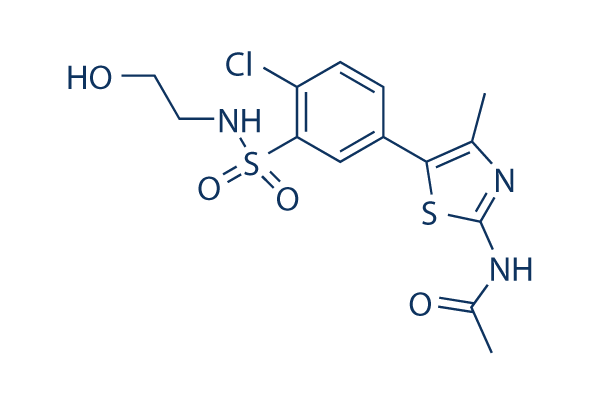
PIK-93 PI4K inhibitor
Cat.No.S1489
Quality Control
Solubility
|
In vitro |
DMSO
: 78 mg/mL
(200.06 mM)
Ethanol : 1 mg/mL Water : Insoluble |
Molarity Calculator
|
In vivo |
|||||
In vivo Formulation Calculator (Clear solution)
Step 1: Enter information below (Recommended: An additional animal making an allowance for loss during the experiment)
Step 2: Enter the in vivo formulation (This is only the calculator, not formulation. Please contact us first if there is no in vivo formulation at the solubility Section.)
Calculation results:
Working concentration: mg/ml;
Method for preparing DMSO master liquid: mg drug pre-dissolved in μL DMSO ( Master liquid concentration mg/mL, Please contact us first if the concentration exceeds the DMSO solubility of the batch of drug. )
Method for preparing in vivo formulation: Take μL DMSO master liquid, next addμL PEG300, mix and clarify, next addμL Tween 80, mix and clarify, next add μL ddH2O, mix and clarify.
Method for preparing in vivo formulation: Take μL DMSO master liquid, next add μL Corn oil, mix and clarify.
Note: 1. Please make sure the liquid is clear before adding the next solvent.
2. Be sure to add the solvent(s) in order. You must ensure that the solution obtained, in the previous addition, is a clear solution before proceeding to add the next solvent. Physical methods such
as vortex, ultrasound or hot water bath can be used to aid dissolving.
Chemical Information, Storage & Stability
| Molecular Weight | 389.88 | Formula | C14H16ClN3O4S2 |
Storage (From the date of receipt) | |
|---|---|---|---|---|---|
| CAS No. | 593960-11-3 | Download SDF | Storage of Stock Solutions |
|
|
| Synonyms | N/A | SMILES | CC1=C(SC(=N1)NC(=O)C)C2=CC(=C(C=C2)Cl)S(=O)(=O)NCCO | ||
Read more about storage stability stock solution CAS number SMILES
Mechanism of Action
| Features |
A novel and potent inhibitor of both PI3Kγ and PI4KIIIβ.
|
|---|---|
| Targets/IC50/Ki |
p110γ
16 nM
PI4KIIIβ
19 nM
p110α
39 nM
DNA-PK
64 nM
p110δ
120 nM
C2β
140 nM
hsVps34
320 nM
ATM
490 nM
p110β
590 nM
PI4KIIIα
1.1 μM
mTORC1
1.38 μM
|
| In vitro |
PIK-93 inhibits PI3Kγ and PI4KIIIβ, with IC50 values of 16 nM and 19 nM, respectively. This compound also inhibits other members of PI3Ks, including PI3Kα, β, and δ, with IC50 values of 39 nM, 0.59 μM, and 0.12 μM, respectively. It shows no obvious inhibitory effect against a panel of other kinases, even at a concentration of 10 μM.
In differentiated HL60 (dHL60) cells, this compound (0.5 μM–1 μM) impairs consolidation and stability of the leading edge formed after treatment with uniform f-Met-Leu-Phe (fMLP). It alters the localization, but not the amount, of the fMLP-dependent accumulation of total F-actin. In fMLP gradients, this chemical reduces the chemotactic index and triples the cells' turning frequency.
In COS-7 cells, this compound (250 nM) effectively abrogates the accumulation of CERT-PH domain and FL-Cer in Golgi. It of the same concentration also significantly inhibits the conversion of [3H]serine-labeled endogenous ceramide to sphingomyelin. These facts indicate a key role of PI4KIIIβ in ceramide transport between the ER and Golgi, as well as in the regulation of spingomyelin synthesis.
In T6.11 cells, this compound (300 nM) reduces carbachol-induced translocation of TRPC6 to the plasma membrane and net Ca2+ entry.
A recent report shows that this chemical has anti-enterovirus effects, as revealed by its inhibition of both poliovirus (PV) and hepatitis C virus (HCV) replication, with EC50 values of 0.14 µM and 1.9 µM, respectively.
|
| Kinase Assay |
Assay of PI3Ks
|
|
IC50 values are measured using a standard TLC assay for lipid kinase activity. Kinase reactions are performed by preparing a reaction mixture containing kinase, PIK-93 (2% DMSO final concentration), buffer (25 mM HEPES, pH 7.4, 10 mM MgCl2), and freshly sonicated phosphatidylinositol (100 µg/ml). Reactions are initiated by the addition of ATP containing 10 µCi of γ-32P-ATP to a final concentration 10 or 100 µM, and allowed to proceed for 20 min at room temperature. For TLC analysis, reactions are then terminated by the addition of 105 µL 1N HCl followed by 160 µL CHCl3:MeOH (1:1). The biphasic mixture is vortexed, briefly centrifuged, and the organic phase transferred to a new tube using a gel loading pipette tip precoated with CHCl3. This extract is spotted on TLC plates and developed for 3 hours–4 hours in a 65:35 solution of n-propanol:1M acetic acid. The TLC plates are then dried, exposed to a phosphorimager screen, and quantitated. Kinase activity is typically measured at 10–12 concentrations of this compound representing two-fold dilutions from the highest concentration of 100 μM.
|
References |
|
Tech Support
Tel: +1-832-582-8158 Ext:3
If you have any other enquiries, please leave a message.

Products are for research use only. Not for human use. We do not sell to patients.
©Copyright 2013 Selleck Chemicals. All Rights Reserved.