
-
 Argentina
-
 Australia
-
 Austria
-
 Belgium
-
 Brazil
-
 Canada
-
 China
China
-
 Czech Republic
-
 Denmark
-
 Finland
-
 France
-
 Germany
-
 Greece
-
 Hong Kong
-
 Hungary
-
 Iceland
-
 India
India
-
 Ireland
-
 Israel
-
 Italy
Italy
-
 Japan
Japan
-
 Korea
Korea
-
 Luxembourg
-
 Malaysia
-
 Netherlands
-
 New Zealand
-
 Norway
-
 Poland
-
 Portugal
-
 Qatar
Qatar
-
 Romania
-
 Saudi Arabia
-
 Singapore
-
 Spain
Spain
-
 Sweden
-
 Switzerland
-
 Taiwan
-
 Turkey
-
 United Kingdom
-
 United States
research use only
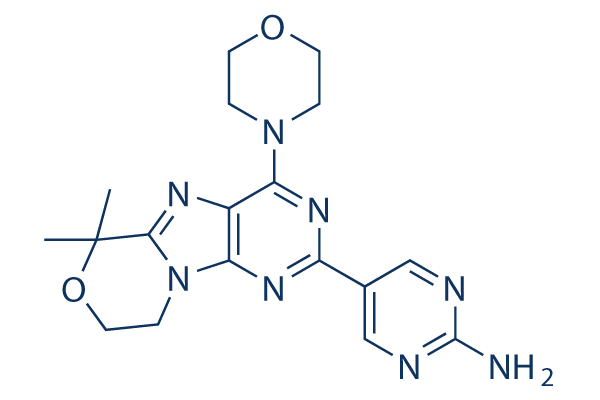
Paxalisib (GDC-0084) PI3K/mTOR inhibitor
Cat.No.S8163
Quality Control
| Related Targets | Akt mTOR GSK-3 ATM/ATR DNA-PK AMPK PDPK1 PTEN PI4K PP2A |
|---|---|
| Other PI3K Inhibitors | GDC-0077 (Inavolisib) SAR405 Quercetin (Sophoretin) LY294002 XL147 analogue Tersolisib (STX-478) Buparlisib (BKM120) 740 Y-P (PDGFR 740Y-P) GO-203 TFA Eganelisib (IPI-549) |
Solubility
|
In vitro |
DMSO
: 5 mg/mL
(13.07 mM)
Water : Insoluble Ethanol : Insoluble |
Molarity Calculator
|
In vivo |
|||||
In vivo Formulation Calculator (Clear solution)
Step 1: Enter information below (Recommended: An additional animal making an allowance for loss during the experiment)
Step 2: Enter the in vivo formulation (This is only the calculator, not formulation. Please contact us first if there is no in vivo formulation at the solubility Section.)
Calculation results:
Working concentration: mg/ml;
Method for preparing DMSO master liquid: mg drug pre-dissolved in μL DMSO ( Master liquid concentration mg/mL, Please contact us first if the concentration exceeds the DMSO solubility of the batch of drug. )
Method for preparing in vivo formulation: Take μL DMSO master liquid, next addμL PEG300, mix and clarify, next addμL Tween 80, mix and clarify, next add μL ddH2O, mix and clarify.
Method for preparing in vivo formulation: Take μL DMSO master liquid, next add μL Corn oil, mix and clarify.
Note: 1. Please make sure the liquid is clear before adding the next solvent.
2. Be sure to add the solvent(s) in order. You must ensure that the solution obtained, in the previous addition, is a clear solution before proceeding to add the next solvent. Physical methods such
as vortex, ultrasound or hot water bath can be used to aid dissolving.
Chemical Information, Storage & Stability
| Molecular Weight | 382.42 | Formula | C18H22N8O2 |
Storage (From the date of receipt) | |
|---|---|---|---|---|---|
| CAS No. | 1382979-44-3 | Download SDF | Storage of Stock Solutions |
|
|
| Synonyms | RG7666 | SMILES | CC1(C2=NC3=C(N2CCO1)N=C(N=C3N4CCOCC4)C5=CN=C(N=C5)N)C | ||
Read more about storage stability stock solution CAS number SMILES
Mechanism of Action
| Targets/IC50/Ki |
PI3Kα
(Cell-free assay) 2 nM(Ki app)
PI3Kδ
(Cell-free assay) 3 nM(Ki app)
PI3Kγ
(Cell-free assay) 10 nM(Ki app)
PI3Kβ
(Cell-free assay) 46 nM(Ki app)
mTOR
(Cell-free assay) 70 nM(Ki app)
|
|---|---|
| In vitro |
Paxalisib (GDC-0084) has excellent human metabolic stability in microsomal and hepatocyte incubations and demonstrated inhibition of pAKT, a key signal within the PI3K pathway, in normal brain tissue. This compound is shown to inhibit the proliferation of several glioma cells in vitro with IC50 ranging from 0.3 to 1.1 μM. Its binding to plasma proteins is low, with a free fraction (%) of 29.5±2.7 (n=3) in CD-1 mouse plasma, when tested at 5 μM. Binding to brain tissues from CD-1 mice is higher, with a free fraction of 6.7% (±1; n=3).
|
| In vivo |
Paxalisib (GDC-0084) markedly inhibits the PI3K pathway in mouse brain, causing up to 90% suppression of the pAkt signal. It achieves significant tumor growth inhibition of 70% and 40% against the U87 and GS2 orthotopic models, respectively. This compound's distribution throughout the brain and intracranial tumors leads to potent inhibition of the PI3K pathway. It is being evaluated in patients, and exposures reached at tolerated doses are consistent with those associated with efficacious doses in mouse models.
|
References |
|
Clinical Trial Information
(data from https://clinicaltrials.gov, updated on 2026-06-23)
| NCT Number | Recruitment | Conditions | Sponsor/Collaborators | Start Date | Phases |
|---|---|---|---|---|---|
| NCT07447076 | RECRUITING | Recurrent Atypical Teratoid/Rhabdoid Tumor; Atypical Teratoid/Rhabdoid Tumor (ATRT) of the CNS |
Sabine Mueller, MD, PhD |
2026-06-17 | PHASE2 |
| NCT06208657 | RECRUITING | Childhood Cancer; Childhood Solid Tumor; Childhood Brain Tumor; Recurrent Cancer; Refractory Cancer |
Australian & New Zealand Children's Haematology/Oncology Group |
2024-07-10 | PHASE1; PHASE2 |
| NCT07391215 | RECRUITING | Malignant Primary Gliomas; Glioblastoma Multiforme (GBM) |
Institute of Cancer Research, United Kingdom |
2026-01-19 | PHASE1; PHASE2 |
| NCT03970447 | RECRUITING | Glioblastoma |
Global Coalition for Adaptive Research |
2019-07-30 | PHASE2; PHASE3 |
| NCT05009992 | RECRUITING | Diffuse Intrinsic Pontine Glioma; Diffuse Midline Glioma, H3 K27M-Mutant; Recurrent Diffuse Intrinsic Pontine Glioma; Recurrent Diffuse Midline Glioma, H3 K27M-Mutant; Recurrent WHO Grade III Glioma; WHO Grade III Glioma |
University of California, San Francisco |
2021-10-20 | PHASE2 |
| NCT07287202 | RECRUITING | Focal Cortical Dysplasia; Tuberous Sclerosis Complex (TSC); Hemimegalencephaly |
Sovargen |
2026-07-14 | PHASE1; PHASE2 |
Read more about Clinical Trials
Tech Support
Tel: +1-832-582-8158 Ext:3
If you have any other enquiries, please leave a message.
Signaling Pathway Map

Products are for research use only. Not for human use. We do not sell to patients.
©Copyright 2013 Selleck Chemicals. All Rights Reserved.