
-
 Argentina
-
 Australia
-
 Austria
-
 Belgium
-
 Brazil
-
 Canada
-
 China
China
-
 Czech Republic
-
 Denmark
-
 Finland
-
 France
-
 Germany
-
 Greece
-
 Hong Kong
-
 Hungary
-
 Iceland
-
 India
India
-
 Ireland
-
 Israel
-
 Italy
Italy
-
 Japan
Japan
-
 Korea
Korea
-
 Luxembourg
-
 Malaysia
-
 Netherlands
-
 New Zealand
-
 Norway
-
 Poland
-
 Portugal
-
 Qatar
Qatar
-
 Romania
-
 Saudi Arabia
-
 Singapore
-
 Spain
Spain
-
 Sweden
-
 Switzerland
-
 Taiwan
-
 Turkey
-
 United Kingdom
-
 United States
research use only
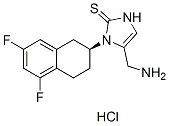
Nepicastat (SYN-117) HCl Hydroxylase inhibitor
Cat.No.S2695
Quality Control
| Related Targets | Dehydrogenase HSP Transferase P450 (e.g. CYP17) PDE phosphatase PPAR Vitamin Carbohydrate Metabolism Mitochondrial Metabolism |
|---|---|
| Other Hydroxylase Inhibitors | Ro 61-8048 Meldonium 4-Chloro-DL-phenylalanine LP-533401 (R)-Nepicastat HCl H-Tyr(3-I)-OH 2-Thiouracil 1,4-DPCA |
Solubility
|
In vitro |
DMSO
: 66 mg/mL
(198.9 mM)
Water : Insoluble Ethanol : Insoluble |
Molarity Calculator
|
In vivo |
|||||
In vivo Formulation Calculator (Clear solution)
Step 1: Enter information below (Recommended: An additional animal making an allowance for loss during the experiment)
Step 2: Enter the in vivo formulation (This is only the calculator, not formulation. Please contact us first if there is no in vivo formulation at the solubility Section.)
Calculation results:
Working concentration: mg/ml;
Method for preparing DMSO master liquid: mg drug pre-dissolved in μL DMSO ( Master liquid concentration mg/mL, Please contact us first if the concentration exceeds the DMSO solubility of the batch of drug. )
Method for preparing in vivo formulation: Take μL DMSO master liquid, next addμL PEG300, mix and clarify, next addμL Tween 80, mix and clarify, next add μL ddH2O, mix and clarify.
Method for preparing in vivo formulation: Take μL DMSO master liquid, next add μL Corn oil, mix and clarify.
Note: 1. Please make sure the liquid is clear before adding the next solvent.
2. Be sure to add the solvent(s) in order. You must ensure that the solution obtained, in the previous addition, is a clear solution before proceeding to add the next solvent. Physical methods such
as vortex, ultrasound or hot water bath can be used to aid dissolving.
Chemical Information, Storage & Stability
| Molecular Weight | 331.81 | Formula | C14H15F2N3S.HCl |
Storage (From the date of receipt) | |
|---|---|---|---|---|---|
| CAS No. | 170151-24-3 | Download SDF | Storage of Stock Solutions |
|
|
| Synonyms | N/A | SMILES | C1CC2=C(CC1N3C(=CNC3=S)CN)C=C(C=C2F)F.Cl | ||
Read more about storage stability stock solution CAS number SMILES
Mechanism of Action
| Targets/IC50/Ki |
Bovine dopamine-beta-hydroxylase
8.5 nM
Human dopamine-beta-hydroxylase
9 nM
|
|---|---|
| In vitro |
In vitro, Nepicastat hydrochloride shows the selective and concentration-dependent inhibition effects on bovine and human dopamine-beta-hydroxylase activity with IC50 of 8.5 nM and 9.0 nM, respectively. While Nepicastat hydrochloride has negligible affinity for twelve other enzymes and thirteen neurotransmitter receptors.
|
| In vivo |
In the artery, left ventricle and cerebral cortex of spontaneously hypertensive rats (SHRs), Nepicastat hydrochloride reduces noradrenaline content, and increases dopamine content and dopamine/noradrenaline ratio in a dose-dependent manner. In addition, Nepicastat hydrochloride also produces the similar effects on noradrenaline, dopamine and dopamine/noradrenaline ratio in tissues and plasma of beagle dogs. In inactin-anesthetized SHRs, Nepicastat hydrochloride (3 mg/kg, i.v.) produces the antihypertensive effects and causes a significant decrease in renal vascular resistance (38%) and an increase in renal blood flow (22%). In dogs with chronic heart failure, low-dose Nepicastat hydrochloride (0.5 mg/kg) prevents left ventricular (LV) dysfunction and remodeling, and combination therapy of Nepicastat hydrochloride and enalapril results in additional improvements in all morphological features. In rat brain, Nepicastat hydrochloride at a dose of 50 mg/kg ( i.p.) leads to the reduction of norepinephrine (NE) and blocks cocaine-primed reinstatement of cocaine seeking.
|
References |
|
Clinical Trial Information
(data from https://clinicaltrials.gov, updated on 2017-05-18)
| NCT Number | Recruitment | Conditions | Sponsor/Collaborators | Start Date | Phases |
|---|---|---|---|---|---|
| NCT01704196 | COMPLETED | Cocaine Dependence |
National Institute on Drug Abuse (NIDA) |
2013-04 | PHASE2 |
| NCT00659230 | COMPLETED | Posttraumatic Stress Disorder |
Tuscaloosa Research & Education Advancement Corporation |
2009-07-01 | PHASE2 |
| NCT00641511 | WITHDRAWN | Post Traumatic Stress Disorder (PTSD) |
Michael E. DeBakey VA Medical Center |
2008-06 | PHASE2 |
| NCT00656357 | COMPLETED | Cocaine Dependence |
Biotie Therapies Inc. |
2008-06 | PHASE1; PHASE2 |
Read more about Clinical Trials
Tech Support
Tel: +1-832-582-8158 Ext:3
If you have any other enquiries, please leave a message.
Frequently Asked Questions
Question 1:
Could you please suggest a vehicle for in vivo injection of it?
Answer:
It can be dissolved in 5% Tween 80+35% PEG 300+ddH2O at 10mg/ml clearly. When preparing the solution, we added solvents individually and in order, and the compound finally dissolved completely. Please prepare the solution each time before use.
Signaling Pathway Map

Products are for research use only. Not for human use. We do not sell to patients.
©Copyright 2013 Selleck Chemicals. All Rights Reserved.