
-
 Australia
-
 Austria
-
 Belgium
-
 Brazil
-
 Canada
-
 China
China
-
 Czech Republic
-
 Denmark
-
 Finland
-
 France
-
 Germany
-
 Greece
-
 Hong Kong
-
 Hungary
-
 Iceland
-
 India
India
-
 Ireland
-
 Israel
-
 Italy
Italy
-
 Japan
Japan
-
 Korea
Korea
-
 Luxembourg
-
 Malaysia
-
 Netherlands
-
 New Zealand
-
 Norway
-
 Poland
-
 Qatar
Qatar
-
 Romania
-
 Saudi Arabia
-
 Singapore
-
 Spain
Spain
-
 Sweden
-
 Switzerland
-
 Taiwan
-
 Turkey
-
 United Kingdom
-
 United States
research use only
Ellagic Acid hydrate Casein Kinase inhibitor
Cat.No.S5516
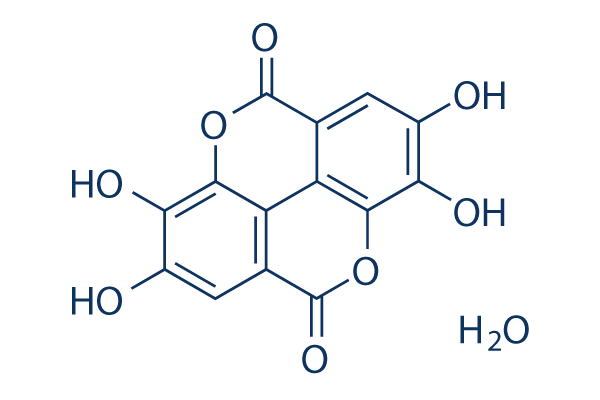
Chemical Structure
Molecular Weight: 320.21
Quality Control
Solubility
|
In vitro |
DMSO
: 2 mg/mL
(6.24 mM)
|
Molarity Calculator
|
In vivo |
|||||
In vivo Formulation Calculator (Clear solution)
Step 1: Enter information below (Recommended: An additional animal making an allowance for loss during the experiment)
Step 2: Enter the in vivo formulation (This is only the calculator, not formulation. Please contact us first if there is no in vivo formulation at the solubility Section.)
Calculation results:
Working concentration: mg/ml;
Method for preparing DMSO master liquid: mg drug pre-dissolved in μL DMSO ( Master liquid concentration mg/mL, Please contact us first if the concentration exceeds the DMSO solubility of the batch of drug. )
Method for preparing in vivo formulation: Take μL DMSO master liquid, next addμL PEG300, mix and clarify, next addμL Tween 80, mix and clarify, next add μL ddH2O, mix and clarify.
Method for preparing in vivo formulation: Take μL DMSO master liquid, next add μL Corn oil, mix and clarify.
Note: 1. Please make sure the liquid is clear before adding the next solvent.
2. Be sure to add the solvent(s) in order. You must ensure that the solution obtained, in the previous addition, is a clear solution before proceeding to add the next solvent. Physical methods such
as vortex, ultrasound or hot water bath can be used to aid dissolving.
Chemical Information, Storage & Stability
| Molecular Weight | 320.21 | Formula | C14H6O8.H2O |
Storage (From the date of receipt) | 3 years -20°C powder |
|---|---|---|---|---|---|
| CAS No. | 314041-08-2 | -- | Storage of Stock Solutions |
|
|
| Synonyms | N/A | Smiles | C1=C2C3=C(C(=C1O)O)OC(=O)C4=CC(=C(C(=C43)OC2=O)O)O.O | ||
Mechanism of Action
| Targets/IC50/Ki |
CK2
(Cell-free assay) 0.04 μM
Lyn
(Cell-free assay) 2.9 μM
PKA
(Cell-free assay) 3.5 μM
|
|---|---|
| In vitro |
Ellagic acid (EA) is able to inhibit the growth of several cancer cells. EA inhibited cell proliferation in a dose- and time-dependent manner by arresting both cell lines at the G1 phase of the cell cycle, which were from elevating p53 and Cip1/p21 and decreasing cyclin D1 and E levels. EA also induced caspase-3-mediated apoptosis by increasing the Bax : Bcl-2 ratio and restored anoikis in ES-2 and PA-1 cells. It is well known to have a free radical scavenging activity. EA reversed epithelial to mesenchymal transition by up-regulating E-cadherin and down-regulating Vimentin.
|
| In vivo |
A 90-day subchronic toxicity study further demonstrated that orally feeding EA (9.4, 19.1, 39.1 g/kg b.w., resp.) could not induce mortality or treatment-related clinical signs throughout the experimental period on F344 rats, indicating the low toxicity of EA to mammalians. Furthermore, EA exhibits potent anticancer and anticarcinogenesis activities towards breast, colorectal, oral, prostate, pancreatic, bladder, neuroblastoma, melanoma, and lymphoma cells. Treatment of PANC-1 xenografted mice with EA resulted in significant inhibition in tumor growth and prolong mice survival rate.
|
References |
|
Tech Support
Tel: +1-832-582-8158 Ext:3
If you have any other enquiries, please leave a message.

Products are for research use only. Not for human use. We do not sell to patients.
©Copyright 2013 Selleck Chemicals. All Rights Reserved.