
-
 Argentina
-
 Australia
-
 Austria
-
 Belgium
-
 Brazil
-
 Canada
-
 China
China
-
 Czech Republic
-
 Denmark
-
 Finland
-
 France
-
 Germany
-
 Greece
-
 Hong Kong
-
 Hungary
-
 Iceland
-
 India
India
-
 Ireland
-
 Israel
-
 Italy
Italy
-
 Japan
Japan
-
 Korea
Korea
-
 Luxembourg
-
 Malaysia
-
 Netherlands
-
 New Zealand
-
 Norway
-
 Poland
-
 Portugal
-
 Qatar
Qatar
-
 Romania
-
 Saudi Arabia
-
 Singapore
-
 Spain
Spain
-
 Sweden
-
 Switzerland
-
 Taiwan
-
 Turkey
-
 United Kingdom
-
 United States
research use only
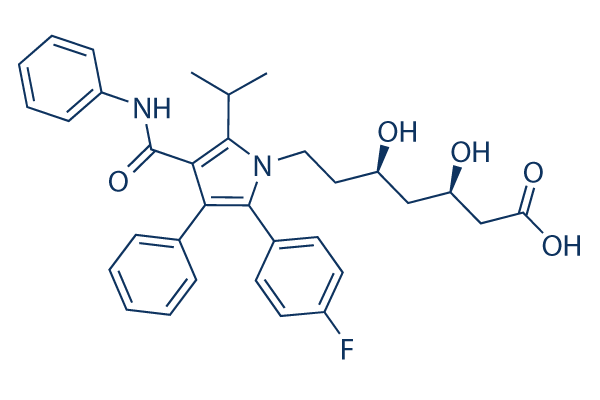
Atorvastatin HMG-CoA Reductase inhibitor
Cat.No.S5715
Quality Control
| Related Targets | Dehydrogenase HSP Transferase P450 (e.g. CYP17) PDE phosphatase PPAR Vitamin Carbohydrate Metabolism Mitochondrial Metabolism |
|---|---|
| Other HMG-CoA Reductase Inhibitors | Mevastatin SR-12813 Clinofibrate Cerivastatin sodium Dihydrolanosterol 7-ketocholesterol |
Cell Culture, Treatment & Working Concentration
| Cell Lines | Assay Type | Concentration | Incubation Time | Formulation | Activity Description | PMID |
|---|---|---|---|---|---|---|
| HEK293 | Function assay | TP_TRANSPORTER: uptake in OATP1B1-expressing HEK293 cells, Km=12.4μM | 15970799 | |||
| L6 | Function assay | Inhibition of cholesterol synthesis in rat L6 cells assessed as incorporation of [14C]acetate into cholesterol, IC50=0.078μM | 18412317 | |||
| C2C12 | Function assay | 1 uM | Induction of cell differentiation in mouse C2C12 cells assessed as myosin heavy chain expression at 1 uM | 20081855 | ||
| HepG2 | Function assay | 1 uM | Upregulation of LDL receptor expression in human HepG2 cells at 1 uM in presence of ARH-specific siRNA | 20356098 | ||
| HEK293 | Function assay | Activity at human liver OATP1B3 expressed in HEK293 Flp-In cells, Km=0.73μM | 22541068 | |||
| HEK293 | Function assay | Activity at human liver OATP1B1 expressed in HEK293 Flp-In cells, Km=0.77μM | 22541068 | |||
| HEK293 | Function assay | Activity at human liver OATP2B1 expressed in HEK293 Flp-In cells, Km=2.84μM | 22541068 | |||
| HEK293 | Function assay | Inhibition of OATP1B1 (unknown origin) expressed in HEK293 cells using estradiol-17beta-glucuronide substrate, IC50=0.6μM | 22587986 | |||
| HEK293 | Function assay | Inhibition of OATP1B1 (unknown origin) expressed in HEK293 cells using pitavastatin substrate, IC50=0.8μM | 22587986 | |||
| HEK293 | Function assay | Inhibition of OATP1B1 (unknown origin) expressed in HEK293 cells using estrone-3-sulfate substrate, IC50=1.6μM | 22587986 | |||
| hepatocytes | Function assay | 0.1 to 10 uM | up to 90 mins | Drug metabolism in Sprague-Dawley rat hepatocytes assessed per 10'6 cells at 0.1 to 10 uM up to 90 mins by media-loss method, Km=0.43μM | 22593038 | |
| hepatocytes | Function assay | 0.1 to 10 uM | up to 90 mins | Drug metabolism in Sprague-Dawley rat hepatocytes assessed per 10'6 cells at 0.1 to 10 uM up to 90 mins by conventional assay, Km=1.3μM | 22593038 | |
| A549 | Cytotoxicity assay | 72 hrs | Cytotoxicity against human A549 cells after 72 hrs by MTT assay, IC50=8.7μM | 23570542 | ||
| HS68 | Cytotoxicity assay | 72 hrs | Cytotoxicity against human HS68 cells after 72 hrs by MTT assay, IC50=22.7μM | 23570542 | ||
| MEF | Cytotoxicity assay | 72 hrs | Cytotoxicity against mouse MEF cells after 72 hrs by MTT assay, IC50=30.7μM | 23570542 | ||
| HepG2 | Function assay | 10 uM | Induction of SREBP2 maturation in human HepG2 cells at 10 uM after overnight incubation by immunoblot analysis | 26784936 | ||
| human red blood cells | Antiplasmodial assay | 48 hrs | Antiplasmodial activity against chloroquine-resistant Plasmodium falciparum W2 infected in human red blood cells after 48 hrs by SYBR test, IC50=10.3μM | 26988303 | ||
| Hep3G | Function assay | 25 uM | 48 hrs | Inhibition of HMG CoA reductase in human Hep3G cells assessed as increase in LDL receptor expression at 25 uM incubated for 48 hrs by immunofluorescence method | 31005367 | |
| A549 | Function assay | Reductase Activity Assay: The HMGR activity was performed using HMG-CoA reductase assay kit from Sigma-Aldrich with the human recombinant protein or 100 μg total cell lysates from A549 cells. Lovastatin was used as a positive control, and SAHA as a negati, IC50=0.0116μM | ChEMBL | |||
| Click to View More Cell Line Experimental Data | ||||||
Solubility
|
In vitro |
DMSO
: 100 mg/mL
(179.0 mM)
Ethanol : 6 mg/mL Water : Insoluble |
Molarity Calculator
|
In vivo |
|||||
In vivo Formulation Calculator (Clear solution)
Step 1: Enter information below (Recommended: An additional animal making an allowance for loss during the experiment)
Step 2: Enter the in vivo formulation (This is only the calculator, not formulation. Please contact us first if there is no in vivo formulation at the solubility Section.)
Calculation results:
Working concentration: mg/ml;
Method for preparing DMSO master liquid: mg drug pre-dissolved in μL DMSO ( Master liquid concentration mg/mL, Please contact us first if the concentration exceeds the DMSO solubility of the batch of drug. )
Method for preparing in vivo formulation: Take μL DMSO master liquid, next addμL PEG300, mix and clarify, next addμL Tween 80, mix and clarify, next add μL ddH2O, mix and clarify.
Method for preparing in vivo formulation: Take μL DMSO master liquid, next add μL Corn oil, mix and clarify.
Note: 1. Please make sure the liquid is clear before adding the next solvent.
2. Be sure to add the solvent(s) in order. You must ensure that the solution obtained, in the previous addition, is a clear solution before proceeding to add the next solvent. Physical methods such
as vortex, ultrasound or hot water bath can be used to aid dissolving.
Chemical Information, Storage & Stability
| Molecular Weight | 558.64 | Formula | C33H35FN2O5 |
Storage (From the date of receipt) | 3 years -20°C powder |
|---|---|---|---|---|---|
| CAS No. | 134523-00-5 | -- | Storage of Stock Solutions |
|
|
| Synonyms | N/A | SMILES | CC(C)C1=C(C(=C(N1CCC(CC(CC(=O)O)O)O)C2=CC=C(C=C2)F)C3=CC=CC=C3)C(=O)NC4=CC=CC=C4 | ||
Read more about storage stability stock solution CAS number SMILES
Mechanism of Action
| In vitro |
Atorvastatin, one of the statins, inhibits the c-Myc pathway in chronic myeloid leukemia (CML) cells, demonstrating that c-Myc is a target of statins. |
|---|---|
| In vivo |
This compound activates AKT/eNOS signaling pathway to augment the angiogenesis of endothelial cells via upregulating miR-211-3p, thereby resulting in accelerated wound regeneration of the diabetic rats. |
References |
|
Applications
| Methods | Biomarkers | Images | PMID |
|---|---|---|---|
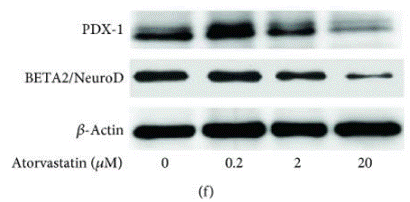
| Western blot | PDX-1 / BETA2 / NeuroD |
|
30863781 |
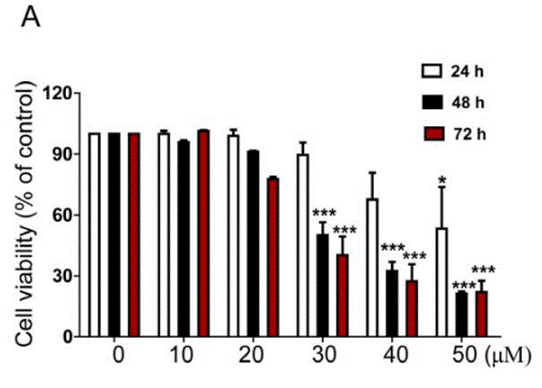
| Growth inhibition assay | Cell viability |
|
24815071 |
Clinical Trial Information
(data from https://clinicaltrials.gov, updated on 2026-05-06)
| NCT Number | Recruitment | Conditions | Sponsor/Collaborators | Start Date | Phases |
|---|---|---|---|---|---|
| NCT03819101 | RECRUITING | Prostate Cancer |
Gustave Roussy, Cancer Campus, Grand Paris |
2019-06-06 | PHASE3 |
| NCT05404139 | RECRUITING | Metastatic Prostate Cancer |
University Health Network, Toronto |
2023-05-24 | PHASE2 |
| NCT07586540 | NOT_YET_RECRUITING | Carotid Stenosis |
Middle East North Africa Stroke and Interventional Neurotherapies Organization |
2027-07 | PHASE3 |
| NCT07799779 | NOT_YET_RECRUITING | Acute Coronary Syndromes (ACS) |
Seoul National University Bundang Hospital |
2026-09 | PHASE4 |
| NCT07307989 | RECRUITING | Ischemic Stroke; Hypercholesteremia |
Chang Gung Memorial Hospital |
2025-08-01 | PHASE2 |
| NCT07685938 | NOT_YET_RECRUITING | Chest Wall Tumor; Breast Cancer; Lung Cancer; Esophageal Cancer; Mediastinal Cancers; Spine Metastases; Spinal Tumor; Thoracic Cancer; Thoracic Neoplasms |
UNC Lineberger Comprehensive Cancer Center |
2026-08-12 | PHASE2 |
Read more about Clinical Trials
Tech Support
Tel: +1-832-582-8158 Ext:3
If you have any other enquiries, please leave a message.
Signaling Pathway Map

Products are for research use only. Not for human use. We do not sell to patients.
©Copyright 2013 Selleck Chemicals. All Rights Reserved.