
-
 Argentina
-
 Australia
-
 Austria
-
 Belgium
-
 Brazil
-
 Canada
-
 China
China
-
 Czech Republic
-
 Denmark
-
 Finland
-
 France
-
 Germany
-
 Greece
-
 Hong Kong
-
 Hungary
-
 Iceland
-
 India
India
-
 Ireland
-
 Israel
-
 Italy
Italy
-
 Japan
Japan
-
 Korea
Korea
-
 Luxembourg
-
 Malaysia
-
 Netherlands
-
 New Zealand
-
 Norway
-
 Poland
-
 Qatar
Qatar
-
 Romania
-
 Saudi Arabia
-
 Singapore
-
 Spain
Spain
-
 Sweden
-
 Switzerland
-
 Taiwan
-
 Turkey
-
 United Kingdom
-
 United States
research use only
Dorzolamide HCl Carbonic Anhydrase inhibitor
Cat.No.S1375
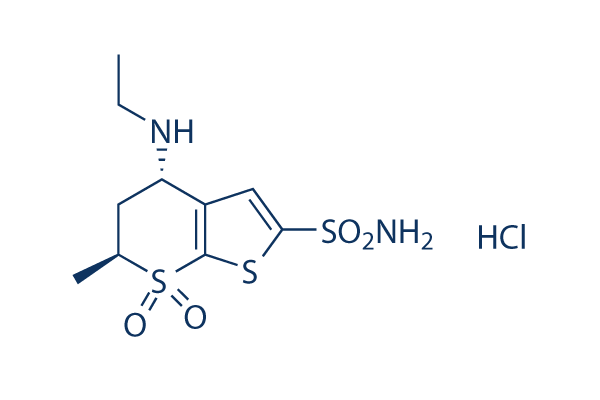
Chemical Structure
Molecular Weight: 360.9
Quality Control
| Related Targets | Dehydrogenase HSP Transferase P450 (e.g. CYP17) PDE phosphatase PPAR Vitamin Carbohydrate Metabolism Mitochondrial Metabolism |
|---|---|
| Other Carbonic Anhydrase Inhibitors | U-104 (SLC-0111) Acipimox Indisulam (E7070) Benzenesulfonamide Tioxolone 2-Aminobenzenesulfonamide |
Solubility
|
In vitro |
Water : 37 mg/mL
DMSO
: Insoluble
Ethanol : Insoluble |
Molarity Calculator
|
In vivo |
|||||
In vivo Formulation Calculator (Clear solution)
Step 1: Enter information below (Recommended: An additional animal making an allowance for loss during the experiment)
Step 2: Enter the in vivo formulation (This is only the calculator, not formulation. Please contact us first if there is no in vivo formulation at the solubility Section.)
Calculation results:
Working concentration: mg/ml;
Method for preparing DMSO master liquid: mg drug pre-dissolved in μL DMSO ( Master liquid concentration mg/mL, Please contact us first if the concentration exceeds the DMSO solubility of the batch of drug. )
Method for preparing in vivo formulation: Take μL DMSO master liquid, next addμL PEG300, mix and clarify, next addμL Tween 80, mix and clarify, next add μL ddH2O, mix and clarify.
Method for preparing in vivo formulation: Take μL DMSO master liquid, next add μL Corn oil, mix and clarify.
Note: 1. Please make sure the liquid is clear before adding the next solvent.
2. Be sure to add the solvent(s) in order. You must ensure that the solution obtained, in the previous addition, is a clear solution before proceeding to add the next solvent. Physical methods such
as vortex, ultrasound or hot water bath can be used to aid dissolving.
Chemical Information, Storage & Stability
| Molecular Weight | 360.9 | Formula | C10H16N2O4S3.HCl |
Storage (From the date of receipt) | |
|---|---|---|---|---|---|
| CAS No. | 130693-82-2 | Download SDF | Storage of Stock Solutions |
|
|
| Synonyms | MK-507 (L-671152) HCl | Smiles | CCNC1CC(S(=O)(=O)C2=C1C=C(S2)S(=O)(=O)N)C.Cl | ||
Mechanism of Action
| Targets/IC50/Ki |
Carbonic anhydrase II
1.9 nM(Ki)
Carbonic anhydrase IV
31 nM(Ki)
Carbonic anhydrase I
6000 nM(Ki)
|
|---|---|
| In vitro |
Dorzolamide is a powerful inhibitor of carbonic anhydrase (CA) II that penetrates the sclera and cornea to reach the ciliary process and lowers formation of HCO3 and aqueous humor. Dorzolamide causes a vasodilatation of retinal arteries, pre-contracted by three different mechanisms by direct action and presumably independent of changes in extracellular pH.
|
| In vivo |
Dorzolamide, administered twice and three times daily, significantly decreases intraocular pressure (IOP) in glaucomatous dogs on the first day (twice daily 7.6 mmHg, and three times daily 16.4 mmHg) that is even greater by day 5 (twice daily 10.4 mmHg, and three times daily 13.9 mmHg). Dorzolamide (instilled in the drug eye for day 1 through to day 5) combined with oral methazolamide (administered from day 3 through to day 5) significantly lowers IOP in the eye on day 1, for day 3 and for all of day 5 for both eyes. Dorzolamide (2%) instilled three times daily produces similar IOP declines compared to the combination of oral methazolamide and 2% dorzolamide administered twice daily. Dorzolamide hydrochloride induces a very large IOP reduction and is found to be also well effective at night in rabbit. Dorzolamide maximally lowers the intraocular pressure (IOP) of glaucomatous monkeys by 22%, 30% and 37%, respectively.
|
References |
|
Clinical Trial Information
(data from https://clinicaltrials.gov, updated on 2024-05-22)
| NCT Number | Recruitment | Conditions | Sponsor/Collaborators | Start Date | Phases |
|---|---|---|---|---|---|
| NCT02967614 | Completed | Glaucoma|Eye Diseases|Ocular Hypertension |
Kukje Pharma |
December 2016 | Phase 1 |
Tech Support
Tel: +1-832-582-8158 Ext:3
If you have any other enquiries, please leave a message.
Signaling Pathway Map

Products are for research use only. Not for human use. We do not sell to patients.
©Copyright 2013 Selleck Chemicals. All Rights Reserved.