
-
 Argentina
-
 Australia
-
 Austria
-
 Belgium
-
 Brazil
-
 Canada
-
 China
China
-
 Czech Republic
-
 Denmark
-
 Finland
-
 France
-
 Germany
-
 Greece
-
 Hong Kong
-
 Hungary
-
 Iceland
-
 India
India
-
 Ireland
-
 Israel
-
 Italy
Italy
-
 Japan
Japan
-
 Korea
Korea
-
 Luxembourg
-
 Malaysia
-
 Netherlands
-
 New Zealand
-
 Norway
-
 Poland
-
 Portugal
-
 Qatar
Qatar
-
 Romania
-
 Saudi Arabia
-
 Singapore
-
 Spain
Spain
-
 Sweden
-
 Switzerland
-
 Taiwan
-
 Turkey
-
 United Kingdom
-
 United States
research use only
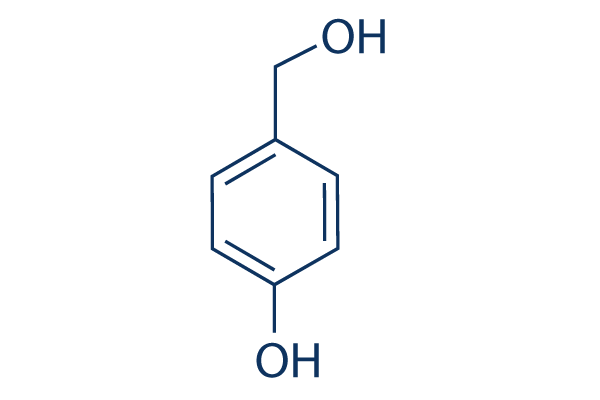
4-Hydroxybenzyl alcohol Apoptosis related chemical
Cat.No.S3857
Quality Control
| Related Targets | Bcl-2 Caspase PD-1/PD-L1 Ferroptosis p53 Synthetic Lethality STAT TNF-alpha Ras KRas |
|---|---|
| Other Apoptosis related Inhibitors | Importazole Pitstop 2 Plumbagin Genipin Cobalt chloride 6-Gingerol Colcemid Sodium propionate Crocin CWI1-2 hydrochloride |
Solubility
|
In vitro |
DMSO
: 24 mg/mL
(193.33 mM)
|
Molarity Calculator
|
In vivo |
|||||
In vivo Formulation Calculator (Clear solution)
Step 1: Enter information below (Recommended: An additional animal making an allowance for loss during the experiment)
Step 2: Enter the in vivo formulation (This is only the calculator, not formulation. Please contact us first if there is no in vivo formulation at the solubility Section.)
Calculation results:
Working concentration: mg/ml;
Method for preparing DMSO master liquid: mg drug pre-dissolved in μL DMSO ( Master liquid concentration mg/mL, Please contact us first if the concentration exceeds the DMSO solubility of the batch of drug. )
Method for preparing in vivo formulation: Take μL DMSO master liquid, next addμL PEG300, mix and clarify, next addμL Tween 80, mix and clarify, next add μL ddH2O, mix and clarify.
Method for preparing in vivo formulation: Take μL DMSO master liquid, next add μL Corn oil, mix and clarify.
Note: 1. Please make sure the liquid is clear before adding the next solvent.
2. Be sure to add the solvent(s) in order. You must ensure that the solution obtained, in the previous addition, is a clear solution before proceeding to add the next solvent. Physical methods such
as vortex, ultrasound or hot water bath can be used to aid dissolving.
Chemical Information, Storage & Stability
| Molecular Weight | 124.14 | Formula | C7H8O2 |
Storage (From the date of receipt) | |
|---|---|---|---|---|---|
| CAS No. | 623-05-2 | -- | Storage of Stock Solutions |
|
|
| Synonyms | P-Methylolphenol, 4-Methylolphenol | SMILES | C1=CC(=CC=C1CO)O | ||
Read more about storage stability stock solution CAS number SMILES
Mechanism of Action
| In vitro |
4-hydroxybenzyl alcohol has been shown to suppress inflammation, which is most probably due to its capability of reducing cyclooxygenase activity. HBA acts as a typical pleiotropic agent, which targets multiple mechanisms of angiogenesis, including production of angiogenic growth factors and MMPs, endothelial cell proliferation and migration as well as vascular sprouting and network formation.
|
|---|---|
| In vivo |
4-hydroxybenzyl alcohol inhibits the vascularization of newly developing tumors and that this is associated with a reduced growth rate of the malignant tissue. It ameliorates cerebral ischaemic injury due to the inhibition of apoptotic pathways and the up-regulation of protein disulphide isomerase without inducing any toxic effects at doses up to 200 mg/kg. It exerts an anxiolytic-like action via the activation of the 5-hydroxytryptaminergic nervous system.
|
References |
Tech Support
Tel: +1-832-582-8158 Ext:3
If you have any other enquiries, please leave a message.

Products are for research use only. Not for human use. We do not sell to patients.
©Copyright 2013 Selleck Chemicals. All Rights Reserved.