
-
 Argentina
-
 Australia
-
 Austria
-
 Belgium
-
 Brazil
-
 Canada
-
 China
China
-
 Czech Republic
-
 Denmark
-
 Finland
-
 France
-
 Germany
-
 Greece
-
 Hong Kong
-
 Hungary
-
 Iceland
-
 India
India
-
 Ireland
-
 Israel
-
 Italy
Italy
-
 Japan
Japan
-
 Korea
Korea
-
 Luxembourg
-
 Malaysia
-
 Netherlands
-
 New Zealand
-
 Norway
-
 Poland
-
 Portugal
-
 Qatar
Qatar
-
 Romania
-
 Saudi Arabia
-
 Singapore
-
 Spain
Spain
-
 Sweden
-
 Switzerland
-
 Taiwan
-
 Turkey
-
 United Kingdom
-
 United States
E3 Ligase Inhibitors
| Cat.No. | Product Name | Information | Product Use Citations | Product Validations |
|---|---|---|---|---|
| S8975 | Mezigdomide (CC-92480) | Mezigdomide (CC-92480) is a novel protein degrader and a cereblon E3 ligase modulator (CELMoD) that has anti-myeloma activity. |
|
|
| S2881 | Homo-PROTAC cereblon degrader 1 | Homo-PROTAC cereblon degrader 1 (OUN20985) is a potent and efficient cereblon (CRBN) degrader with minimal effects on IKZF1 and IKZF3. |
|
|
| S4925 | SMER3 | SMER3, the small-molecule enhancer of rapamycin (SMER), is an inhibitor of the Skp1-Cullin-F-box (SCF)Met30 ubiquitin ligase with IC50 of 51 nM. |
|
|
| S8300 | CC-885 |
CC-885 is a novel cereblon (CRBN) modulator. This compound selectively promotes CRBN- and p97-dependent PLK1 ubiquitination and degradation. |
|
|
| S9889 | dCBP-1 | dCBP-1 is a potent and selective heterobifunctional degrader of p300/CBP by hijacking the E3 ubiquitin ligase CRBN, also is exceptionally potent at killing multiple myeloma cells and can abolish the enhancer that drives MYC oncogene expression. |
|
|
| E6808New | PRLX-93936 hydrochloride | PRLX-93936 hydrochloride is a potent molecular glue degrader that selectively binds to E3 ubiquitin ligase TRIM21 and forms a functional ternary complex between TRIM21 and NUP98 (Nucleoporin 98). This complex formation drives the subsequent polyubiquitination and proteasomal degradation of NUP98 alongside other essential components of the nuclear pore complex (NPC). | ||
| E6809New | JWZ-8-103 | JWZ-8-103 is an orally bioavailable selective degrader of the nuclear pore complex that acts as a TRIM21-targeting molecular glue. It induces a robust TRIM21 PRYSPRY–NUP98 APD interaction with an apparent EC50 ≈ 20 µM and increases TRIM21 thermal stability. It also exhibits potent antitumor efficacy in pancreatic cancer xenografts and patient-derived organoids. | ||
| E1427 | MRT-2359 | MRT-2359 is a potent degrader of GSPT1. It exhibits anti-tumor activity in non-small cell lung cancer (NSCLC) and small cell lung cancer (SCLC) cells. | ||
| E7619 | VH032 | VH032 is a potent and selective VHL ligand used in PROTACs that binds to the VHL E3 ligase with a Kd of 185 nM and disrupts the VHL:HIF-α interaction. By stabilizing HIF-α, it activates the hypoxic response and serves as a tool for developing therapies targeting hypoxia signaling. | ||
| E1957 | NX-1607 (Cbl-b-IN-3) | NX-1607 (Cbl-b-IN-3) is an oral inhibitor of Casitas B-lineage lymphoma proto-oncogene B (CBL-B), which is an E3 ubiquitin ligase and a key regulator of T, NK, and dendritic cell activation and suppresses their anti-tumor functions. NX-1607 enhances antigen recall, reduces T cell exhaustion, and increases cytokine production in response to T cell receptor stimulation, thereby counteracting suppressive signals from the tumor microenvironment. | ||
| E1216 | Heclin | Heclin is an inhibitor of HECT-type E3 ubiquitin ligase with an IC50 of 6.8, 6.3, and 6.9 μM for Smurf2, Nedd4, and WWP1 HECT domains, respectively. | ||
| S0322 | BC-1215 | BC-1215 is an inhibitor of F-box protein 3 (Fbxo3, a ubiquitin E3 ligase component) with IC50 of 0.9 μg/mL and LC50 of 87 μg/ml for IL-1β release. This compound inhibits the Fbxo3-TRAF activation pathway by destabilizing TRAF1-6. | ||
| E5844 | NSC2805 | NSC2805 is a potent inhibitor of WWP2 ubiquitin ligase with an IC50 of 0.38 μM. It is used in cancer research for studying WWP2-associated pathways. | ||
| E1847 | GBD-9 | GBD-9 is a double-mechanism efficient degrader of BTK and GSPT1 by recruiting the E3 ligase cereblon (CRBN). This compound acts both as a PROTAC molecule to induce the degradation of BTK and as a molecular glue to degrade GSPT1. It exhibits anti-proliferative effects, inhibiting cancer cell survival. | ||
| S0097 | (S,R,S)-AHPC (MDK7526) | (S,R,S)-AHPC (MDK7526, VH032-NH2, VHL ligand 1) is the VH032-based VHL ligand used in the recruitment of the von Hippel-Lindau (VHL) protein. (S,R,S)-AHPC is potential useful for the targeted degradation of the androgen receptor. (S,R,S)-AHPC can be connected to the ligand for protein such as BCR-ABL1 by a linker to form PROTACs such as GMB-475. GMB-475 induces the degradation of BCR-ABL1 with IC50 of 1.11 μM in Ba/F3 cells. | ||
| S0345 | Smurf1-IN-A01 | Smurf1-IN-A01 can inhibit Smurf1-mediated Smad1/5 degradation and accelerate BMP-2 signal responsiveness with a Kd of 3.664 nM. | ||
| S3502 | (S,R,S)-AHPC-PEG4-NH2 hydrochloride | (S,R,S)-AHPC-PEG4-NH2 hydrochloride (VH032-PEG4-NH2 hydrochloride, VHL Ligand-Linker Conjugates 4 hydrochloride, E3 ligase Ligand-Linker Conjugates 7) is a PROTAC E3 ligase ligand-linker conjugate that incorporates the (S,R,S)-AHPC based VHL ligand and 4-unit PEG linker. | ||
| S1015 | Thalidomide-OH | Thalidomide-OH (Cereblon ligand 2, E3 ligase Ligand 2) is a presumed hydroxylated thalidomide metabolite, with weak antiangiogenic activity (the average inhibition rate of vessel density was 14% in 100 μg), also can be applicable to the recruitment of CRBN protein. | ||
| E1300 | SJ6986 | SJ6986 is a CRBN modulator and specifically degrades GSPT1/2, with a DC50 of 2.1 nM (Dmax 99%) for GSPT1. | ||
| E0071 | MuRF1-IN-1 | MuRF1-IN-1 is a muscle ring finger protein-1 (MuRF1) inhibitor that attenuates skeletal muscle atrophy and dysfunction in cardiac cachexia. | ||
| E1937 | PT-179 | PT-179, an orthogonal Thalidomide derivative targets cereblon without causing off-target degradation effects. This compound specifically binds CRBN, forms a ternary complex with a target protein fused to a zinc finger (ZF) degron, and mediates the degradation of the tagged protein. | ||
| E6651New | HGC652 | HGC652 is a TRIM21-dependent molecular glue degrader that binds the E3 ubiquitin ligase TRIM21 (Kd ≈ 0.06 µM) to induce a TRIM21–NUP98 ternary complex, driving the ubiquitination and selective degradation of nuclear pore complex proteins like NUP155, leading to nuclear pore collapse and cancer cell death. | ||
| E5839 | OICR-8268 | OICR-8268 is a potent, reversible and in-cell active DCAF1 ligand. It significantly binds to DCAF1 WDR domain with an Kd value of 38 nM. It serves as a promising starting point for developing chemical handles for DCAF1-based PROTACs targeting selective protein degradation as well as cancer therapeutics. | ||
| E5877 | LYG-409 | LYG-409 is a potent, selective, and orally bioavailable degrader of GSPT1, with a DC50 of 7.87 nM. It exhibits strong antiproliferative activity in KG-1 cells with an IC50 of 9.50 nM and demonstrates significant antitumor efficacy in vivo in models of acute myeloid leukemia and prostate cancer. | ||
| E0351 | NSC232003 | NSC232003 is a highly potent and cell-permeable UHRF1 inhibitor that binds to the 5mC binding pocket of the SRA domain of UHRF1. This compound modulates DNA methylation in a cellular context. | ||
| E6741New | SB-405483 | SB‑405483 is an allosteric cereblon (CRBN) ligand that cooperatively enhances the binding of orthosteric CRBN ligands (IMiDs) and potentiates degradation of CRBN neosubstrates, including CK1α, Wee1, and IKZF1/3. SB‑405483 stabilizes CRBN and reduces its autoubiquitination. | ||
| E1678 | SPOP-i-6lc | SPOP-i-6lc is a selective speckle-type POZ protein (SPOP) E3 ubiquitin ligase inhibitor with IC50 of 2.1 μM and 3.5 μM, in A498 and OS-RC-2 cell lines, respectively. In vitro, It suppresses viability and proliferation of A498 and OS-RC-2 kidney cancer cell lines. | ||
| E1087 | 5-amino-2,4-dimethylpyridine (5A-DMP) |
5-amino-2,4-dimethylpyridine (5A-DMP) is a novel tandem Tudor domain (TTD)-binding compound that inhibits the full-length UHRF1:LIG1 interaction in Xenopus egg extracts. |
||
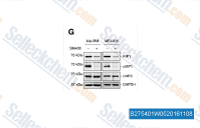
| S2754 | Xevinapant (AT406) | Xevinapant (AT406, ARRY-334543, Debio1143, SM-406) is a potent Smac mimetic and an antagonist of IAP (inhibitor of apoptosis protein via E3 ubiquitin ligase), binding to XIAP-BIR3, cIAP1-BIR3 and cIAP2-BIR3 with Ki of 66.4 nM, 1.9 nM, and 5.1 nM, 50- to 100-fold higher affinities than the Smac AVPI peptide. Phase 1. |
|
|
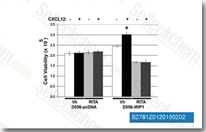
| S2781 | RITA | RITA induces both DNA-protein and DNA-DNA cross-links with no detectable DNA single-strand breaks, and this compound also inhibits MDM2-p53 interaction by targeting p53. |
|
|
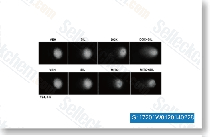
| S1172 | Serdemetan (JNJ-26854165) | Serdemetan (JNJ-26854165) acts as a HDM2 ubiquitin ligase antagonist and also induces early apoptosis in p53 wild-type cells, inhibits cellular proliferation followed by delayed apoptosis in the absence of functional p53. Phase 1. |
|
|
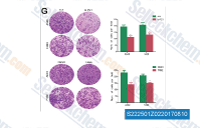
| S2225 | TAME | Tosyl-L-Arginine Methyl Ester (TAME) is an APC inhibitor. |
|
|
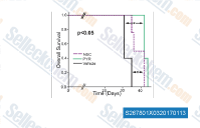
| S2678 | NSC 207895 | NSC 207895 (XI-006) suppresses MDMX with IC50 of 2.5 μM, leading to enhanced p53 stabilization/activation and DNA damage, and also regulates MDM2, an E3 ligase. |
|
|
| S8979 | THAL-SNS-032 | THAL-SNS-032 is a selective Cyclin-dependent kinase 9 (CDK9) degrader PROTAC consisting of a CDK-binding SNS-032 ligand linked to that binds the E3 ubiquitin ligase Cereblon (CRBN). |
|
|
| S8888 | GMB-475 | GMB-475 is a proteolysis-targeting chimera (PROTAC) that allosterically targets BCR-ABL1 protein and recruit the E3 ligase Von Hippel-Lindau (VHL), resulting in ubiquitination and subsequent degradation of the oncogenic fusion protein. | ||
| S6794 | Thalidomide-O-COOH (Cereblon ligand 3) | Thalidomide-O-COOH (Cereblon ligand 3, E3 ligase Ligand 3), a Thalidomide-based Cereblon (CRBN) ligand used in the recruitment of CRBN protein, can be connected to the ligand for protein by a linker to form PROTACs (Proteolysis Targeting Chimera). | ||

Products are for research use only. Not for human use. We do not sell to patients.
©Copyright 2013 Selleck Chemicals. All Rights Reserved.