
-
 Australia
-
 Austria
-
 Belgium
-
 Brazil
-
 Canada
-
 China
China
-
 Czech Republic
-
 Denmark
-
 Finland
-
 France
-
 Germany
-
 Greece
-
 Hong Kong
-
 Hungary
-
 Iceland
-
 India
India
-
 Ireland
-
 Israel
-
 Italy
Italy
-
 Japan
Japan
-
 Korea
Korea
-
 Luxembourg
-
 Malaysia
-
 Netherlands
-
 New Zealand
-
 Norway
-
 Poland
-
 Qatar
Qatar
-
 Romania
-
 Saudi Arabia
-
 Singapore
-
 Spain
Spain
-
 Sweden
-
 Switzerland
-
 Taiwan
-
 Turkey
-
 United Kingdom
-
 United States
research use only
MPEP GluR antagonist
Cat.No.S2809
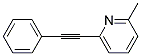
Chemical Structure
Molecular Weight: 193.24
Quality Control
Solubility
|
In vitro |
DMSO
: 39 mg/mL
(201.82 mM)
Ethanol : 39 mg/mL Water : Insoluble |
Molarity Calculator
|
In vivo |
|||||
In vivo Formulation Calculator (Clear solution)
Step 1: Enter information below (Recommended: An additional animal making an allowance for loss during the experiment)
Step 2: Enter the in vivo formulation (This is only the calculator, not formulation. Please contact us first if there is no in vivo formulation at the solubility Section.)
Calculation results:
Working concentration: mg/ml;
Method for preparing DMSO master liquid: mg drug pre-dissolved in μL DMSO ( Master liquid concentration mg/mL, Please contact us first if the concentration exceeds the DMSO solubility of the batch of drug. )
Method for preparing in vivo formulation: Take μL DMSO master liquid, next addμL PEG300, mix and clarify, next addμL Tween 80, mix and clarify, next add μL ddH2O, mix and clarify.
Method for preparing in vivo formulation: Take μL DMSO master liquid, next add μL Corn oil, mix and clarify.
Note: 1. Please make sure the liquid is clear before adding the next solvent.
2. Be sure to add the solvent(s) in order. You must ensure that the solution obtained, in the previous addition, is a clear solution before proceeding to add the next solvent. Physical methods such
as vortex, ultrasound or hot water bath can be used to aid dissolving.
Chemical Information, Storage & Stability
| Molecular Weight | 193.24 | Formula | C14H11N |
Storage (From the date of receipt) | |
|---|---|---|---|---|---|
| CAS No. | 96206-92-7 | Download SDF | Storage of Stock Solutions |
|
|
| Synonyms | N/A | Smiles | CC1=NC(=CC=C1)C#CC2=CC=CC=C2 | ||
Mechanism of Action
| Features |
Inactive against other group I/II/III metabotropic glutamate receptors.
|
|---|---|
| Targets/IC50/Ki |
mGluR5
36 nM
|
| In vitro |
MPEP has no appreciable agonist or antagonist activity at the closely related recombinant human mGlu1b receptor expressed in CHO-K1 cells or a purinoreceptor endogenously expressed in L(tk-) cells up to concentrations of 100 μM. Furthermore, this compound shows no appreciable agonist or antagonist activity in cAMP accumulation or [35S]-GTPγS binding assays at the recombinant human group II and III metabotropic receptors (human mGlu2, -3, -4a, -6, -7b, -8a) as well as the human NMDA (NMDAR1A/2A, -1A/2B), rat AMPA (GluR3) and human kainate (GluR6) receptor subtypes. In slices of rat neonatal hippocampus, striatum, and cortex but not cerebellum, it inhibits DHPG-stimulated PI hydrolysis with IC50 of 8.0 nM, 20.5 nM, and 17.9 nM, respectively. This chemical positively modulates the hmGluR4 in a recombinant expression system, and the effect is fully dependent on the activation of the orthosteric agonist L-AP4.
|
| In vivo |
When microiontophoretically applied into the brain of rats, MPEP reduces DHPG-induced excitations but not the excitations induced by AMPA. Following intravenous administration, this compound produces a dose-dependent inhibition of DHPG-induced but not AMPA-induced excitations with a rapid onset of action. Oral administration of this chemical also exhibits excellent anti-hyperalgesic activity in the Complete Freund's Adjuvant and turpentine models of inflammatory pain. It (1-30 mg/kg) induces anxiolytic-like effects in the conflict drinking test and the elevated plus-maze test in rats as well as in the four-plate test in mice. This compound (1-20 mg/kg) shortens the immobility time in a tail suspension test in mice, but it is inactive in the behavioural despair test in rats. It has no effect on locomotor activity or motor coordination. This chemical significantly reduces fmr1 but not wild-type center square entries and duration. In open field tests, it reduces fmr1tm1Cgr center field behavior to one indistinguishable from wild-type. It produces a significant reduction of total locomotor activity in three of four groups tested, at both 10 mg/kg and 30 mg/kg.
|
References |
|
Tech Support
Tel: +1-832-582-8158 Ext:3
If you have any other enquiries, please leave a message.
Signaling Pathway Map

Products are for research use only. Not for human use. We do not sell to patients.
©Copyright 2013 Selleck Chemicals. All Rights Reserved.