
-
 Australia
-
 Austria
-
 Belgium
-
 Brazil
-
 Canada
-
 China
China
-
 Czech Republic
-
 Denmark
-
 Finland
-
 France
-
 Germany
-
 Greece
-
 Hong Kong
-
 Hungary
-
 Iceland
-
 India
India
-
 Ireland
-
 Israel
-
 Italy
Italy
-
 Japan
Japan
-
 Korea
Korea
-
 Luxembourg
-
 Malaysia
-
 Netherlands
-
 New Zealand
-
 Norway
-
 Poland
-
 Qatar
Qatar
-
 Romania
-
 Saudi Arabia
-
 Singapore
-
 Spain
Spain
-
 Sweden
-
 Switzerland
-
 Taiwan
-
 Turkey
-
 United Kingdom
-
 United States
research use only
Cisapride hydrate 5-HT Receptor agonist
Cat.No.S4751
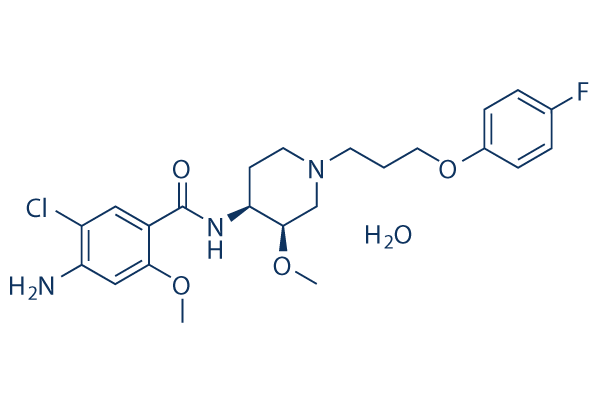
Chemical Structure
Molecular Weight: 483.96
Quality Control
| Related Targets | Adrenergic Receptor AChR COX Calcium Channel Histamine Receptor Dopamine Receptor GABA Receptor TRP Channel Cholinesterase (ChE) GluR |
|---|---|
| Other 5-HT Receptor Inhibitors | WAY-100635 Maleate Puerarin Serotonin (5-HT) HCl SB269970 HCl Ketanserin BRL-15572 Dihydrochloride Nuciferine RS-127445 Flopropione Azacyclonol |
Cell Culture, Treatment & Working Concentration
| Cell Lines | Assay Type | Concentration | Incubation Time | Formulation | Activity Description | PMID |
|---|---|---|---|---|---|---|
| MCF7 cells | Function assay | Inhibition of human ERG in MCF7 cells, IC50=0.00646 μM | ||||
| HEK293 cells | Function assay | Inhibition of human ERG td[wt:F656A] mutant expressed in HEK293 cells by whole cell patch clamp method, IC50=0.01 μM | ||||
| CHO cells | Function assay | Inhibition of human ERG expressed in CHO cells by whole cell patch clamp technique, IC50=0.03981 μM | ||||
| Click to View More Cell Line Experimental Data | ||||||
Solubility
|
In vitro |
DMSO
: 96 mg/mL
(198.36 mM)
Water : Insoluble Ethanol : Insoluble |
Molarity Calculator
|
In vivo |
|||||
In vivo Formulation Calculator (Clear solution)
Step 1: Enter information below (Recommended: An additional animal making an allowance for loss during the experiment)
Step 2: Enter the in vivo formulation (This is only the calculator, not formulation. Please contact us first if there is no in vivo formulation at the solubility Section.)
Calculation results:
Working concentration: mg/ml;
Method for preparing DMSO master liquid: mg drug pre-dissolved in μL DMSO ( Master liquid concentration mg/mL, Please contact us first if the concentration exceeds the DMSO solubility of the batch of drug. )
Method for preparing in vivo formulation: Take μL DMSO master liquid, next addμL PEG300, mix and clarify, next addμL Tween 80, mix and clarify, next add μL ddH2O, mix and clarify.
Method for preparing in vivo formulation: Take μL DMSO master liquid, next add μL Corn oil, mix and clarify.
Note: 1. Please make sure the liquid is clear before adding the next solvent.
2. Be sure to add the solvent(s) in order. You must ensure that the solution obtained, in the previous addition, is a clear solution before proceeding to add the next solvent. Physical methods such
as vortex, ultrasound or hot water bath can be used to aid dissolving.
Chemical Information, Storage & Stability
| Molecular Weight | 483.96 | Formula | C23H29ClFN3O4.H2O |
Storage (From the date of receipt) | |
|---|---|---|---|---|---|
| CAS No. | 260779-88-2 | Download SDF | Storage of Stock Solutions |
|
|
| Synonyms | Propulsid, Alimix, Propulsin, Enteropride, Kinestase | Smiles | COC1CN(CCC1NC(=O)C2=CC(=C(C=C2OC)N)Cl)CCCOC3=CC=C(C=C3)F.O | ||
Mechanism of Action
| Targets/IC50/Ki |
5-HT4 receptor
(Cell-free assay) 0.483 μM
hERG
(Cell-free assay) <1 μM
|
|---|---|
| In vitro |
Cisapride inhibits vascular Kv current independently of serotonin 5-HT4-receptor activation. As HERG channel blocker, cisapride, can inhibit the growth of gastric cancer cells by altering distribution of cell cycle and inducing apoptosis so as to be of potential value in the treatment of gastric cancer. Cisapride could inhibit the growth and clonogenicity of human gastric cancer lines by specific blockage of HERG channel in a time- and dose-dependent manner while has little effects on GES cells.
|
| In vivo |
Cisapride is widely prescribed for the treatment of gastrointestinal motility dysfunctions, such as gastroesophageal reflux disorder (GERD), chronic intestinal pseudo-obstruction, and slow-transit constipation gastroparesis. Although cisapride is a beneficial prokinetic agent, several common side effects, such as abdominal pain, nausea, diarrhea, and increased frequency of urination, have been reported. In rat, the PK profile indicate the T1/2 for cisapride is 1.48 h.
|
References |
|
Tech Support
Tel: +1-832-582-8158 Ext:3
If you have any other enquiries, please leave a message.
Signaling Pathway Map

Products are for research use only. Not for human use. We do not sell to patients.
©Copyright 2013 Selleck Chemicals. All Rights Reserved.