PARP, one of the most abundant proteins in the nucleus, has the principal role in regulating the cellular processes that are most relevant in terms of pathophysiology and experimental therapy. PARP1 which is a 116-kDa protein consists of three main domains is the most important member of the PARP family and can be a DNA-damage sensor and signalling molecule because the ZINC FINGERS of PARP recognize singleand double-stranded DNA breaks. PARP can be cleaved into inactive fragments by caspases or matrix metalloproteinases (MMPs). The phosphorylation of PARP by protein kinase-C (PKC), through the inhibition of its DNA binding, also suppresses PARP activity. PARP, through physical interactions and/or catalytic actions, promotes activator protein-1 (AP1) and nuclear factor-κB (NF-κB)-dependent signal-transduction processes and can suppress the activation of the cytoprotective AKT pathway; therefore, the inhibition of PARP can suppress AP1 and NF-κB activation and induce AKT phosphorylation.

-
 Australia
-
 Austria
-
 Belgium
-
 Brazil
-
 Canada
-
 China
China
-
 Czech Republic
-
 Denmark
-
 Finland
-
 France
-
 Germany
-
 Greece
-
 Hong Kong
-
 Hungary
-
 Iceland
-
 India
India
-
 Ireland
-
 Israel
-
 Italy
Italy
-
 Japan
Japan
-
 Korea
Korea
-
 Luxembourg
-
 Malaysia
-
 Netherlands
-
 New Zealand
-
 Norway
-
 Poland
-
 Qatar
Qatar
-
 Romania
-
 Saudi Arabia
-
 Singapore
-
 Spain
Spain
-
 Sweden
-
 Switzerland
-
 Taiwan
-
 Turkey
-
 United Kingdom
-
 United States
PARP inhibitors
Other DNA Damage/DNA Repair Related Inhibitors
Isoform-selective Products
| Cat.No. | Product Name | Information | Product Use Citations | Product Validations |
|---|---|---|---|---|
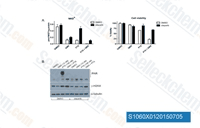
| S1060 | AZD2281 (Olaparib) | Olaparib (AZD2281, KU0059436) is a selective inhibitor of PARP1/2 with IC50 of 5 nM/1 nM in cell-free assays, 300-times less effective against tankyrase-1. Olaparib induces significant autophagy that is associated with mitophagy in cells with BRCA mutations. |
|
|
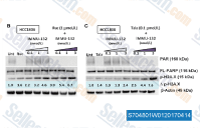
| S7048 | BMN-673 (Talazoparib) | Talazoparib (BMN 673, LT-673) is a novel PARP inhibitor with IC50 of 0.57 nM for PARP1 in a cell-free assay. It is also a potent inhibitor of PARP-2, but does not inhibit PARG and is highly sensitive to PTEN mutation. Phase 3. |
|
|
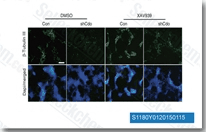
| S1180 | XAV-939 | XAV-939 (NVP-XAV939) selectively inhibits Wnt/β-catenin-mediated transcription through tankyrase1/2 inhibition with IC50 of 11 nM/4 nM in cell-free assays, regulates axin levels and does not affect CRE, NF-κB or TGF-β. |
|
|
| S9875 | AZD5305 (Saruparib) | Saruparib (AZD5305) is a highly selective and potent inhibitor of PARP1 with an IC50 of 3 nM in wild-type A549 lung cancer cells. AZD5305 shows no or minimal growth inhibitory effects in other cells (IC50s >10μM). |
|
|
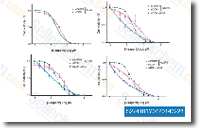
| S2741 | Niraparib (MK-4827) | Niraparib (MK-4827) is a selective inhibitor of PARP1/2 with IC50 of 3.8 nM/2.1 nM, with great activity in cancer cells with mutant BRCA-1 and BRCA-2. It is >330-fold selective against PARP3, V-PARP and Tank1. This compound can form PARP–DNA complexes resulting in DNA damage, apoptosis, and cell death. Phase 3. |
|
|
| S4948 | Rucaparib (AG-014699) | Rucaparib is an inhibitor of PARP with Ki of 1.4 nM for PARP1 in a cell-free assay, also showing binding affinity to eight other PARP domains. |
|
|
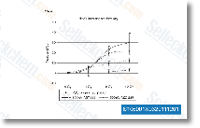
| S1004 | Veliparib (ABT-888) | Veliparib (ABT-888, NSC 737664) is a potent inhibitor of PARP1 and PARP2 with Ki of 5.2 nM and 2.9 nM in cell-free assays, respectively. This compound is inactive to SIRT2 and increases autophagy and apoptosis. Phase 3. |
|
|
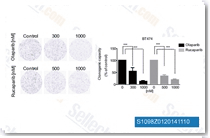
| S1098 | Rucaparib phosphate | Rucaparib phosphate is an inhibitor of PARP with Ki of 1.4 nM for PARP1 in a cell-free assay, also showing binding affinity to eight other PARP domains. Phase 3. |
|
|
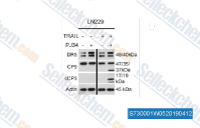
| S7300 | PJ34 HCl | PJ34 HCl is the hydrochloride salt of PJ34, which is a PARP inhibitor with EC50 of 20 nM and is equally potent to PARP1/2. |
|
|
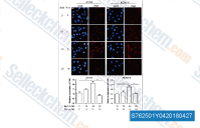
| S7625 | Niraparib tosylate | Niraparib tosylate is a selective inhibitor of PARP1/PARP2 with IC50 of 3.8 nM/2.1 nM. Niraparib increases formation of PARP-DNA complexes resulting in DNA damage, apoptosis, and cell death. |
|
|
Signaling Pathway Map

Products are for research use only. Not for human use. We do not sell to patients.
©Copyright 2013 Selleck Chemicals. All Rights Reserved.