
-
 Argentina
-
 Australia
-
 Austria
-
 Belgium
-
 Brazil
-
 Canada
-
 China
China
-
 Czech Republic
-
 Denmark
-
 Finland
-
 France
-
 Germany
-
 Greece
-
 Hong Kong
-
 Hungary
-
 Iceland
-
 India
India
-
 Ireland
-
 Israel
-
 Italy
Italy
-
 Japan
Japan
-
 Korea
Korea
-
 Luxembourg
-
 Malaysia
-
 Netherlands
-
 New Zealand
-
 Norway
-
 Poland
-
 Portugal
-
 Qatar
Qatar
-
 Romania
-
 Saudi Arabia
-
 Singapore
-
 Spain
Spain
-
 Sweden
-
 Switzerland
-
 Taiwan
-
 Turkey
-
 United Kingdom
-
 United States
research use only
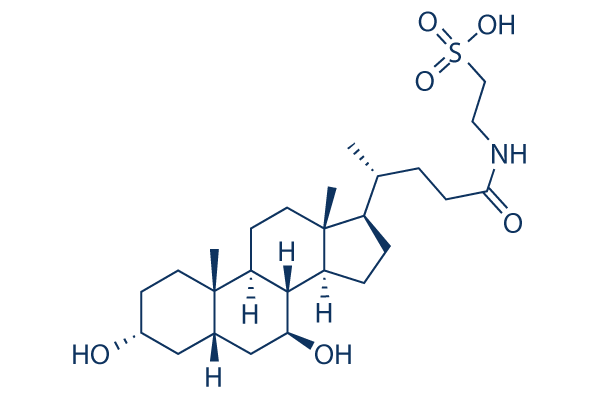
Tauroursodeoxycholic Acid (TUDCA) ER Stress Inhibitor
Cat.No.S3654
Quality Control
| Related Targets | HSP JNK Antioxidant ROS eIF IRE1 PERK PDI PKR ASK |
|---|---|
| Featured Inhibitors | Y-27632 Dihydrochloride SB431542 CHIR-99021 (Laduviglusib) RMC-7977 RMC-6236 (Daraxonrasib) MRTX1133 MG132 Z-VAD-FMK VT3989 IAG933 |
Cell Culture, Treatment & Working Concentration
| Cell Lines | Assay Type | Concentration | Incubation Time | Formulation | Activity Description | PMID |
|---|---|---|---|---|---|---|
| CHO cells | Function assay | Agonist activity at human TGR5 expressed in CHO cells by luciferase assay, EC50=30 μM | 18307294 | |||
| Sf9 | Function assay | TP_TRANSPORTER: uptake in membrane vesicles from Bsep-expressing Sf9 cells, Km=4.1μM | 10648470 | |||
| MDCK | Function assay | TP_TRANSPORTER: uptake in Oatp3-expressing MDCK cells, Km=6.6μM | 11093941 | |||
| HEK293 | Function assay | 90 mins | Inhibition of human ATX expressed in HEK293 Flp-In cells assessed as decrease in choline release from LPC measured every 30 secs for 90 mins by HVA based fluorescence assay, IC50=10.3μM | 28165241 | ||
| Sf9 | Function assay | TP_TRANSPORTER: uptake in membrane vesicles isolated from Bsep-expressing Sf9 cells, Km=11.9μM | 12404240 | |||
| CHO | Function assay | TP_TRANSPORTER: uptake in Ntcp-expressing CHO cells, Km=14μM | 9486191 | |||
| COS | Function assay | TP_TRANSPORTER: inhibition of Taurocholate uptake in ASBT-expressing COS cells, Ki=28μM | 9458785 | |||
| HuH7 | Cytoprotective assay | 6 hrs | Cytoprotective activity against tunicamycin-induced ER stress in human HuH7 cells assessed as inhibition of CHOP mRNA levels after 6 hrs | 27729186 | ||
| HuH7 | Cytoprotective assay | 6 hrs | Cytoprotective activity against DCA-induced ER stress in human HuH7 cells assessed as increase in XBPu mRNA levels after 6 hrs | 27729186 | ||
| HuH7 | Cytoprotective assay | 6 hrs | Cytoprotective activity against tunicamycin-induced ER stress in human HuH7 cells assessed as increase in XBPu mRNA levels after 6 hrs | 27729186 | ||
| HuH7 | Cytoprotective assay | 6 hrs | Cytoprotective activity against DCA-induced ER stress in human HuH7 cells assessed as inhibition of XBPs mRNA levels after 6 hrs | 27729186 | ||
| HuH7 | Cytoprotective assay | 6 hrs | Cytoprotective activity against tunicamycin-induced ER stress in human HuH7 cells assessed as inhibition of XBPs mRNA levels after 6 hrs | 27729186 | ||
| HuH7 | Cytoprotective assay | 6 hrs | Cytoprotective activity against tunicamycin-induced ER stress in human HuH7 cells assessed as reduction in XBPs/XBPu ratio after 6 hrs | 27729186 | ||
| HuH7 | Cytoprotective assay | 1 mM | 24 hrs | Cytoprotective activity against DCA-induced cell death in human HuH7 cells assessed as increase in cell viability at 1 mM preincubated with cells followed by DCA addition measured after 24 hrs by MTT/INCELL assay | 27729186 | |
| HuH7 | Cytoprotective assay | 6 hrs | Cytoprotective activity against tunicamycin-induced ER stress in human HuH7 cells assessed as inhibition of BIP/GRP78 mRNA levels after 6 hrs | 27729186 | ||
| HEK293 | Function assay | Non-competitive inhibition of human ATX expressed in HEK293 Flp-In cells assessed as decrease in LPC hydrolysis by Lineweaver-Burk plot analysis | 28165241 | |||
| Click to View More Cell Line Experimental Data | ||||||
Solubility
|
In vitro |
DMSO
: 100 mg/mL
(200.12 mM)
Water : 100 mg/mL Ethanol : 50 mg/mL |
Molarity Calculator
|
In vivo |
|||||
In vivo Formulation Calculator (Clear solution)
Step 1: Enter information below (Recommended: An additional animal making an allowance for loss during the experiment)
Step 2: Enter the in vivo formulation (This is only the calculator, not formulation. Please contact us first if there is no in vivo formulation at the solubility Section.)
Calculation results:
Working concentration: mg/ml;
Method for preparing DMSO master liquid: mg drug pre-dissolved in μL DMSO ( Master liquid concentration mg/mL, Please contact us first if the concentration exceeds the DMSO solubility of the batch of drug. )
Method for preparing in vivo formulation: Take μL DMSO master liquid, next addμL PEG300, mix and clarify, next addμL Tween 80, mix and clarify, next add μL ddH2O, mix and clarify.
Method for preparing in vivo formulation: Take μL DMSO master liquid, next add μL Corn oil, mix and clarify.
Note: 1. Please make sure the liquid is clear before adding the next solvent.
2. Be sure to add the solvent(s) in order. You must ensure that the solution obtained, in the previous addition, is a clear solution before proceeding to add the next solvent. Physical methods such
as vortex, ultrasound or hot water bath can be used to aid dissolving.
Chemical Information, Storage & Stability
| Molecular Weight | 499.70 | Formula | C26H45NO6S |
Storage (From the date of receipt) | |
|---|---|---|---|---|---|
| CAS No. | 14605-22-2 | Download SDF | Storage of Stock Solutions |
|
|
Read more about storage stability stock solution CAS number
Mechanism of Action
| In vitro |
Tauroursodeoxycholic acid (TUDCA) is an endogenous hydrophilic tertiary bile acid produced in humans at a low level. In ER stress conditions, treatment with this compound reduces the activation of ER stress-associated proteins, including GRP78, PERK, eIF2α, ATF4, IRE1α, JNK, p38, and CHOP, and inhibits the dissociation between GRP78 and PERK, resulting in reduced ER stress-mediated cell death. It also increases PrPC (Cellular prion protein) expression. TUDCA regulates stem cell differentiation into various lineages such as adipogenic and osteogenic lineages. It attenuates ER stress, prevents unfolded protein response dysfunction, and stabilizes mitochondria. Under ER stress, treatment with this compound significantly increases the expression of BCL-2 and significantly decreases the expression of Bax, cleaved caspase-3, and cleaved PARP-1, compared with that of untreated cells.
|
|---|---|
| In vivo |
Tauroursodeoxycholic Acid (TUDCA) is effective for treating cholestatic liver diseases and also has an ameliorating effect on several diseases, including neurodegenerative diseases, osteoarthritis, vascular diseases, and diabetes. In a murine hindlimb ischemia model, TUDCA-treated mesenchymal stem cells (MSCs) transplantation augments the blood perfusion ratio, vessel formation, and transplanted cell survival more than untreated MSC transplantation does. Augmented functional recovery following MSC transplantation is blocked by PrPC downregulation. Several studies in animals have shown that this compound, an endogenous ambiphilic bile acid, can inhibit unfolded protein response dysfunction and ameliorate ER stress. Its administration attenuates HDM-induced ER stress, airway inflammation, mucus metaplasia, airway remodeling, and methacholine-induced AHR.
|
References |
|
Applications
| Methods | Biomarkers | Images | PMID |
|---|---|---|---|
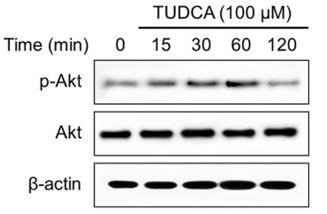
| Western blot | p-Akt / Akt PrPc CHOP / Caspase-12 / Cleaved caspase-12 RIPK1 / RIPK3 / p-RIPK1 / p-RIPK3 |
|
28004805 |
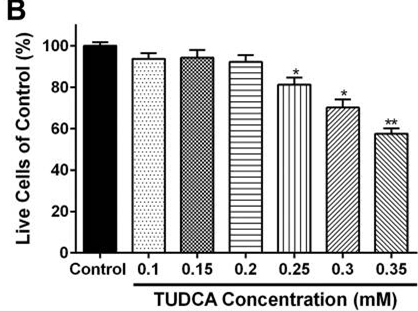
| Growth inhibition assay | Cell viability |
|
30038553 |
Clinical Trial Information
(data from https://clinicaltrials.gov, updated on 2026-04-21)
| NCT Number | Recruitment | Conditions | Sponsor/Collaborators | Start Date | Phases |
|---|---|---|---|---|---|
| NCT07328009 | RECRUITING | Hepato Cellular Carcinoma (HCC) |
Fudan University |
2026-01-19 | PHASE2 |
| NCT06025630 | RECRUITING | Hypertension |
University of North Texas Health Science Center |
2023-08-15 | PHASE1; PHASE2 |
| NCT07457632 | NOT_YET_RECRUITING | Diabetic Macular Edema (DME) |
University of Alabama at Birmingham |
2026-10-01 | PHASE2 |
| NCT07100392 | RECRUITING | Hepatocellular Carcinoma (HCC) |
Fudan University |
2025-08-14 | PHASE2 |
| NCT07064668 | NOT_YET_RECRUITING | Hepatocellular Carcinoma |
Tongji Hospital |
2025-07-30 | PHASE2 |
| NCT07517276 | NOT_YET_RECRUITING | Metabolic Dysfunction-Associated Steatotic Liver Disease Infant Development |
Peking University First Hospital |
2026-04-02 | PHASE2 |
Read more about Clinical Trials
Tech Support
Tel: +1-832-582-8158 Ext:3
If you have any other enquiries, please leave a message.

Products are for research use only. Not for human use. We do not sell to patients.
©Copyright 2013 Selleck Chemicals. All Rights Reserved.