
-
 Argentina
-
 Australia
-
 Austria
-
 Belgium
-
 Brazil
-
 Canada
-
 China
China
-
 Czech Republic
-
 Denmark
-
 Finland
-
 France
-
 Germany
-
 Greece
-
 Hong Kong
-
 Hungary
-
 Iceland
-
 India
India
-
 Ireland
-
 Israel
-
 Italy
Italy
-
 Japan
Japan
-
 Korea
Korea
-
 Luxembourg
-
 Malaysia
-
 Netherlands
-
 New Zealand
-
 Norway
-
 Poland
-
 Portugal
-
 Qatar
Qatar
-
 Romania
-
 Saudi Arabia
-
 Singapore
-
 Spain
Spain
-
 Sweden
-
 Switzerland
-
 Taiwan
-
 Turkey
-
 United Kingdom
-
 United States
research use only
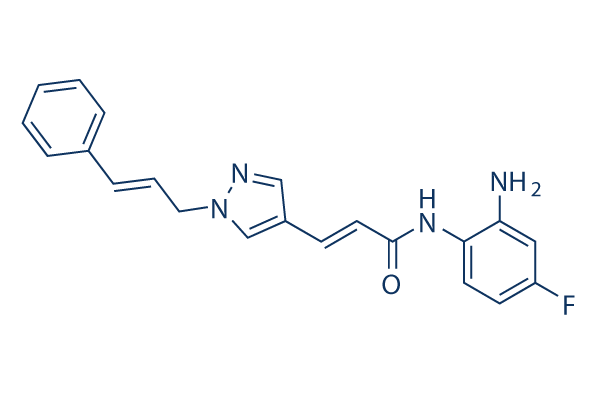
RGFP966 HDAC3 inhibitor
Cat.No.S7229
Quality Control
Products Often Used Together with RGFP966
Cell Culture, Treatment & Working Concentration
| Cell Lines | Assay Type | Concentration | Incubation Time | Formulation | Activity Description | PMID |
|---|---|---|---|---|---|---|
| APL cells | Function assay | ≤2 μM | 48 h | DMSO | RGFP966 did not induce apoptosis in APL cells but did reduce clonogenicity and increased maturation. | 26447190 |
| Em-Myc lymphoma cells | Function assay | ≤1 μM | 48 h | DMSO | Cell proliferated significantly more slowly than vehicle-treated controls in the presence or absence of pro-survival BCL-2 overexpression | 26447190 |
| HH and Hut78 cells | Proliferation assay | 10 μM | 0, 24, 48, 72 h | DMSO | Both cell lines were sensitive to treatment with 10 μM 966. However, Hut78 cells exhibited a greater sensitivity than HH cells. | 23894374 |
| HH | Function assay | 10 μM | 24 h | DMSO | increases the acetylation at H3K9/K14, H3K27, and H4K5 | 23894374 |
| Hut78 | Function assay | 10 μM | 24 h | DMSO | increases the acetylation at H3K9/K14, H3K27, and H4K5 | 23894374 |
| HL60 | Antiproliferative assay | 48 hrs | Antiproliferative activity against human HL60 cells after 48 hrs in presence of JAK2 inhibitor CYT-387 by CCK-8 assay, IC50 = 1.64 μM. | 29940115 | ||
| K562 | Antiproliferative assay | 48 hrs | Antiproliferative activity against human K562 cells after 48 hrs in presence of JAK2 inhibitor CYT-387 by CCK-8 assay, IC50 = 1.64 μM. | 29940115 | ||
| HEL | Antiproliferative assay | 48 hrs | Antiproliferative activity against human HEL cells after 48 hrs in presence of JAK2 inhibitor CYT-387 by CCK-8 assay, IC50 = 1.64 μM. | 29940115 | ||
| HL60 | Antiproliferative assay | 48 hrs | Antiproliferative activity against human HL60 cells after 48 hrs by CCK-8 assay, IC50 = 21.71 μM. | 29940115 | ||
| K562 | Antiproliferative assay | 48 hrs | Antiproliferative activity against human K562 cells after 48 hrs by CCK-8 assay, IC50 = 21.71 μM. | 29940115 | ||
| HEL | Antiproliferative assay | 48 hrs | Antiproliferative activity against human HEL cells after 48 hrs by CCK-8 assay, IC50 = 21.71 μM. | 29940115 | ||
| Sf9 | Function assay | 60 mins | Inhibition of full length human C-terminal His-tagged HDAC3/N-terminal GST-tagged NCOR2 (395 to 489 residues) expressed in baculovirus infected Sf9 insect cells using substrate measured after 60 mins by colorimetric method | 29541372 | ||
| Click to View More Cell Line Experimental Data | ||||||
Solubility
|
In vitro |
DMSO
: 72 mg/mL
(198.67 mM)
Water : Insoluble Ethanol : Insoluble |
Molarity Calculator
|
In vivo |
|||||
In vivo Formulation Calculator (Clear solution)
Step 1: Enter information below (Recommended: An additional animal making an allowance for loss during the experiment)
Step 2: Enter the in vivo formulation (This is only the calculator, not formulation. Please contact us first if there is no in vivo formulation at the solubility Section.)
Calculation results:
Working concentration: mg/ml;
Method for preparing DMSO master liquid: mg drug pre-dissolved in μL DMSO ( Master liquid concentration mg/mL, Please contact us first if the concentration exceeds the DMSO solubility of the batch of drug. )
Method for preparing in vivo formulation: Take μL DMSO master liquid, next addμL PEG300, mix and clarify, next addμL Tween 80, mix and clarify, next add μL ddH2O, mix and clarify.
Method for preparing in vivo formulation: Take μL DMSO master liquid, next add μL Corn oil, mix and clarify.
Note: 1. Please make sure the liquid is clear before adding the next solvent.
2. Be sure to add the solvent(s) in order. You must ensure that the solution obtained, in the previous addition, is a clear solution before proceeding to add the next solvent. Physical methods such
as vortex, ultrasound or hot water bath can be used to aid dissolving.
Chemical Information, Storage & Stability
| Molecular Weight | 362.4 | Formula | C21H19FN4O |
Storage (From the date of receipt) | |
|---|---|---|---|---|---|
| CAS No. | 1396841-57-8 | Download SDF | Storage of Stock Solutions |
|
|
| Synonyms | N/A | SMILES | C1=CC=C(C=C1)C=CCN2C=C(C=N2)C=CC(=O)NC3=C(C=C(C=C3)F)N | ||
Read more about storage stability stock solution CAS number SMILES
Mechanism of Action
| Targets/IC50/Ki |
HDAC3
(Cell-free assay) 80 nM
|
|---|---|
| In vitro |
RGFP966 is a slow-on/slow-off, competitive tight-binding HDAC inhibitor, with an IC50 of 0.08μM for HDAC3 and no effective inhibition of any other HDAC at concentrations up to 15μM. This compound treatment on two CTCL cell lines for 24 hours prior to western blot analysis resulted in increased acetylation at H3K9/K14, H3K27, and H4K5, but not H3K56ac. It decreases cell growth in CTCL (cutaneous T cell lymphoma) cell lines due to increased apoptosis that is associated with DNA damage and impaired S phase progression. This chemical causes a significant reduction in DNA replication fork velocity within the first hour of drug treatment.
|
| Kinase Assay |
Deacetylation assays
|
|
Deacetylation assays are based on the homogenous fluorescence release assay. Purified recombinant enzymes are incubated with serial-diluted inhibitors at the concentrations indicated in the figures, with pre-incubation times ranging from 0 to 3 hours, in the standard HDAC buffer. Acetyl-Lys(Ac)-AMC substrate (at 10 μM, corresponding to the Km for both HDAC1 and HDAC3) is added after the pre-incubation period. The reaction is allowed to run for 1 hour. The trypsin peptidase developer, at final concentration of 5mg/ml, is added after 1 hour, and the fluorescence emission is then measured using a Tecan M200 96-well plate reader.
|
|
| In vivo |
RGFP966 treatment (10 mg/kg) enhances long-term memory for object memory. This compound (3 or 10 mg/kg, s.c.) facilitates extinction and prevents reinstatement of cocaine- conditioned place preference.
|
References |
|
Applications
| Methods | Biomarkers | Images | PMID |
|---|---|---|---|
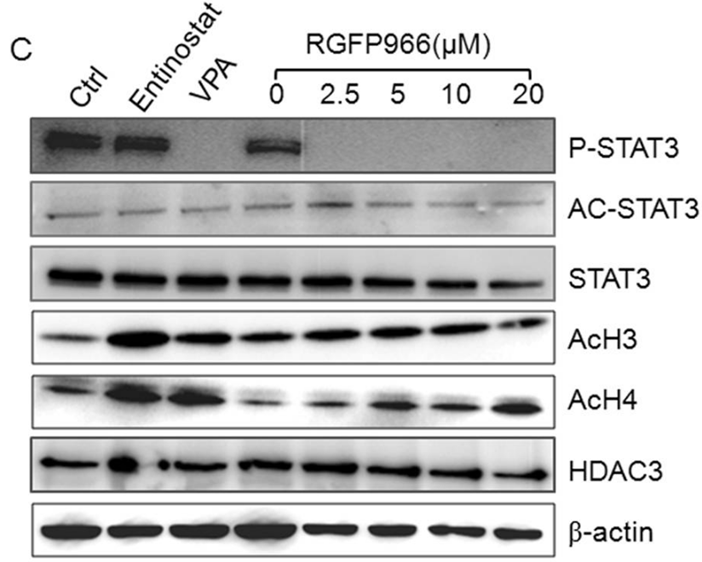
| Western blot | p-STAT3 / Acetyl-STAT3 / STAT3 / Ac-H3 / Ac-H4 H3K9K14ac / H3 / H3K56ac / H3K27ac / H4K5ac |
|
28338101 |
Tech Support
Tel: +1-832-582-8158 Ext:3
If you have any other enquiries, please leave a message.
Frequently Asked Questions
Question 1:
Does this product S7229 specifically inhibit HDAC3? Or does it target other HDACs as well?
Answer:
In the paper, it is indicated that "this compound is specific for HDAC3, with an IC50 of 0.08 μM and no effective inhibition of any other HDAC at concentrations up to 15 μM." However, we did not perform experiment to confirm this data. Please refer to the following link for detailed information: http://www.pnas.org/content/110/7/2647.long
Signaling Pathway Map

Products are for research use only. Not for human use. We do not sell to patients.
©Copyright 2013 Selleck Chemicals. All Rights Reserved.