research use only
Cat.No.S1010
| Related Targets | EGFR PDGFR FGFR c-Met Src MEK CSF-1R FLT3 HER2 c-Kit |
|---|---|
| Other VEGFR Inhibitors | SAR131675 SU 5402 Cediranib (AZD2171) Vatalanib (PTK787) 2HCl Anlotinib (AL3818) Dihydrochloride Linifanib (ABT-869) Apatinib (YN968D1) Apatinib (YN968D1) mesylate Semaxanib (SU5416) Ki8751 |
| Cell Lines | Assay Type | Concentration | Incubation Time | Formulation | Activity Description | PMID |
|---|---|---|---|---|---|---|
| SKOV3 | Function Assay | 5 µM | 24 h | DMSO | induces a significant increase in the promoter activities of E-cad, CDH1, and CDH3 | 26061747 |
| A549 | Function Assay | 2/5 μM | 24 h | DMSO | has a general EMT reversal effect | 26061747 |
| T24 | Function Assay | 2/5 μM | 24 h | DMSO | has a general EMT reversal effect | 26061747 |
| Mia-Paca2 | Function Assay | 2/5 μM | 24 h | DMSO | has a general EMT reversal effect | 26061747 |
| A549 | Function Assay | 0.01–5 μM | 24 h | DMSO | induces SFTPD mRNA expression dose dependently | 25843005 |
| A549 | Function Assay | 0.01–5 μM | 72 h | DMSO | enhances SP-D protein expression in a dose-dependent manner at concentrations of up to 5 μM | 25843005 |
| A549 | Function Assay | 5 μM | 0-1 h | DMSO | increases AP-1 activation after 30 min | 25843005 |
| Hep3B | Cell Viability Assay | 0-20 μM | 48 h | decreases cell viability dose dependently | 24657398 | |
| HepG2 | Cell Viability Assay | 0-20 μM | 48 h | decreases cell viability dose dependently | 24657398 | |
| PLC5 | Cell Viability Assay | 0-20 μM | 48 h | decreases cell viability dose dependently | 24657398 | |
| HuH7 | Cell Viability Assay | 0-20 μM | 48 h | decreases cell viability dose dependently | 24657398 | |
| SK-Hep1 | Cell Viability Assay | 0-20 μM | 48 h | decreases cell viability dose dependently | 24657398 | |
| Hep3B | Apoptosis Assay | 0-20 μM | 48 h | induces cell apoptosis dose dependently | 24657398 | |
| HepG2 | Apoptosis Assay | 0-20 μM | 48 h | induces cell apoptosis dose dependently | 24657398 | |
| PLC5 | Apoptosis Assay | 0-20 μM | 48 h | induces cell apoptosis dose dependently | 24657398 | |
| HuH7 | Apoptosis Assay | 0-20 μM | 48 h | induces cell apoptosis dose dependently | 24657398 | |
| SK-Hep1 | Apoptosis Assay | 0-20 μM | 48 h | induces cell apoptosis dose dependently | 24657398 | |
| H1703 | Growth Inhibition Assay | IC50=0.05 μM | 23729403 | |||
| Sf9 | Function assay | 20 mins | Inhibition of mouse GST-fused VEGFR2 expressed in Sf9 insect cells after 20 mins by scintillation counting, IC50 = 0.013 μM. | 18559524 | ||
| Sf9 | Function assay | 20 mins | Inhibition of human GST-fused VEGFR2 expressed in Sf9 insect cells after 20 mins by scintillation counting, IC50 = 0.021 μM. | 18559524 | ||
| NIH3T3 | Function assay | 50 nM | 1 hr | Inhibition of VEGFR2 transfected in mouse NIH3T3 cells at 50 nM incubated for 1 hr measured after 32 hrs washout followed by VEGF stimulation for 10 mins by Western blotting | 18559524 | |
| HT-29 | Antiproliferative assay | 72 hrs | Antiproliferative activity against human HT-29 cells after 72 hrs by MTT assay, IC50 = 4.9 μM. | 28190652 | ||
| SKOV3 | Antiproliferative assay | 72 hrs | Antiproliferative activity against human SKOV3 cells after 72 hrs by MTT assay, IC50 = 28.76 μM. | 28190652 | ||
| BL21 (DE3) | Function assay | 30 mins | Inhibition of His6-tagged MELK catalytic domain (1 to 340 residues) (unknown origin) expressed in Escherichia coli BL21 (DE3) cells using Bcl-GL as substrate measured after 30 mins in presence of [gamma32P]ATP by liquid scintillation counting method, Ki = 0.0056 μM. | 28351607 | ||
| BL21 (DE3) | Function assay | 30 mins | Inhibition of His6-tagged MELK catalytic domain (1 to 340 residues) (unknown origin) expressed in Escherichia coli BL21 (DE3) cells using Bcl-GL as substrate measured after 30 mins in presence of [gamma32P]ATP by liquid scintillation counting method, IC50 = 0.043 μM. | 28351607 | ||
| HT-29 | Antiproliferative assay | 72 hrs | Antiproliferative activity against human HT-29 cells after 72 hrs by MTT assay, IC50 = 0.83 μM. | 28826084 | ||
| MCF7 | Antiproliferative assay | 72 hrs | Antiproliferative activity against human MCF7 cells after 72 hrs by MTT assay, IC50 = 8.28 μM. | 28826084 | ||
| A549 | Antiproliferative assay | 72 hrs | Antiproliferative activity against human A549 cells after 72 hrs by MTT assay, IC50 = 22.62 μM. | 28826084 | ||
| NIH/3T3 | Function assay | 42 hrs | Inhibition of PDGFR in mouse NIH/3T3 cells assessed as reduction in recombinant human PDGF-BB-induced cell proliferation after 42 hrs by cell titer 96 aqueous one solution based assay, IC50 = 0.085 μM. | 29152045 | ||
| Sf9 | Function assay | Inhibition of human VEGFR2 expressed in Sf9 cells, IC50 = 0.005 μM. | 19522465 | |||
| NIH3T3 | Function assay | 1 hr | Inhibition of VEGF-stimulated human VEGFR2 phosphorylation expressed in mouse NIH3T3 cells pretreated for 1 hr measured 32 hrs after drug dose by immunoprecipitation based pulse-chase experiment | 19522465 | ||
| BRP | Apoptosis assay | Induction of apoptosis in BRP cells assessed as caspase-3 cleavage | 19522465 | |||
| BRP | Antiangiogenic assay | Antiangiogenic activity BRP cells assessed as inhibition of cell proliferation by [3H]thymidine incorporation assay | 19522465 | |||
| TC32 | qHTS assay | qHTS of pediatric cancer cell lines to identify multiple opportunities for drug repurposing: Primary screen for TC32 cells | 29435139 | |||
| A673 | qHTS assay | qHTS of pediatric cancer cell lines to identify multiple opportunities for drug repurposing: Primary screen for A673 cells | 29435139 | |||
| DAOY | qHTS assay | qHTS of pediatric cancer cell lines to identify multiple opportunities for drug repurposing: Primary screen for DAOY cells | 29435139 | |||
| Saos-2 | qHTS assay | qHTS of pediatric cancer cell lines to identify multiple opportunities for drug repurposing: Primary screen for Saos-2 cells | 29435139 | |||
| BT-37 | qHTS assay | qHTS of pediatric cancer cell lines to identify multiple opportunities for drug repurposing: Primary screen for BT-37 cells | 29435139 | |||
| SK-N-SH | qHTS assay | qHTS of pediatric cancer cell lines to identify multiple opportunities for drug repurposing: Primary screen for SK-N-SH cells | 29435139 | |||
| NB1643 | qHTS assay | qHTS of pediatric cancer cell lines to identify multiple opportunities for drug repurposing: Primary screen for NB1643 cells | 29435139 | |||
| OHS-50 | qHTS assay | qHTS of pediatric cancer cell lines to identify multiple opportunities for drug repurposing: Primary screen for OHS-50 cells | 29435139 | |||
| LAN-5 | qHTS assay | qHTS of pediatric cancer cell lines to identify multiple opportunities for drug repurposing: Confirmatory screen for LAN-5 cells | 29435139 | |||
| DAOY | qHTS assay | qHTS of pediatric cancer cell lines to identify multiple opportunities for drug repurposing: Confirmatory screen for DAOY cells | 29435139 | |||
| Rh41 | qHTS assay | qHTS of pediatric cancer cell lines to identify multiple opportunities for drug repurposing: Primary screen for Rh41 cells | 29435139 | |||
| MG 63 (6-TG R) | qHTS assay | qHTS of pediatric cancer cell lines to identify multiple opportunities for drug repurposing: Confirmatory screen for MG 63 (6-TG R) cells | 29435139 | |||
| Rh30 | qHTS assay | qHTS of pediatric cancer cell lines to identify multiple opportunities for drug repurposing: Confirmatory screen for Rh30 cells | 29435139 | |||
| U-2 OS | qHTS assay | qHTS of pediatric cancer cell lines to identify multiple opportunities for drug repurposing: Confirmatory screen for U-2 OS cells | 29435139 | |||
| OHS-50 | qHTS assay | qHTS of pediatric cancer cell lines to identify multiple opportunities for drug repurposing: Confirmatory screen for OHS-50 cells | 29435139 | |||
| Rh41 | qHTS assay | qHTS of pediatric cancer cell lines to identify multiple opportunities for drug repurposing: Confirmatory screen for Rh41 cells | 29435139 | |||
| SJ-GBM2 | qHTS assay | qHTS of pediatric cancer cell lines to identify multiple opportunities for drug repurposing: Primary screen for SJ-GBM2 cells | 29435139 | |||
| NB-EBc1 | qHTS assay | qHTS of pediatric cancer cell lines to identify multiple opportunities for drug repurposing: Primary screen for NB-EBc1 cells | 29435139 | |||
| LAN-5 | qHTS assay | qHTS of pediatric cancer cell lines to identify multiple opportunities for drug repurposing: Primary screen for LAN-5 cells | 29435139 | |||
| NB1643 | qHTS assay | qHTS of pediatric cancer cell lines to identify multiple opportunities for drug repurposing: Confirmatory screen for NB1643 cells | 29435139 | |||
| SK-N-MC | qHTS assay | qHTS of pediatric cancer cell lines to identify multiple opportunities for drug repurposing: Confirmatory screen for SK-N-MC cells | 29435139 | |||
| TC32 | qHTS assay | qHTS of pediatric cancer cell lines to identify multiple opportunities for drug repurposing: Confirmatory screen for TC32 cells | 29435139 | |||
| Rh18 | qHTS assay | qHTS of pediatric cancer cell lines to identify multiple opportunities for drug repurposing: Confirmatory screen for Rh18 cells | 29435139 | |||
| Click to View More Cell Line Experimental Data | ||||||
|
In vitro |
DMSO
: 10 mg/mL
(18.53 mM)
Water : Insoluble Ethanol : Insoluble |
|
In vivo |
|||||
Step 1: Enter information below (Recommended: An additional animal making an allowance for loss during the experiment)
Step 2: Enter the in vivo formulation (This is only the calculator, not formulation. Please contact us first if there is no in vivo formulation at the solubility Section.)
Calculation results:
Working concentration: mg/ml;
Method for preparing DMSO master liquid: mg drug pre-dissolved in μL DMSO ( Master liquid concentration mg/mL, Please contact us first if the concentration exceeds the DMSO solubility of the batch of drug. )
Method for preparing in vivo formulation: Take μL DMSO master liquid, next addμL PEG300, mix and clarify, next addμL Tween 80, mix and clarify, next add μL ddH2O, mix and clarify.
Method for preparing in vivo formulation: Take μL DMSO master liquid, next add μL Corn oil, mix and clarify.
Note: 1. Please make sure the liquid is clear before adding the next solvent.
2. Be sure to add the solvent(s) in order. You must ensure that the solution obtained, in the previous addition, is a clear solution before proceeding to add the next solvent. Physical methods such
as vortex, ultrasound or hot water bath can be used to aid dissolving.
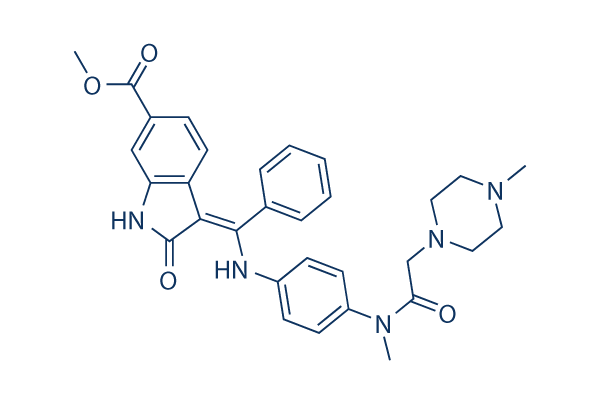
| Molecular Weight | 539.62 | Formula | C31H33N5O4 |
Storage (From the date of receipt) | |
|---|---|---|---|---|---|
| CAS No. | 656247-17-5 | Download SDF | Storage of Stock Solutions |
|
|
| Synonyms | BIBF 1120, Intedanib | Smiles | CN1CCN(CC1)CC(=O)N(C)C2=CC=C(C=C2)N=C(C3=CC=CC=C3)C4=C(NC5=C4C=CC(=C5)C(=O)OC)O | ||
| Targets/IC50/Ki |
VEGFR2
(Cell-free assay) 13 nM
VEGFR3
(Cell-free assay) 13 nM
LCK
(Cell-free assay) 16 nM
FLT3
(Cell-free assay) 26 nM
VEGFR1
(Cell-free assay) 34 nM
FGFR2
(Cell-free assay) 37 nM
PDGFRα
(Cell-free assay) 59 nM
PDGFRβ
(Cell-free assay) 65 nM
FGFR1
(Cell-free assay) 69 nM
FGFR3
(Cell-free assay) 108 nM
Src
(Cell-free assay) 156 nM
Lyn
(Cell-free assay) 195 nM
FGFR4
(Cell-free assay) 610 nM
|
|---|---|
| In vitro |
BIBF1120 inhibits PDGFR kinase activity of PDGFR alpha and PDGFR beta types with IC50 values of 59 nM and 65 nM, respectively. In addition, BIBF1120 suppresses the FGFR subtypes with IC50 of 60 nM, 37 nM and 108 nM for FGFR1, FGFR2, and FGFR3, respectively. BIBF1120 binds to the ATP-binding site in the cleft between the amino and carboxy terminal lobes of the kinase domain. The indolinone scaffold forms two hydrogen bonds with the backbone nitrogen of Cys919 and the backbone carbonyl oxygen of Glu917 in the hinge region. BIBF 1120 inhibits proliferation of PDGF-BB stimulated BRPs with EC50 of 79 nM in cell assays. BIBF1120 at concentrations as low as 100 nM blocks activation of MAPK after stimulation with 5% serum plus PDGF-BB. In cultures of human vascular smooth muscle cells (HUASMC), BIBF1120 prevents PDGF-BB stimulated proliferation with an EC50 of 69 nM. |
| Kinase Assay |
VEGFR2 Kinase Assay
|
|
The cytoplasmic tyrosine kinase domain of VEGFR2 (residues 797-1355 according to sequence deposited in databank SWISS-PROT P35968) is cloned into pFastBac fused to GST and extracted. Enzyme activity is assayed in the presence or absence of serial dilutions of BIBF1120 performed in 25% DMSO. Each microtiter plate contains internal controls such as blank, maximum reaction, and historical reference compound. All incubations are conducted at room temperature on a rotation shaker. 10 μL of each BIBF1120 dilution is added to 10 μL of diluted kinase (0.8 μg/mL VEGFR2, 10 mM Tris pH 7.5, 2 mM EDTA, and 2 mg/mL BSA) and preincubated for 1 hour. The reaction is started by addition of 30 μL of substrate mix containing 62.4 mM Tris pH 7.5, 2.7 mM DTT, 5.3 mM MnCl2, 13.3 mM Mg-acetate, 0.42 mM ATP, 0.83 mg/mL Poly-Glu-Tyr(4:1), and 1.7 μg/mL Poly-Glu-Tyr(4:1)-biotin and incubated for 1 hour. The reaction is stopped by addition of 50 μL of 250 mM EDTA, 20 mM HEPES, pH 7.4. 90 μL of the reaction mix is transferred to a streptavidin plate and incubated for 1-2 hours. After three washes with PBS the EU-labeled antibody, PY20 is added (recommended dilution 1:2000 of 0.5 mg/mL labeled antibody in DELFIA assay buffer). Excessive detection antibody is removed by three washes of DELFIA washing buffer. Then 10 minutes before measurement on the multilabel reader, each well is incubated with 100 μL of DELFIA enhancement solution.
|
|
| In vivo |
In all tumor models tested thus far, including human tumor xenografts growing in nude mice and a syngeneic rat tumor model, BIBF1120 is highly active at well-tolerated doses (25-100 mg/kg daily p.o.). This is evident in the magnetic resonance imaging of tumor perfusion after 3 days, reducing vessel density and vessel integrity after 5 days, and profound growth inhibition. |
References |
|
| Methods | Biomarkers | Images | PMID |
|---|---|---|---|
| Western blot | p-EGFR / FGFR1 / p-AKT / AKT / p-ERK / ERK Cyclin A / Cyclin D1 / Cyclin E / CDK2 / CDK4 / CDK6 p-SMAD3 / SMAD3 / p-p38 MAPK / p38 MAPK Fibronectin / Collagen 1a1 |
|
27581340 |
| Immunofluorescence | Vimentin / E-cadherin |
|
29934570 |
(data from https://clinicaltrials.gov, updated on 2024-05-22)
| NCT Number | Recruitment | Conditions | Sponsor/Collaborators | Start Date | Phases |
|---|---|---|---|---|---|
| NCT06200714 | Recruiting | Idiopathic Pulmonary Fibrosis|Diarrhoea |
Boehringer Ingelheim |
April 30 2024 | -- |
| NCT05676112 | Withdrawn | Pulmonary Fibrosis |
Boehringer Ingelheim|China-Japan Friendship Hospital |
December 29 2023 | -- |
| NCT06070610 | Completed | Healthy |
Boehringer Ingelheim |
November 8 2023 | Phase 1 |
| NCT05755308 | Not yet recruiting | Idiopathic Pulmonary Fibrosis |
Fondazione Policlinico Universitario Agostino Gemelli IRCCS |
October 2023 | Not Applicable |
| NCT06071013 | Not yet recruiting | Non-small Cell Lung Cancer|EGFR Gene Mutation|EGFR-TKI Resistant Mutation |
China Medical University Hospital |
September 28 2023 | Phase 1|Phase 2 |
Tel: +1-832-582-8158 Ext:3
If you have any other enquiries, please leave a message.