
-
 Argentina
-
 Australia
-
 Austria
-
 Belgium
-
 Brazil
-
 Canada
-
 China
China
-
 Czech Republic
-
 Denmark
-
 Finland
-
 France
-
 Germany
-
 Greece
-
 Hong Kong
-
 Hungary
-
 Iceland
-
 India
India
-
 Ireland
-
 Israel
-
 Italy
Italy
-
 Japan
Japan
-
 Korea
Korea
-
 Luxembourg
-
 Malaysia
-
 Netherlands
-
 New Zealand
-
 Norway
-
 Poland
-
 Portugal
-
 Qatar
Qatar
-
 Romania
-
 Saudi Arabia
-
 Singapore
-
 Spain
Spain
-
 Sweden
-
 Switzerland
-
 Taiwan
-
 Turkey
-
 United Kingdom
-
 United States
research use only
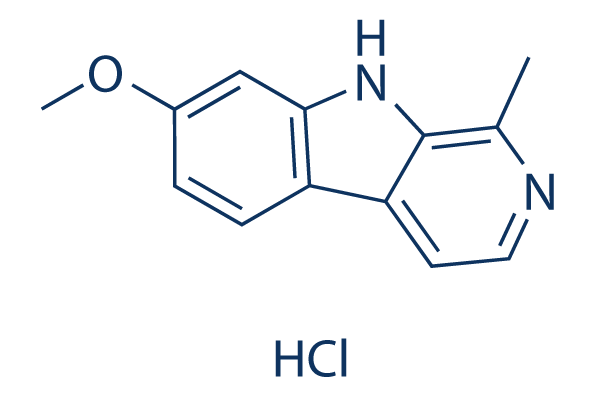
Harmine Hydrochloride (Telepathine) DYRK/MAO-A Inhibitor
Cat.No.S3817
Quality Control
| Related Targets | CDK HSP PD-1/PD-L1 ROCK Wee1 DNA/RNA Synthesis Microtubule Associated Ras KRas Aurora Kinase |
|---|---|
| Other DYRK Inhibitors | AZ191 ID-8 INDY GNF4877 GSK626616 |
Solubility
|
In vitro |
|
Molarity Calculator
|
In vivo |
|||||
In vivo Formulation Calculator (Clear solution)
Step 1: Enter information below (Recommended: An additional animal making an allowance for loss during the experiment)
Step 2: Enter the in vivo formulation (This is only the calculator, not formulation. Please contact us first if there is no in vivo formulation at the solubility Section.)
Calculation results:
Working concentration: mg/ml;
Method for preparing DMSO master liquid: mg drug pre-dissolved in μL DMSO ( Master liquid concentration mg/mL, Please contact us first if the concentration exceeds the DMSO solubility of the batch of drug. )
Method for preparing in vivo formulation: Take μL DMSO master liquid, next addμL PEG300, mix and clarify, next addμL Tween 80, mix and clarify, next add μL ddH2O, mix and clarify.
Method for preparing in vivo formulation: Take μL DMSO master liquid, next add μL Corn oil, mix and clarify.
Note: 1. Please make sure the liquid is clear before adding the next solvent.
2. Be sure to add the solvent(s) in order. You must ensure that the solution obtained, in the previous addition, is a clear solution before proceeding to add the next solvent. Physical methods such
as vortex, ultrasound or hot water bath can be used to aid dissolving.
Chemical Information, Storage & Stability
| Molecular Weight | 248.71 | Formula | C13H12N2O.HCl |
Storage (From the date of receipt) | |
|---|---|---|---|---|---|
| CAS No. | 343-27-1 | Download SDF | Storage of Stock Solutions |
|
|
Read more about storage stability stock solution CAS number
Mechanism of Action
| Targets/IC50/Ki |
DYRK1A
(Cell-free assay) 33 nM
MNB
(Cell-free assay) 149 nM
DYRK1B
(Cell-free assay) 166 nM
DYRK2
(Cell-free assay) 1.9 μM
|
|---|---|
| In vitro |
Harmine inhibits substrate phosphorylation by DYRK1A more potently than it inhibits substrate phosphorylation by the closely related kinase DYRK1B [half maximal inhibitory concentrations (IC50) of 33 nM versus 166 nM, respectively] and by the more distant members of the family, DYRK2 and DYRK4 (1.9 μM and 80 μM, respectively). Much higher concentrations of harmine are required to suppress tyrosine autophosphorylation of the translational intermediate of DYRK1A in a bacterial in vitro translation system (IC50 = 1.9 μM). Harmine inhibits the phosphorylation of a specific substrate by DYRK1A in cultured cells with a potency similar to that observed in vitro (IC50=48 nM), without negative effects on the viability of the cells. Harmine does not inhibit tyrosine autophosphorylation of DYRK1A in HEK293 cells. Harmine is able to induce beta cell proliferation, increase islet mass and improve glycemic control. It is a CNS stimulant. |
| In vivo |
In a partial pancreatectomy (PPX) model, harmine treatment induces Ki-67 labeling in beta cells in both sham-operated mice and in mice subjected to PPX, with the most robust proliferation in the beta cells of harmine-treated PPX mice. In the PPX model, regeneration of beta cell mass is substantially more rapid in the harmine-treated mice than in the controls, reaching near-normal values in only 14 d. In a euglycemic nonobese diabetic-severe combined immunodeficiency (NOD-SCID) mouse model, BrdU and Ki-67 labeling is two- to threefold higher in human beta cells transplanted into the renal capsule of harmine-treated compared to control euglycemic mice, without evidence of beta cell death. In a marginal mass human islet transplant model in streptozotocin-diabetic NOD-SCID mice, harmine treatment also results in near normal glycemic control. Harmine induces production of the important beta cell transcription factors NKX6.1, PDX1 and MAFA. |
References |
|
Clinical Trial Information
(data from https://clinicaltrials.gov, updated on 2025-03-19)
| NCT Number | Recruitment | Conditions | Sponsor/Collaborators | Start Date | Phases |
|---|---|---|---|---|---|
| NCT06252506 | COMPLETED | Neuropharmacological Investigation of Ayahuasca Constituents DMT and Harmine |
Insel Gruppe AG, University Hospital Bern |
2024-01-22 | PHASE1 |
| NCT05829603 | COMPLETED | Healthy |
Reconnect Labs |
2023-05-05 | PHASE1 |
| NCT05780216 | COMPLETED | Healthy Participants |
Milan Scheidegger |
2023-02-20 | EARLY_PHASE1 |
| NCT05526430 | COMPLETED | Diabetes Mellitus |
James Murrough |
2022-09-13 | PHASE1 |
| NCT04716335 | COMPLETED | Emotions; Mood; Cognitive Function 1, Social; Empathy |
Psychiatric University Hospital, Zurich |
2020-12-01 | EARLY_PHASE1 |
Read more about Clinical Trials
Tech Support
Tel: +1-832-582-8158 Ext:3
If you have any other enquiries, please leave a message.

Products are for research use only. Not for human use. We do not sell to patients.
©Copyright 2013 Selleck Chemicals. All Rights Reserved.