
-
 Argentina
-
 Australia
-
 Austria
-
 Belgium
-
 Brazil
-
 Canada
-
 China
China
-
 Czech Republic
-
 Denmark
-
 Finland
-
 France
-
 Germany
-
 Greece
-
 Hong Kong
-
 Hungary
-
 Iceland
-
 India
India
-
 Ireland
-
 Israel
-
 Italy
Italy
-
 Japan
Japan
-
 Korea
Korea
-
 Luxembourg
-
 Malaysia
-
 Netherlands
-
 New Zealand
-
 Norway
-
 Poland
-
 Portugal
-
 Qatar
Qatar
-
 Romania
-
 Saudi Arabia
-
 Singapore
-
 Spain
Spain
-
 Sweden
-
 Switzerland
-
 Taiwan
-
 Turkey
-
 United Kingdom
-
 United States
research use only
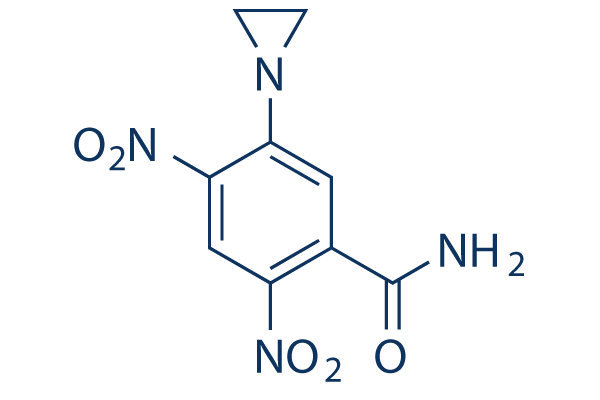
Tretazicar (CB1954) DNA alkylator chemical
Cat.No.S7829
Quality Control
| Related Targets | HDAC PARP ATM/ATR DNA-PK WRN DNA/RNA Synthesis Topoisomerase PPAR Sirtuin Casein Kinase |
|---|---|
| Other DNA alkylator Inhibitors | Lomeguatrib Methyl methanesulfonate Lobaplatin (D-19466) Semustine Calicheamicin Treosulfan Phosphoramide mustard cyclohexanamine |
Solubility
|
In vitro |
DMSO
: 50 mg/mL
(198.27 mM)
Water : Insoluble Ethanol : Insoluble |
Molarity Calculator
|
In vivo |
|||||
In vivo Formulation Calculator (Clear solution)
Step 1: Enter information below (Recommended: An additional animal making an allowance for loss during the experiment)
Step 2: Enter the in vivo formulation (This is only the calculator, not formulation. Please contact us first if there is no in vivo formulation at the solubility Section.)
Calculation results:
Working concentration: mg/ml;
Method for preparing DMSO master liquid: mg drug pre-dissolved in μL DMSO ( Master liquid concentration mg/mL, Please contact us first if the concentration exceeds the DMSO solubility of the batch of drug. )
Method for preparing in vivo formulation: Take μL DMSO master liquid, next addμL PEG300, mix and clarify, next addμL Tween 80, mix and clarify, next add μL ddH2O, mix and clarify.
Method for preparing in vivo formulation: Take μL DMSO master liquid, next add μL Corn oil, mix and clarify.
Note: 1. Please make sure the liquid is clear before adding the next solvent.
2. Be sure to add the solvent(s) in order. You must ensure that the solution obtained, in the previous addition, is a clear solution before proceeding to add the next solvent. Physical methods such
as vortex, ultrasound or hot water bath can be used to aid dissolving.
Chemical Information, Storage & Stability
| Molecular Weight | 252.18 | Formula | C9H8N4O5 |
Storage (From the date of receipt) | |
|---|---|---|---|---|---|
| CAS No. | 21919-05-1 | Download SDF | Storage of Stock Solutions |
|
|
| Synonyms | NSC 115829 | SMILES | C1CN1C2=C(C=C(C(=C2)C(=O)N)[N+](=O)[O-])[N+](=O)[O-] | ||
Read more about storage stability stock solution CAS number SMILES
Mechanism of Action
| In vitro |
The overexpression of nitroreductase oxidored nitro domain containing protein 1 (NOR1) is capable of converting the monofunctional alkylating agent Tretazicar (CB1954) into a toxic form by reducing its 4 nitro group, which is a potent cytotoxin. This compound enhances cell killing in the NPC cell line CNE1. The NOR1 gene enhances CB1954-mediated cell cytotoxicity through the upregulation of Grb2 expression and the activation of MAPK signal transduction in the HepG2 cell line.
|
|---|---|
| In vivo |
The Tretazicar (CB1954) system is used for specific ablation of cells in vivo. The effect of this inducible ablation system is dose-dependent. NTR-mediated cell killing by this compound does not require cell proliferation. The activated form cross-links DNA which presumably triggers the apoptosis cascade, resulting in rapid cell death. Specific and effective cell killing by NTR-CB1954 does not require a functional p53.
|
References |
|
Clinical Trial Information
(data from https://clinicaltrials.gov, updated on 2021-11-03)
| NCT Number | Recruitment | Conditions | Sponsor/Collaborators | Start Date | Phases |
|---|---|---|---|---|---|
| NCT04374240 | COMPLETED | Prostate Cancer |
University of Birmingham |
2013-03-19 | PHASE1 |
| NCT04374240 | Completed | Prostate Cancer |
University of Birmingham|Janssen LP|Department of Health United Kingdom|Medical Research Council |
2013-03-19 | Phase 1 |
| NCT00746590 | TERMINATED | Hepatocellular Carcinoma |
BTG International Inc. |
2008-09 | PHASE2 |
Read more about Clinical Trials
Tech Support
Tel: +1-832-582-8158 Ext:3
If you have any other enquiries, please leave a message.

Products are for research use only. Not for human use. We do not sell to patients.
©Copyright 2013 Selleck Chemicals. All Rights Reserved.