
-
 Australia
-
 Austria
-
 Belgium
-
 Brazil
-
 Canada
-
 China
China
-
 Czech Republic
-
 Denmark
-
 Finland
-
 France
-
 Germany
-
 Greece
-
 Hong Kong
-
 Hungary
-
 Iceland
-
 India
India
-
 Ireland
-
 Israel
-
 Italy
Italy
-
 Japan
Japan
-
 Korea
Korea
-
 Luxembourg
-
 Malaysia
-
 Netherlands
-
 New Zealand
-
 Norway
-
 Poland
-
 Qatar
Qatar
-
 Romania
-
 Saudi Arabia
-
 Singapore
-
 Spain
Spain
-
 Sweden
-
 Switzerland
-
 Taiwan
-
 Turkey
-
 United Kingdom
-
 United States
research use only
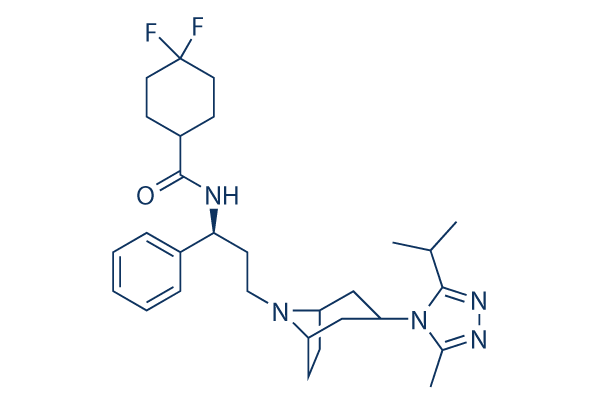
Maraviroc (UK-427857) CCR5 antagonist
Cat.No.S2003
Quality Control
| Related Targets | Integrase Bacterial Antibiotics Anti-infection Fungal Antiviral COVID-19 Parasite Reverse Transcriptase HIV |
|---|---|
| Other CCR Inhibitors | Cenicriviroc INCB3344 SB-297006 ZK756326 2HCl BX471 (ZK-811752) Adaptavir (DAPTA) R243 RS102895 BMS-813160 AZD2098 |
Solubility in DMSO or Water
|
In vitro |
DMSO
: 100 mg/mL
(194.67 mM)
Ethanol : 100 mg/mL Water : Insoluble The solubility data above are all experimental results (not literature values). |
Molarity Calculator
|
In vivo |
|||||
In vivo Formulation Calculator (Clear solution)
Step 1: Enter information below (Recommended: An additional animal making an allowance for loss during the experiment)
Step 2: Enter the in vivo formulation (This is only the calculator, not formulation. Please contact us first if there is no in vivo formulation at the solubility Section.)
Calculation results:
Working concentration: mg/ml;
Method for preparing DMSO master liquid: mg drug pre-dissolved in μL DMSO ( Master liquid concentration mg/mL, Please contact us first if the concentration exceeds the DMSO solubility of the batch of drug. )
Method for preparing in vivo formulation: Take μL DMSO master liquid, next addμL PEG300, mix and clarify, next addμL Tween 80, mix and clarify, next add μL ddH2O, mix and clarify.
Method for preparing in vivo formulation: Take μL DMSO master liquid, next add μL Corn oil, mix and clarify.
Note: 1. Please make sure the liquid is clear before adding the next solvent.
2. Be sure to add the solvent(s) in order. You must ensure that the solution obtained, in the previous addition, is a clear solution before proceeding to add the next solvent. Physical methods such
as vortex, ultrasound or hot water bath can be used to aid dissolving.
Read more about Maraviroc (UK-427857) solubility in DMSO or water
Working Concentrations for Cell Culture Treatment
Search directly for a cell line, or select a cell line to find matched working concentrations
Read more about Maraviroc (UK-427857) working concentrations for cell culture treatment
Selectivity & Specificity
Maraviroc (UK-427857) is a potent inhibitor of HIV-1 (IC90 in vitro), CCR5, TBI, FCS, CIBI, ICH, pain, opioid effectiveness, HIV, HIV-1 RNA (<50 copies/mL), CCL5, Acute lymphoblastic leukemia, Acute myeloid leukemia, Hodgkin lymphoma, MSC recruitment, monocyte recruitment, tumor cell growth, doxorubicin, brentuximab vedotin, heterospheroid formation, cell viability, tumor growth (>50% reduction), monocyte accumulation, Treg migration, lung metastasis, angiogenesis, metastasis, survival, immune-suppressive myeloid cells, antitumor immunity, thoracic metastasis, trastuzumab resistance, CAF growth, tumor xenograft growth, macrophages, CRC, MSC-induced tumor xenograft growth, tumor cell migration, tumor cell invasion, Gastric cancer cell dissemination, M1 polarization of microglia, microglia migration, invasion, xenograft growth, proliferation, caspase activation, Bax increase, cell cycle progression, PDAC liver metastasis, macrophage migration, overall survival, behavioural outcomes, motor performance, cognitive outcomes, dendritic spine preservation, axonal projections to contralateral cortex, inflammatory response, CREB/DLK signalling, Akt, vasculature, endothelial cell migration, mTOR/Akt pathway, M1/M2 macrophages, cancer cell killing, migration, breast cancer cell homing to the lungs, prostate cancer metastasis, M1 macrophages, pro-migratory chemokines and cytokines, T cell agglomeration, macrophage repolarisation, tumour-promoting inflammation, liver metastases, inflammation, IL-6, sICAM1, sVCAM-1, arterial stiffness, neointimal development, endothelial function, circulating endothelial microparticles, leukocyte-endothelial adhesion, IL-6 secretion, IL-8 secretion, sICAM1 secretion, sVCAM1 secretion, senescence, STAT1 pathways, PDK1 pathways, AKT pathways, HIV-induced BBB dysfunction. Maraviroc (UK-427857) exhibits the greatest inhibitory potency toward HIV-1 RNA.
Mechanism of Action
| Information | Maraviroc (UK-427857) is a potent, allosteric CCR5 antagonist. It affects CCL5/CCR5 and PI3K/AKT signaling pathways by binding to the receptor's transmembrane domain and stabilizing its inactive conformation, effectively inhibiting HIV-1 entry, macrophage polarization, and inflammation. |
|---|---|
|
Read more about Maraviroc (UK-427857) IC50 for cell-based and cell-free assays |
|
| Primary Applications and Mechanism of Action | |
Chemical Information, Storage & Stability
| Molecular Weight | 513.67 | Formula | C29H41F2N5O |
Storage (From the date of receipt) | |
|---|---|---|---|---|---|
| CAS No. | 376348-65-1 | Download SDF | Storage of Stock Solutions |
|
|
| Synonyms | UK-427857 | Smiles | CC1=NN=C(N1C2CC3CCC(C2)N3CCC(C4=CC=CC=C4)NC(=O)C5CCC(CC5)(F)F)C(C)C | ||
Tech Support
Tel: +1-832-582-8158 Ext:3
If you have any other enquiries, please leave a message.
Frequently Asked Questions
Question 1:
What vehicle do you recommend to dissolve it for in vivo experiments?
Answer:
It can be dissolved in 5% DMSO/castor oil at 62 mg/ml as suspension for oral administration. As to a clear solution for injection, following three vehicles at 10mg/ml will help: 1. 2% DMSO/castor oil; 2. 2%DMSO/sunflower oil; 3. 2%DMSO/30%PEG 300/ddH2O.

Products are for research use only. Not for human use. We do not sell to patients.
©Copyright 2013 Selleck Chemicals. All Rights Reserved.