
- Bioactive Compounds
- By Signaling Pathways
- PI3K/Akt/mTOR
- Epigenetics
- Methylation
- Immunology & Inflammation
- Protein Tyrosine Kinase
- Angiogenesis
- Apoptosis
- Autophagy
- ER stress & UPR
- JAK/STAT
- MAPK
- Cytoskeletal Signaling
- Cell Cycle
- TGF-beta/Smad
- DNA Damage/DNA Repair
- Compound Libraries
- Antibodies
- Bioreagents
- qPCR
- 2x SYBR Green qPCR Master Mix
- 2x SYBR Green qPCR Master Mix(Low ROX)
- 2x SYBR Green qPCR Master Mix(High ROX)
- Protein Assay
- Protein A/G Magnetic Beads for IP
- Anti-Flag magnetic beads
- Anti-Flag Affinity Gel
- Anti-Myc magnetic beads
- Anti-HA magnetic beads
- Poly DYKDDDDK Tag Peptide lyophilized powder
- Protease Inhibitor Cocktail
- Protease Inhibitor Cocktail (EDTA-Free, 100X in DMSO)
- Phosphatase Inhibitor Cocktail (2 Tubes, 100X)
- Cell Biology
- Cell Counting Kit-8 (CCK-8)
- Animal Experiment
- Mouse Direct PCR Kit (For Genotyping)
- New Products
- Contact Us
-
 Australia
-
 Austria
-
 Belgium
-
 Canada
-
 China
China
-
 Czech Republic
-
 Denmark
-
 Finland
-
 France
-
 Germany
-
 Greece
-
 Hong Kong
-
 Hungary
-
 Iceland
-
 India
India
-
 Ireland
-
 Israel
-
 Italy
Italy
-
 Japan
Japan
-
 Korea
Korea
-
 Luxembourg
-
 Malaysia
-
 Netherlands
-
 New Zealand
-
 Norway
-
 Poland
-
 Qatar
Qatar
-
 Romania
-
 Saudi Arabia
-
 Singapore
-
 Spain
Spain
-
 Sweden
-
 Switzerland
-
 Taiwan
-
 Turkey
-
 United Kingdom
-
 United States
-
Tylosin tartrate of Selleck (Japan)

research use only
Tylosin tartrate Antibiotics for Mammalian Cell Culture inhibitor
Tylosin tartrate is a macrolide antibiotic approved for the control of mycoplasmosis in poultry.
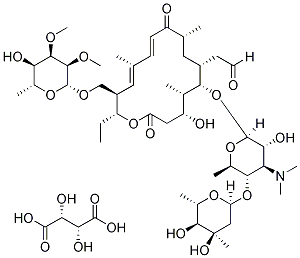
Chemical Structure
Molecular Weight: 1066.19
Purity & Quality Control
Batch:
Purity:
99.52%
99.52
Related Products
| Related Compound Libraries | Anti-infection Compound Library Antibiotics compound Library Antiviral Compound Library Anti-parasitic Compound Library Gut Microbial Metabolite Library | Click to Expand |
|---|
Mechanism of Action
In vitro |
||||
| In vitro | Tylosin tartrate (25 mg/L) significantly inhibits methane production relative to unamended controls, thus indicating that this compound at concentrations commonly found in swine lagoons can negatively impact anaerobic metabolism. [1] Its disappearance follows a biphasic pattern, where rapid initial loss is followed by a slow removal phase. The 90% disappearance times for tylosin, relomycin (tylosin D), and desmycosin (tylosin B) in anaerobically incubated slurries are 30 to 130 hours, and aerating the slurries reduced the 90% disappearance times to between 12 and 26 hours. This chemical is stable for at least one month when stored in Milli-Q water at pH 5.7 to 6.7 at 22 ℃. [2] | |||
|---|---|---|---|---|
In Vivo |
||
| In vivo | Tylosin increases splenocyte proliferation and splenocyte conditioned medium (CM) proliferative activity above control levels from whole splenocyte cultures in chickens. Tylosin also increases antitumor activity of splenocytes in chickens. [3] This compound (50 mg/kg) administered orally twice daily for 10 days, beginning 14 days after intranasal infection, significantly reduces the incidence and severity of macroscopical pneumonic lung lesions in neonatal piglets. [4] After this chemical administered intravenously (i.v.) at 10 mg/kg in camels, serum tylosin concentrations in the water-deprived camels are significantly higher, rate of drug elimination is slower, the volume of distribution is significantly smaller, and total body clearance is significantly slower than in the normal camels. On the other hand, serum tylosin concentrations are lower in the water deprived camels and the mean absorption time is significantly shorter in camels treat with this compound (20 mg/kg i.m.). [5] | |
|---|---|---|
References |
|
Chemical Information
| Molecular Weight | 1066.19 | Formula | C46H77NO17.C4H6O6 |
| CAS No. | 74610-55-2 | SDF | Download SDF |
| Synonyms | N/A | ||
| Smiles | CC1C(C=C(C=CC(=O)C(CC(C(C(C(CC(=O)O1)O)C)OC2C(C(C(C(O2)C)OC3CC(C(C(O3)C)O)(C)O)N(C)C)O)CC=O)C)C)COC4C(C(C(C(O4)C)O)OC)OC.C(C(C(=O)O)O)(C(=O)O)O | ||
Storage and Stability
| Storage (From the date of receipt) | |||
|
In vitro |
DMSO : 300 mg/mL ( (281.37 mM) Moisture-absorbing DMSO reduces solubility. Please use fresh DMSO.) Ethanol : 300 mg/mL Water : 200 mg/mL |
Molecular Weight Calculator |
|
In vivo Add solvents to the product individually and in order. |
In vivo Formulation Calculator |
|||||
Preparing Stock Solutions
Molarity Calculator
In vivo Formulation Calculator (Clear solution)
Step 1: Enter information below (Recommended: An additional animal making an allowance for loss during the experiment)
mg/kg
g
μL
Step 2: Enter the in vivo formulation (This is only the calculator, not formulation. Please contact us first if there is no in vivo formulation at the solubility Section.)
% DMSO
%
% Tween 80
% ddH2O
%DMSO
%
Calculation results:
Working concentration: mg/ml;
Method for preparing DMSO master liquid: mg drug pre-dissolved in μL DMSO ( Master liquid concentration mg/mL, Please contact us first if the concentration exceeds the DMSO solubility of the batch of drug. )
Method for preparing in vivo formulation: Take μL DMSO master liquid, next addμL PEG300, mix and clarify, next addμL Tween 80, mix and clarify, next add μL ddH2O, mix and clarify.
Method for preparing in vivo formulation: Take μL DMSO master liquid, next add μL Corn oil, mix and clarify.
Note: 1. Please make sure the liquid is clear before adding the next solvent.
2. Be sure to add the solvent(s) in order. You must ensure that the solution obtained, in the previous addition, is a clear solution before proceeding to add the next solvent. Physical methods such
as vortex, ultrasound or hot water bath can be used to aid dissolving.
Tech Support
Answers to questions you may have can be found in the inhibitor handling instructions. Topics include how to prepare stock solutions, how to store inhibitors, and issues that need special attention for cell-based assays and animal experiments.
Tel: +1-832-582-8158 Ext:3
If you have any other enquiries, please leave a message.
* Indicates a Required Field



Products are for research use only. Not for human use. We do not sell to patients.
©Copyright 2013 Selleck Chemicals. All Rights Reserved.