
-
 Australia
-
 Austria
-
 Belgium
-
 Brazil
-
 Canada
-
 China
China
-
 Czech Republic
-
 Denmark
-
 Finland
-
 France
-
 Germany
-
 Greece
-
 Hong Kong
-
 Hungary
-
 Iceland
-
 India
India
-
 Ireland
-
 Israel
-
 Italy
Italy
-
 Japan
Japan
-
 Korea
Korea
-
 Luxembourg
-
 Malaysia
-
 Netherlands
-
 New Zealand
-
 Norway
-
 Poland
-
 Qatar
Qatar
-
 Romania
-
 Saudi Arabia
-
 Singapore
-
 Spain
Spain
-
 Sweden
-
 Switzerland
-
 Taiwan
-
 Turkey
-
 United Kingdom
-
 United States
research use only
Terazosin HCl Dihydrate Adrenergic Receptor antagonist
Cat.No.S2059
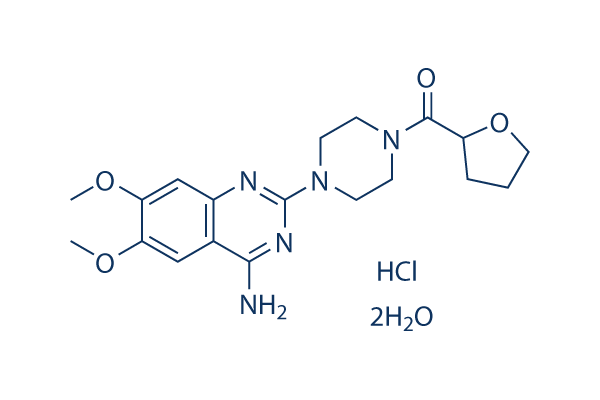
Chemical Structure
Molecular Weight: 459.92
Quality Control
| Related Targets | AChR 5-HT Receptor COX Calcium Channel Histamine Receptor Dopamine Receptor GABA Receptor TRP Channel Cholinesterase (ChE) GluR |
|---|---|
| Other Adrenergic Receptor Inhibitors | Zenidolol (ICI-118551) Hydrochloride L755507 Yohimbine HCl Atipamezole Higenamine hydrochloride Detomidine HCl Naftopidil Demethyl-Coclaurine Buflomedil HCl Fenoterol hydrobromide |
Solubility
|
In vitro |
DMSO
: 26 mg/mL
(56.53 mM)
Water : Insoluble Ethanol : Insoluble |
Molarity Calculator
|
In vivo |
|||||
In vivo Formulation Calculator (Clear solution)
Step 1: Enter information below (Recommended: An additional animal making an allowance for loss during the experiment)
Step 2: Enter the in vivo formulation (This is only the calculator, not formulation. Please contact us first if there is no in vivo formulation at the solubility Section.)
Calculation results:
Working concentration: mg/ml;
Method for preparing DMSO master liquid: mg drug pre-dissolved in μL DMSO ( Master liquid concentration mg/mL, Please contact us first if the concentration exceeds the DMSO solubility of the batch of drug. )
Method for preparing in vivo formulation: Take μL DMSO master liquid, next addμL PEG300, mix and clarify, next addμL Tween 80, mix and clarify, next add μL ddH2O, mix and clarify.
Method for preparing in vivo formulation: Take μL DMSO master liquid, next add μL Corn oil, mix and clarify.
Note: 1. Please make sure the liquid is clear before adding the next solvent.
2. Be sure to add the solvent(s) in order. You must ensure that the solution obtained, in the previous addition, is a clear solution before proceeding to add the next solvent. Physical methods such
as vortex, ultrasound or hot water bath can be used to aid dissolving.
Chemical Information, Storage & Stability
| Molecular Weight | 459.92 | Formula | C19H25N5O4.HCl.2H2O |
Storage (From the date of receipt) | |
|---|---|---|---|---|---|
| CAS No. | 70024-40-7 | Download SDF | Storage of Stock Solutions |
|
|
| Synonyms | N/A | Smiles | COC1=C(C=C2C(=C1)C(=NC(=N2)N3CCN(CC3)C(=O)C4CCCO4)N)OC.O.O.Cl | ||
Mechanism of Action
| Targets/IC50/Ki |
α-adrenergic receptor
|
|---|---|
| In vitro |
Terazosin results in a significant loss of cell viability, via induction of apoptosis in a dose-dependent manner in prostate cancer cells. Terazosin suppresses prostate growth potentially via α 1-adrenoceptor-independent actions gains further support from another study documenting that Doxazosin inhibits proliferation of human vascular smooth muscle cells independently of an antagonistic effect on α1-adrenoceptor. Terazosin blocks HERG currents in Xenopus oocytes with IC50 of 113.2 mM, while Terazosin blocks HERG channel inhibition in human HEK 293 cells with IC50 of 17.7 mM. Terazosin or genistein treatment inhibits the growth of DU-145 cells in a dose-dependent manner, whereas has no effect on normal prostate epithelial cells. Terazosin results in the genistein-induced arrest of DU-145 cells in G2/M phase being overridden and an increase in apoptotic cells, as evidenced by procaspase-3 activation and PARP cleavage. Terazosin induces cytotoxicity in PC-3 and human benign prostatic cells with an IC50 of more than 100 mM.
|
| In vivo |
Terazosin significantly inhibits vascular endothelial growth factor induced angiogenesis in nude mice with an IC50 of 7.9 mM, showing that it has a more potent anti-angiogenic than cytotoxic effect. Terazosin also effectively inhibits vascular endothelial growth factor induced proliferation and tube formation in cultured human umbilical vein endothelial cells (IC50 9.9 and 6.8 mM, respectively).
|
References |
|
Clinical Trial Information
(data from https://clinicaltrials.gov, updated on 2024-05-22)
| NCT Number | Recruitment | Conditions | Sponsor/Collaborators | Start Date | Phases |
|---|---|---|---|---|---|
| NCT04760860 | Not yet recruiting | Dementia With Lewy Bodies |
Qiang Zhang|University of Iowa |
October 2024 | Phase 1|Phase 2 |
| NCT04551040 | Active not recruiting | Healthy |
University of Iowa|Michael J. Fox Foundation for Parkinson''s Research |
March 26 2021 | Phase 1 |
| NCT04386317 | Recruiting | REM Sleep Behavior Disorder|Pre-motor Parkinson''s Disease|Symptomatic Parkinson Disease |
Cedars-Sinai Medical Center |
November 1 2020 | Phase 2 |
| NCT00449683 | Completed | Hyperhidrosis |
Thomas Jefferson University|National Alliance for Research on Schizophrenia and Depression |
March 2007 | Phase 4 |
| NCT00237510 | Completed | Antidepressant Induced Excessive Sweating |
Thomas Jefferson University |
May 2005 | Not Applicable |
| NCT02244333 | Completed | Prostatic Hyperplasia |
Boehringer Ingelheim |
February 2004 | -- |
Tech Support
Tel: +1-832-582-8158 Ext:3
If you have any other enquiries, please leave a message.
Signaling Pathway Map

Products are for research use only. Not for human use. We do not sell to patients.
©Copyright 2013 Selleck Chemicals. All Rights Reserved.