
-
 Australia
-
 Austria
-
 Belgium
-
 Brazil
-
 Canada
-
 China
China
-
 Czech Republic
-
 Denmark
-
 Finland
-
 France
-
 Germany
-
 Greece
-
 Hong Kong
-
 Hungary
-
 Iceland
-
 India
India
-
 Ireland
-
 Israel
-
 Italy
Italy
-
 Japan
Japan
-
 Korea
Korea
-
 Luxembourg
-
 Malaysia
-
 Netherlands
-
 New Zealand
-
 Norway
-
 Poland
-
 Qatar
Qatar
-
 Romania
-
 Saudi Arabia
-
 Singapore
-
 Spain
Spain
-
 Sweden
-
 Switzerland
-
 Taiwan
-
 Turkey
-
 United Kingdom
-
 United States
research use only
Synephrine HCl Adrenergic Receptor agonist
Cat.No.S2438
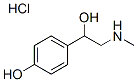
Chemical Structure
Molecular Weight: 203.67
Quality Control
| Related Targets | AChR 5-HT Receptor COX Calcium Channel Histamine Receptor Dopamine Receptor GABA Receptor TRP Channel Cholinesterase (ChE) GluR |
|---|---|
| Other Adrenergic Receptor Inhibitors | Zenidolol (ICI-118551) Hydrochloride L755507 Yohimbine HCl Atipamezole Higenamine hydrochloride Detomidine HCl Naftopidil Demethyl-Coclaurine Buflomedil HCl Fenoterol hydrobromide |
Solubility
|
In vitro |
Water : 41 mg/mL
DMSO
: 14 mg/mL
(68.73 mM)
Ethanol : 4 mg/mL |
Molarity Calculator
|
In vivo |
|||||
In vivo Formulation Calculator (Clear solution)
Step 1: Enter information below (Recommended: An additional animal making an allowance for loss during the experiment)
Step 2: Enter the in vivo formulation (This is only the calculator, not formulation. Please contact us first if there is no in vivo formulation at the solubility Section.)
Calculation results:
Working concentration: mg/ml;
Method for preparing DMSO master liquid: mg drug pre-dissolved in μL DMSO ( Master liquid concentration mg/mL, Please contact us first if the concentration exceeds the DMSO solubility of the batch of drug. )
Method for preparing in vivo formulation: Take μL DMSO master liquid, next addμL PEG300, mix and clarify, next addμL Tween 80, mix and clarify, next add μL ddH2O, mix and clarify.
Method for preparing in vivo formulation: Take μL DMSO master liquid, next add μL Corn oil, mix and clarify.
Note: 1. Please make sure the liquid is clear before adding the next solvent.
2. Be sure to add the solvent(s) in order. You must ensure that the solution obtained, in the previous addition, is a clear solution before proceeding to add the next solvent. Physical methods such
as vortex, ultrasound or hot water bath can be used to aid dissolving.
Chemical Information, Storage & Stability
| Molecular Weight | 203.67 | Formula | C9H13NO2.HCl |
Storage (From the date of receipt) | |
|---|---|---|---|---|---|
| CAS No. | 5985-28-4 | Download SDF | Storage of Stock Solutions |
|
|
| Synonyms | N/A | Smiles | CNCC(C1=CC=C(C=C1)O)O.Cl | ||
Mechanism of Action
| Targets/IC50/Ki |
α-adrenergic receptor
|
|---|---|
| In vitro |
Synephrine (0.1-30 μM) displays potent vasoconstrictive effects on isolated rat aorta in a dose dependent manner, which can be significantly inhibited by pretreatment with prazosin, BRL15572, and ketanserin but not by pretreatment with SB216641 and propranolol, indicating that Synephrine exerts the constrictive effects via adrenergic alpha(1)-receptors, serotonergic 5-HT(1D) receptors, and 5-HT(2A) receptors. Although the Ki values of Synephrine, 1R,2S-norephedrine, and β-phenethylamine are same for all three subtypes, only Synephrine is a partial agonist of α1A-AR subtype stably expressed in HEK 293 cells with EC50 of 4 µM, giving a maximal response at 100 µM that is equal to 55.3 % of the L-phenylephrine maximum. Functional studies on the α2A- and α2C-AR subtypes stably expressed in CHO cells indicate that Synephrine may act as an antagonist rather than an agonist of the pre-synaptic α(2A)- and α(2C)-AR subtypes present in nerve terminals, although antagonist activity of synephrine is lower than its partial agonist potency. Synephrine (~100 μM) treatment increases basal glucose consumption up to 50% over the control in a dose-dependent manner, without affecting the viability of L6 skeletal muscle cells. Synephrine significantly stimulates the basal- or insulin-stimulated lactic acid production as well as glucose consumption. Synephrine treatment stimulates the phosphorylation of AMPK but not Akt, and Synephrine-induced glucose consumption and the translocation of Glut4 from the cytoplasm to the plasma membrane are sensitive to the inhibition of AMPK but not to the inhibition of PI3 kinase.
|
| In vivo |
Administration of Synephrine (1 mg/kg per 12 hours) for 8 days significantly improves the hyperdynamic state in portal hypertensive rats induced by either partial portal vein ligation (PVL) or bile duct ligation (BDL), and significantly reduces the portal venous pressure, portal tributary blood flow and cardiac index in both PVL and BDL rats.
|
References |
|
Tech Support
Tel: +1-832-582-8158 Ext:3
If you have any other enquiries, please leave a message.
Signaling Pathway Map

Products are for research use only. Not for human use. We do not sell to patients.
©Copyright 2013 Selleck Chemicals. All Rights Reserved.