
-
 Australia
-
 Austria
-
 Belgium
-
 Brazil
-
 Canada
-
 China
China
-
 Czech Republic
-
 Denmark
-
 Finland
-
 France
-
 Germany
-
 Greece
-
 Hong Kong
-
 Hungary
-
 Iceland
-
 India
India
-
 Ireland
-
 Israel
-
 Italy
Italy
-
 Japan
Japan
-
 Korea
Korea
-
 Luxembourg
-
 Malaysia
-
 Netherlands
-
 New Zealand
-
 Norway
-
 Poland
-
 Qatar
Qatar
-
 Romania
-
 Saudi Arabia
-
 Singapore
-
 Spain
Spain
-
 Sweden
-
 Switzerland
-
 Taiwan
-
 Turkey
-
 United Kingdom
-
 United States
research use only
Idebenone ROS chemical
Cat.No.S2605
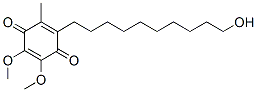
Chemical Structure
Molecular Weight: 338.44
Quality Control
Solubility
|
In vitro |
DMSO
: 68 mg/mL
(200.92 mM)
Ethanol : 68 mg/mL Water : Insoluble |
Molarity Calculator
|
In vivo |
|||||
In vivo Formulation Calculator (Clear solution)
Step 1: Enter information below (Recommended: An additional animal making an allowance for loss during the experiment)
Step 2: Enter the in vivo formulation (This is only the calculator, not formulation. Please contact us first if there is no in vivo formulation at the solubility Section.)
Calculation results:
Working concentration: mg/ml;
Method for preparing DMSO master liquid: mg drug pre-dissolved in μL DMSO ( Master liquid concentration mg/mL, Please contact us first if the concentration exceeds the DMSO solubility of the batch of drug. )
Method for preparing in vivo formulation: Take μL DMSO master liquid, next addμL PEG300, mix and clarify, next addμL Tween 80, mix and clarify, next add μL ddH2O, mix and clarify.
Method for preparing in vivo formulation: Take μL DMSO master liquid, next add μL Corn oil, mix and clarify.
Note: 1. Please make sure the liquid is clear before adding the next solvent.
2. Be sure to add the solvent(s) in order. You must ensure that the solution obtained, in the previous addition, is a clear solution before proceeding to add the next solvent. Physical methods such
as vortex, ultrasound or hot water bath can be used to aid dissolving.
Chemical Information, Storage & Stability
| Molecular Weight | 338.44 | Formula | C19H30O5 |
Storage (From the date of receipt) | |
|---|---|---|---|---|---|
| CAS No. | 58186-27-9 | Download SDF | Storage of Stock Solutions |
|
|
| Synonyms | CV-2619 | Smiles | CC1=C(C(=O)C(=C(C1=O)OC)OC)CCCCCCCCCCO | ||
Mechanism of Action
| In vitro |
Idebenone effectively protects from retinal cell injury after oxidative stress or hypoglycemia, whereas the protection afforded after postincubation of both antioxidants is decreased. This compound attenuates delayed retinal cell damage, mediated by chemical ischemia. This chemical, a centrally active antioxidant used to treat multiinfarct dementia, protects cells from this form of glutamate-induced cytotoxicity in vitro. It provides significant protection against the neuronal degeneration induced by intrastriatal injection of kainic acid and quisqualic acid, but not the NMDA receptor agonist, quinolinic acid.
|
|---|---|
| In vivo |
Idebenone prevents the behavioural deficits in Y-maze and water maze, but not passive avoidance, tasks in A beta-(1-42)-infused rats when they are repeatedly administered by mouth once a day from 3 days before the start of A beta infusion to the end of behavioural experiments. This compound (100 and 300 mg/kg) is orally administered to rats for 3 days, it increases the state 3 respiration stimulated by ADP, slightly decreasez the state 4 respiration after the consumption of ADP and resultz in a significant increase of the respiratory control index (RCI) by 14-19% for glutamate oxidation and 10-17% for succinate oxidation, respectively. It significantly suppresses by about 10% the non-respiratory oxygen consumption, which closely associated with non-enzymatic reactions such as lipid peroxidation, membrane lysis and swelling of mitochondria.
|
References |
|
Clinical Trial Information
(data from https://clinicaltrials.gov, updated on 2024-05-22)
| NCT Number | Recruitment | Conditions | Sponsor/Collaborators | Start Date | Phases |
|---|---|---|---|---|---|
| NCT01303406 | Completed | Friedreich''s Ataxia |
Santhera Pharmaceuticals |
April 2011 | Phase 3 |
| NCT00758225 | Completed | Duchenne Muscular Dystrophy |
Santhera Pharmaceuticals |
September 2008 | Phase 2 |
| NCT00747487 | Completed | Leber''s Hereditary Optic Neuropathy |
Santhera Pharmaceuticals |
November 2007 | Phase 2 |
| NCT00229632 | Completed | Friedreich Ataxia |
National Institute of Neurological Disorders and Stroke (NINDS)|National Institutes of Health Clinical Center (CC) |
September 27 2005 | Phase 2 |
Tech Support
Tel: +1-832-582-8158 Ext:3
If you have any other enquiries, please leave a message.

Products are for research use only. Not for human use. We do not sell to patients.
©Copyright 2013 Selleck Chemicals. All Rights Reserved.