
-
 Australia
-
 Austria
-
 Belgium
-
 Brazil
-
 Canada
-
 China
China
-
 Czech Republic
-
 Denmark
-
 Finland
-
 France
-
 Germany
-
 Greece
-
 Hong Kong
-
 Hungary
-
 Iceland
-
 India
India
-
 Ireland
-
 Israel
-
 Italy
Italy
-
 Japan
Japan
-
 Korea
Korea
-
 Luxembourg
-
 Malaysia
-
 Netherlands
-
 New Zealand
-
 Norway
-
 Poland
-
 Qatar
Qatar
-
 Romania
-
 Saudi Arabia
-
 Singapore
-
 Spain
Spain
-
 Sweden
-
 Switzerland
-
 Taiwan
-
 Turkey
-
 United Kingdom
-
 United States
research use only
Efaproxiral Sodium ROS modulator
Cat.No.S4263
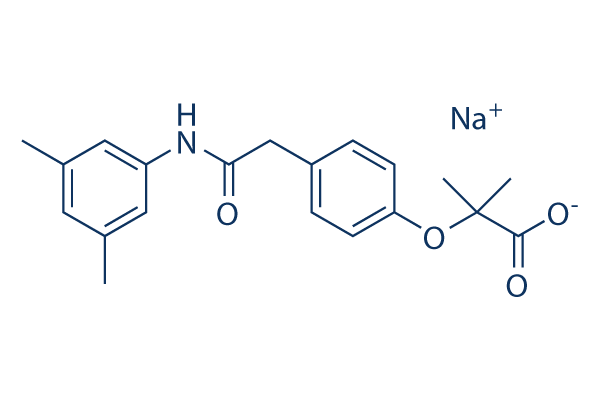
Chemical Structure
Molecular Weight: 363.38
Quality Control
Solubility
|
In vitro |
DMSO
: 73 mg/mL
(200.89 mM)
Water : 73 mg/mL Ethanol : 73 mg/mL |
Molarity Calculator
|
In vivo |
|||||
In vivo Formulation Calculator (Clear solution)
Step 1: Enter information below (Recommended: An additional animal making an allowance for loss during the experiment)
Step 2: Enter the in vivo formulation (This is only the calculator, not formulation. Please contact us first if there is no in vivo formulation at the solubility Section.)
Calculation results:
Working concentration: mg/ml;
Method for preparing DMSO master liquid: mg drug pre-dissolved in μL DMSO ( Master liquid concentration mg/mL, Please contact us first if the concentration exceeds the DMSO solubility of the batch of drug. )
Method for preparing in vivo formulation: Take μL DMSO master liquid, next addμL PEG300, mix and clarify, next addμL Tween 80, mix and clarify, next add μL ddH2O, mix and clarify.
Method for preparing in vivo formulation: Take μL DMSO master liquid, next add μL Corn oil, mix and clarify.
Note: 1. Please make sure the liquid is clear before adding the next solvent.
2. Be sure to add the solvent(s) in order. You must ensure that the solution obtained, in the previous addition, is a clear solution before proceeding to add the next solvent. Physical methods such
as vortex, ultrasound or hot water bath can be used to aid dissolving.
Chemical Information, Storage & Stability
| Molecular Weight | 363.38 | Formula | C20H23NO4.Na |
Storage (From the date of receipt) | |
|---|---|---|---|---|---|
| CAS No. | 170787-99-2 | Download SDF | Storage of Stock Solutions |
|
|
| Synonyms | RSR13 Sodium | Smiles | CC1=CC(=CC(=C1)NC(=O)CC2=CC=C(C=C2)OC(C)(C)C(=O)[O-])C.[Na+] | ||
Mechanism of Action
| In vitro |
Efaproxiral Sodium, a synthetic allosteric modifier of hemoglobinoxygen binding affinity, has been shown to bind reversibly to hemoglobin, stabilizing the deoxyhemoglobin tetramer conformation to reduce its affinity for oxygen. |
|---|---|
| In vivo |
Efaproxiral Sodium plus oxygen breathing reduces the radiobiological hypoxic fraction of EMT6 tumors from the value of 24% found in both air-breathing and oxygen-breathing mice to 9% and improves the response of the tumors to radiation. Carboplatin (100 mg/kg) slowes tumor growth in air-breathing mice, producing a growth delay of 3.3 days. This compound plus oxygen increases the growth delay to 5.7 days; this is 2.4 days (71%) greater than that for carboplatin alone and 2.1 days (57%) greater than that for carboplatin plus oxygen breathing. This chemical plus oxygen breathing, therefore, improves the tumor growth delay obtained with 100 mg/kg carboplatin to or beyond that obtained with the highly toxic dose of 150 mg/kg carboplatin, but does so without increasing the toxicity beyond that seen with 100 mg/kg carboplatin in air-breathing mice. It significantly increases tumor oxygenation by 8.4 to 43.4 mmHg within 5 days in C3H mice with RIF-1 tumors, with maximum increases at 22-31 min after treatment. This compound plus oxygen plus Radiation produces tumor growth inhibition throughout the treatment duration in C3H mice with RIF-1 tumors, and inhibition is significantly different from radiation plus oxygen from day 3 to day 5. |
References |
|
Clinical Trial Information
(data from https://clinicaltrials.gov, updated on 2024-05-22)
| NCT Number | Recruitment | Conditions | Sponsor/Collaborators | Start Date | Phases |
|---|---|---|---|---|---|
| NCT00433472 | Withdrawn | Brain and Central Nervous System Tumors |
Sidney Kimmel Comprehensive Cancer Center at Johns Hopkins|National Cancer Institute (NCI) |
Not Applicable |
Tech Support
Tel: +1-832-582-8158 Ext:3
If you have any other enquiries, please leave a message.

Products are for research use only. Not for human use. We do not sell to patients.
©Copyright 2013 Selleck Chemicals. All Rights Reserved.