


Executive Summary
The accurate adjudication of cardiovascular (CV) endpoints is a cornerstone of modern clinical trial design. In 2012, amidst growing scrutiny regarding the cardiovascular safety of non-cardiovascular drugs (particularly in the realms of diabetes and oncology), the need for a unified language to define adverse events became critical. Variations in how investigators defined a “heart attack” or “hospitalization for heart failure” could lead to statistical discrepancies that masked true safety signals or created false positives.
This 2012 Draft Consensus, often referred to as the “MI Preamble” document, sought to align clinical trial adjudication with the Third Universal Definition of Myocardial Infarction. Furthermore, it established rigorous, objective criteria for identifying Heart Failure events, ensuring that subjective patient reports were substantiated by hemodynamic or biomarker evidence.
For contemporary researchers, understanding these historical definitions is not merely an academic exercise; it provides the context for current regulatory guidelines (such as ICH E19) and informs the pre-clinical development strategies—specifically how early-stage compound screening and mechanistic toxicity studies are designed to prevent these clinical outcomes.
Part I: The MI Preamble – Redefining Myocardial Infarction
The diagnosis of Myocardial Infarction (MI) in a clinical trial setting presents unique challenges compared to routine clinical practice. In trials, data may be missing, and “silent” MIs detected only via routine ECG monitoring must be distinguished from acute symptomatic events. The 2012 definitions categorized MI based on etiology and mandated specific evidentiary thresholds.
1. The Central Role of Cardiac Biomarkers
The 2012 draft emphasized that myocardial necrosis is the fundamental pathology of MI. Consequently, the detection of specific biomarkers was elevated to a primary diagnostic criterion.
- Cardiac Troponin (cTn): The preferred biomarker, due to its high tissue specificity. The definition required a rise and/or fall of cardiac troponin values with at least one value exceeding the 99th percentile upper reference limit (URL).
- CK-MB: Creatine Kinase-MB was retained as an alternative only when cTn assays were unavailable.
| Criteria Category | Definition & Threshold | Research Context (Biochemical Tools) |
|---|---|---|
| Biomarker Evidence | Cardiac Troponin (cTn) > 99th percentile URL with a rise/fall pattern. | Requires high-sensitivity assays validated by reagent standards. |
| Ischemic Symptoms | Acute chest pain, dyspnea, or anginal equivalents. | Modeled in vitro using hypoxia-inducing agents. |
| ECG Changes | New ST-segment T-wave changes or LBBB; Pathological Q waves. | Correlated with ion channel dysfunction (e.g., hERG inhibition). |
| Imaging Evidence | Loss of viable myocardium or new regional wall motion abnormality. | Validated via mechanistic studies using small molecule probes. |
2. Clinical and Electrocardiographic Criteria
Biomarker elevation alone (myocardial injury) was insufficient for an MI diagnosis without corroborating evidence of ischemia. The draft specified that at least one of the following must accompany the biomarker rise: Symptoms of Ischemia, New ECG Changes, Pathological Q Waves, or Imaging Evidence.
3. Classification by Etiology
The document adopted the universal classification system, including Type 1 (Spontaneous MI), Type 2 (Secondary to supply/demand mismatch), Type 3 (Sudden unexpected cardiac death), and Type 4 & 5 (Associated with PCI/CABG).

Part II: Heart Failure (HF) – A Cardiovascular Outcome in Diabetes
As highlighted in seminal publications within The Lancet Diabetes & Endocrinology, heart failure is a pervasive comorbidity in diabetic patients. The 2012 Draft Definitions were instrumental in standardizing “Hospitalization for Heart Failure” (hHF) as a primary endpoint.
- Objective Evidence: Confirmation via Echocardiography (HFrEF or HFpEF) and Biomarkers (BNP or NT-proBNP).
- Adjudication of Hospitalization: Admission required primary treatment including IV diuretics, vasodilators, or mechanical fluid removal.
Part III: Adjudication Process and Data Quality
The “Clean” version of the 2012 definitions also addressed the operational aspects of EACs. The draft proposed specific data fields for Case Report Forms (CRFs), including Raw Biomarker Data and digital ECG Waveforms. This emphasis on high-fidelity data mirrors the shift in early discovery phases where High-Throughput Screening (HTS) generates massive datasets.
Part IV: Bridging Clinical Definitions to Pre-Clinical Discovery
The ultimate goal of the 2012 Draft Definitions was not just to categorize damage, but to prevent it. By clearly defining what constitutes cardiac toxicity (MI, HF, Arrhythmia) in humans, the consortium provided a “reverse blueprint” for drug discovery.
1. From TQT to CiPA
The industry is moving toward the Comprehensive in vitro Proarrhythmia Assay (CiPA), integrating in vitro ion channel assays, in silico modeling, and stem cell models.
2. Mitigating Mitochondrial Toxicity and Apoptosis
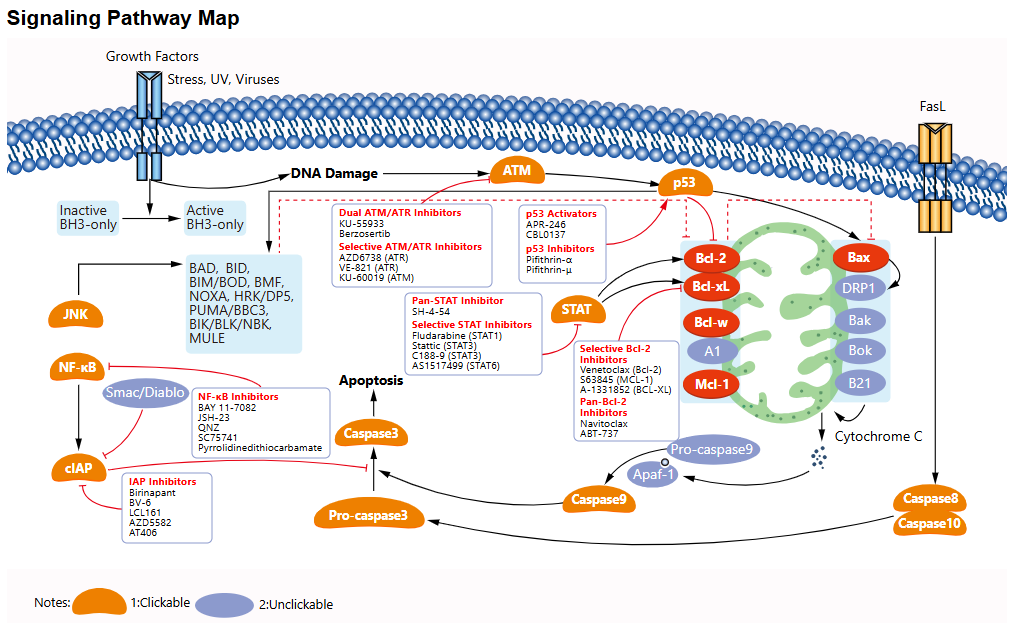
Understanding the mechanisms of cardiomyocyte death (necrosis vs. apoptosis) is crucial for distinguishing Type 1 MI from drug-induced toxicity. Researchers utilize specific inhibitors shown in this pathway, such as Venetoclax (ABT-199) and Navitoclax, to model these safety thresholds in vitro.
Conclusion
The Draft Definitions for Testing (November 9, 2012) represented a watershed moment. They remind us that clinical safety begins in the laboratory. Whether it is through the precise application of ion channel screening, the use of targeted inhibitor libraries to map toxicity pathways, or the rigorous adjudication of clinical endpoints, the goal remains the same: developing therapies that extend life without compromising cardiac health.
References & Further Reading
- Gintant G, Sager PT, Stockbridge N. Evolution of strategies to improve preclinical cardiac safety testing. Nat Rev Drug Discov. 2016.
- Thygesen K, Alpert JS, Jaffe AS, et al. Third universal definition of myocardial infarction. Circulation. 2012.
- McMurray JJ, Adamopoulos S, Anker SD, et al. ESC Guidelines for the diagnosis and treatment of acute and chronic heart failure 2012.
- Sager PT, Gintant G, Turner JR, et al. Rechanneling the cardiac proarrhythmia safety paradigm: a meeting report from the Cardiac Safety Research Consortium. Am Heart J. 2014.
