
-
 Argentina
-
 Australia
-
 Austria
-
 Belgium
-
 Brazil
-
 Canada
-
 China
China
-
 Czech Republic
-
 Denmark
-
 Finland
-
 France
-
 Germany
-
 Greece
-
 Hong Kong
-
 Hungary
-
 Iceland
-
 India
India
-
 Ireland
-
 Israel
-
 Italy
Italy
-
 Japan
Japan
-
 Korea
Korea
-
 Luxembourg
-
 Malaysia
-
 Netherlands
-
 New Zealand
-
 Norway
-
 Poland
-
 Portugal
-
 Qatar
Qatar
-
 Romania
-
 Saudi Arabia
-
 Singapore
-
 Spain
Spain
-
 Sweden
-
 Switzerland
-
 Taiwan
-
 Turkey
-
 United Kingdom
-
 United States
research use only
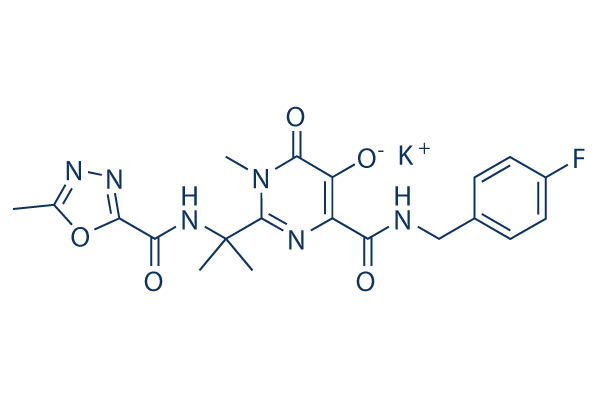
Raltegravir potassium Integrase inhibitor
Cat.No.S5245
Quality Control
| Related Targets | Bacterial Antibiotics Anti-infection Fungal Antiviral COVID-19 Parasite Reverse Transcriptase HIV HCV Protease |
|---|---|
| Other Integrase Inhibitors | MK-2048 BMS-707035 Robinetin Lavendustin B |
Solubility
|
In vitro |
DMSO
: 96 mg/mL
(198.95 mM)
Ethanol : 10 mg/mL Water : Insoluble |
Molarity Calculator
|
In vivo |
|||||
In vivo Formulation Calculator (Clear solution)
Step 1: Enter information below (Recommended: An additional animal making an allowance for loss during the experiment)
Step 2: Enter the in vivo formulation (This is only the calculator, not formulation. Please contact us first if there is no in vivo formulation at the solubility Section.)
Calculation results:
Working concentration: mg/ml;
Method for preparing DMSO master liquid: mg drug pre-dissolved in μL DMSO ( Master liquid concentration mg/mL, Please contact us first if the concentration exceeds the DMSO solubility of the batch of drug. )
Method for preparing in vivo formulation: Take μL DMSO master liquid, next addμL PEG300, mix and clarify, next addμL Tween 80, mix and clarify, next add μL ddH2O, mix and clarify.
Method for preparing in vivo formulation: Take μL DMSO master liquid, next add μL Corn oil, mix and clarify.
Note: 1. Please make sure the liquid is clear before adding the next solvent.
2. Be sure to add the solvent(s) in order. You must ensure that the solution obtained, in the previous addition, is a clear solution before proceeding to add the next solvent. Physical methods such
as vortex, ultrasound or hot water bath can be used to aid dissolving.
Chemical Information, Storage & Stability
| Molecular Weight | 482.51 | Formula | C20H20FN6O5.K |
Storage (From the date of receipt) | |
|---|---|---|---|---|---|
| CAS No. | 871038-72-1 | -- | Storage of Stock Solutions |
|
|
| Synonyms | MK-0518 potassium | SMILES | CC1=NN=C(O1)C(=O)NC(C)(C)C2=NC(=C(C(=O)N2C)[O-])C(=O)NCC3=CC=C(C=C3)F.[K+] | ||
Read more about storage stability stock solution CAS number SMILES
Mechanism of Action
| Targets/IC50/Ki |
HIV integrase
|
|---|---|
| In vitro |
PFV IN carrying the S217H substitution is 10-fold less susceptible to Raltegravir with IC50 of 900 nM. PFV IN displays 10% of WT activity and is inhibited by Raltegravir with an IC50 of 200 nM, indicating a ~twofold decrease in susceptibility to the IN strand transfer inhibitor (INSTI) compared with WT IN. S217Q PFV IN is as sensitive to Raltegravir as the WT enzyme. Raltegravir is metabolized by glucuronidation, not hepatically. Raltegravir has potent in vitro activity against HIV-1, with a 95% inhibitory concentration of 31?0 nM, in human T lymphoid cell cultures. Raltegravir is also active against HIV-2 when Raltegravir is tested in CEMx174 cells, with an IC95 of 6 nM. Raltegravir metabolism occurs primarily through glucuronidation. Drugs that are strong inducers of the glucuronidation enzyme, UGT1A1, significantly reduce Raltegravir concentrations and should not be used. Raltegravir exhibits weak inhibitory effects on hepatic cytochrome P450 activity. Raltegravir does not induce CYP3A4 RNA expression or CYP3A4-dependent testosterone 6-β-hydroxylase activity. Raltegravir cellular permeativity is reduced in the presence of magnesium and calcium. Raltegravir and related HIV-1 integrase (IN) strand transfer inhibitors (INSTIs efficiently block viral replication. In acutely infected human lymphoid CD4+ T-cell lines MT-4 and CEMx174, SIVmac251 replication is efficiently inhibited by Raltegravir, which shows an EC90 in the low nanomolar range. |
| In vivo |
Raltegravir induces viro-immunological improvement of nonhuman primates with progressing SIVmac251 infection. One non-human primate shows an undetectable viral load following Raltegravir monotherapy. |
References |
|
Clinical Trial Information
(data from https://clinicaltrials.gov, updated on 2026-08-19)
| NCT Number | Recruitment | Conditions | Sponsor/Collaborators | Start Date | Phases |
|---|---|---|---|---|---|
| NCT02140255 | RECRUITING | HIV Infection |
National Institute of Allergy and Infectious Diseases (NIAID) |
2015-01-23 | PHASE1; PHASE2 |
| NCT04513626 | RECRUITING | HIV Infections |
Centre de Recherches et d'Etude sur la Pathologie Tropicale et le Sida |
2020-09-15 | PHASE2 |
| NCT03174977 | UNKNOWN | HIV-1-infection |
University of California, San Francisco |
2018-04-01 | EARLY_PHASE1 |
| NCT04258475 | UNKNOWN | Calcium Supplementation in HIV Patients Using Raltegravir |
Ottawa Hospital Research Institute |
2020-12-09 | PHASE4 |
| NCT03954327 | COMPLETED | Primary Biliary Cholangitis |
University of Alberta |
2021-03-01 | PHASE2 |
| NCT02691065 | COMPLETED | HIV |
McGill University Health Centre/Research Institute of the McGill University Health Centre |
2017-01-20 | PHASE4 |
Read more about Clinical Trials
Tech Support
Tel: +1-832-582-8158 Ext:3
If you have any other enquiries, please leave a message.
Signaling Pathway Map

Products are for research use only. Not for human use. We do not sell to patients.
©Copyright 2013 Selleck Chemicals. All Rights Reserved.