
-
 Argentina
-
 Australia
-
 Austria
-
 Belgium
-
 Brazil
-
 Canada
-
 China
China
-
 Czech Republic
-
 Denmark
-
 Finland
-
 France
-
 Germany
-
 Greece
-
 Hong Kong
-
 Hungary
-
 Iceland
-
 India
India
-
 Ireland
-
 Israel
-
 Italy
Italy
-
 Japan
Japan
-
 Korea
Korea
-
 Luxembourg
-
 Malaysia
-
 Netherlands
-
 New Zealand
-
 Norway
-
 Poland
-
 Portugal
-
 Qatar
Qatar
-
 Romania
-
 Saudi Arabia
-
 Singapore
-
 Spain
Spain
-
 Sweden
-
 Switzerland
-
 Taiwan
-
 Turkey
-
 United Kingdom
-
 United States
research use only
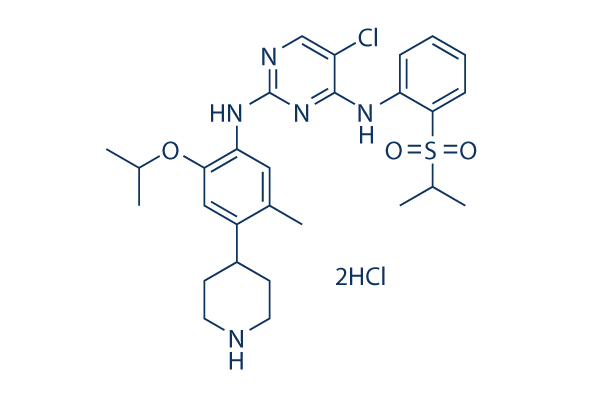
Ceritinib dihydrochloride ALK inhibitor
Cat.No.S4967
Quality Control
| Related Targets | EGFR VEGFR FGFR PDGFR c-Met Src MEK CSF-1R FLT3 HER2 |
|---|---|
| Other ALK Inhibitors | TAE684 (NVP-TAE684) GSK1838705A Repotrectinib (TPX-0005) Ensartinib dihydrochloride AZD3463 AP26113-analog (ALK-IN-1) ASP3026 NVL-655 (Neladalkib) HG-14-10-04 X-376 |
Solubility
|
In vitro |
DMSO
: 13 mg/mL
(20.6 mM)
Ethanol : 10 mg/mL Water : Insoluble |
Molarity Calculator
|
In vivo |
|||||
In vivo Formulation Calculator (Clear solution)
Step 1: Enter information below (Recommended: An additional animal making an allowance for loss during the experiment)
Step 2: Enter the in vivo formulation (This is only the calculator, not formulation. Please contact us first if there is no in vivo formulation at the solubility Section.)
Calculation results:
Working concentration: mg/ml;
Method for preparing DMSO master liquid: mg drug pre-dissolved in μL DMSO ( Master liquid concentration mg/mL, Please contact us first if the concentration exceeds the DMSO solubility of the batch of drug. )
Method for preparing in vivo formulation: Take μL DMSO master liquid, next addμL PEG300, mix and clarify, next addμL Tween 80, mix and clarify, next add μL ddH2O, mix and clarify.
Method for preparing in vivo formulation: Take μL DMSO master liquid, next add μL Corn oil, mix and clarify.
Note: 1. Please make sure the liquid is clear before adding the next solvent.
2. Be sure to add the solvent(s) in order. You must ensure that the solution obtained, in the previous addition, is a clear solution before proceeding to add the next solvent. Physical methods such
as vortex, ultrasound or hot water bath can be used to aid dissolving.
Chemical Information, Storage & Stability
| Molecular Weight | 631.06 | Formula | C28H38Cl3N5O3S |
Storage (From the date of receipt) | 3 years -20°C powder |
|---|---|---|---|---|---|
| CAS No. | 1380575-43-8 | -- | Storage of Stock Solutions |
|
|
| Synonyms | Zykadia, LDK378 dihydrochloride | SMILES | Cl.Cl.CC(C)OC1=C(NC2=NC=C(Cl)C(=N2)NC3=CC=CC=C3[S](=O)(=O)C(C)C)C=C(C)C(=C1)C4CCNCC4 | ||
Read more about storage stability stock solution CAS number SMILES
Mechanism of Action
| Targets/IC50/Ki |
ALK
(Cell-free assay) 0.2 nM
InsR
(Cell-free assay) 7 nM
IGF-1R
(Cell-free assay) 8 nM
STK22D
(Cell-free assay) 23 nM
|
|---|---|
| In vitro |
LDK378 shows great anti-proliferative activity in Ba/F3-NPM-ALK and Karpas290 cells with IC50 of 26.0 nM and 22.8 nM, compared with IC50 of 319.5 nM and 2477 nM in Ba/F3-Tel-InsR and Ba/F3-WT cells. |
| Kinase Assay |
Enzymatic kinase profiling description
|
|
All kinases are expressed as either Histidine- or GST-tagged fusion proteins using the baculovirus expression technology except for the untagged ERK2 which is produced in E. coli. The kinase activity is measured in the LabChip mobility shift assay. The assay is performed at 30°C for 60 min. The effect of LDK378 on the enzymatic activity is obtained from the linear progress curves in the absence and presence of LDK378 and routinely determines from one reading (end point measurement)
|
|
| In vivo |
LDK378 is designed to reduce the possibility of forming reactive metabolites and shows undetectable levels of glutathione (GSH) adducts (<1%) in liver microsomes. LDK378 has relatively good metabolic stability, with moderate CYP3A4 (Midazolam substrate) inhibition and hERG inhibition. LDK378 exhibits low plasma clearance in animals (mouse, rat, dog and monkey) compared to liver blood flow, with the oral bioavailability of above 55% in mouse, rat, dog and monkey. LDK378 induces a dose-dependent growth inhibition and tumor regression in the Karpas299 and H2228 rat xenograft models, with no body-weight loss. LDK378 shows no impact on insulin levels or plasma glucose utilization in the mouse upon chronic dosing up to 100 mg/kg. |
References |
|
Clinical Trial Information
(data from https://clinicaltrials.gov, updated on 2026-09-04)
| NCT Number | Recruitment | Conditions | Sponsor/Collaborators | Start Date | Phases |
|---|---|---|---|---|---|
| NCT02559778 | RECRUITING | Neuroblastoma |
Giselle Sholler |
2015-09 | PHASE2 |
| NCT06813079 | RECRUITING | Pancreatic Ductal Carcinoma; Advanced Cancer; Epithelial Tumor |
University Health Network, Toronto |
2025-04-07 | PHASE2 |
| NCT02584933 | ACTIVE_NOT_RECRUITING | ALK Positive Malignancies |
Novartis Pharmaceuticals |
2015-12-11 | PHASE4 |
| NCT02393625 | ACTIVE_NOT_RECRUITING | ALK-positive NSCLC |
Novartis Pharmaceuticals |
2015-05-27 | PHASE1 |
| NCT02321501 | ACTIVE_NOT_RECRUITING | ALK Positive; Locally Advanced Malignant Solid Neoplasm; Metastatic Malignant Solid Neoplasm; ROS1 Gene Rearrangement; Stage IIIB Lung Non-Small Cell Cancer AJCC v7; Stage IV Lung Non-Small Cell Cancer AJCC v7 |
M.D. Anderson Cancer Center |
2016-06-22 | PHASE1 |
| NCT03611738 | ACTIVE_NOT_RECRUITING | Non-small Cell Lung Cancer; Lung Cancer; Non-small Cell Lung Cancer Metastatic; Non-small Cell Lung Cancer Stage IIIB; Stage IV Non-small Cell Lung Cancer; EGFR Negative Non-Small Cell Lung Cancer |
H. Lee Moffitt Cancer Center and Research Institute |
2019-02-01 | PHASE1 |
Read more about Clinical Trials
Tech Support
Tel: +1-832-582-8158 Ext:3
If you have any other enquiries, please leave a message.
Signaling Pathway Map

Products are for research use only. Not for human use. We do not sell to patients.
©Copyright 2013 Selleck Chemicals. All Rights Reserved.