
-
 Australia
-
 Austria
-
 Belgium
-
 Brazil
-
 Canada
-
 China
China
-
 Czech Republic
-
 Denmark
-
 Finland
-
 France
-
 Germany
-
 Greece
-
 Hong Kong
-
 Hungary
-
 Iceland
-
 India
India
-
 Ireland
-
 Israel
-
 Italy
Italy
-
 Japan
Japan
-
 Korea
Korea
-
 Luxembourg
-
 Malaysia
-
 Netherlands
-
 New Zealand
-
 Norway
-
 Poland
-
 Qatar
Qatar
-
 Romania
-
 Saudi Arabia
-
 Singapore
-
 Spain
Spain
-
 Sweden
-
 Switzerland
-
 Taiwan
-
 Turkey
-
 United Kingdom
-
 United States
research use only
Vicriviroc Malate CCR inhibitor
Cat.No.S2004
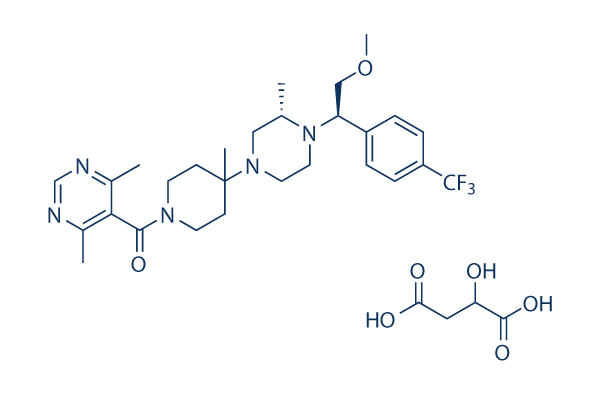
Chemical Structure
Molecular Weight: 667.72
Quality Control
| Related Targets | Integrase Bacterial Antibiotics Anti-infection Fungal Antiviral COVID-19 Parasite Reverse Transcriptase HIV |
|---|---|
| Other CCR Inhibitors | Cenicriviroc INCB3344 SB-297006 ZK756326 2HCl BX471 (ZK-811752) Adaptavir (DAPTA) R243 RS102895 BMS-813160 AZD2098 |
Solubility
|
In vitro |
DMSO
: 100 mg/mL
(149.76 mM)
Water : 100 mg/mL Ethanol : 100 mg/mL |
Molarity Calculator
|
In vivo |
|||||
In vivo Formulation Calculator (Clear solution)
Step 1: Enter information below (Recommended: An additional animal making an allowance for loss during the experiment)
Step 2: Enter the in vivo formulation (This is only the calculator, not formulation. Please contact us first if there is no in vivo formulation at the solubility Section.)
Calculation results:
Working concentration: mg/ml;
Method for preparing DMSO master liquid: mg drug pre-dissolved in μL DMSO ( Master liquid concentration mg/mL, Please contact us first if the concentration exceeds the DMSO solubility of the batch of drug. )
Method for preparing in vivo formulation: Take μL DMSO master liquid, next addμL PEG300, mix and clarify, next addμL Tween 80, mix and clarify, next add μL ddH2O, mix and clarify.
Method for preparing in vivo formulation: Take μL DMSO master liquid, next add μL Corn oil, mix and clarify.
Note: 1. Please make sure the liquid is clear before adding the next solvent.
2. Be sure to add the solvent(s) in order. You must ensure that the solution obtained, in the previous addition, is a clear solution before proceeding to add the next solvent. Physical methods such
as vortex, ultrasound or hot water bath can be used to aid dissolving.
Chemical Information, Storage & Stability
| Molecular Weight | 667.72 | Formula | C28H38F3N5O2.C4H6O5 |
Storage (From the date of receipt) | |
|---|---|---|---|---|---|
| CAS No. | 541503-81-5 | Download SDF | Storage of Stock Solutions |
|
|
| Synonyms | SCH 417690 (SCH-D) Malate | Smiles | COCC(N1CCN(CC1C)C2(C)CCN(CC2)C(=O)C3=C(C)N=CN=C3C)C4=CC=C(C=C4)C(F)(F)F.OC(CC(O)=O)C(O)=O | ||
Mechanism of Action
| In vitro |
Vicriviroc binds with higher affinity to CCR5 versus SCH-C (SCH-351125) in competition binding assays with Ki value of 0.8 nM versus 2.6 nM. Vicriviroc is nearly 6-fold less active than SCH-C (IC50 = 5.8 μM versus 1.1 μM) in attenuating hERG current among voltage-clamped L929 cells, indicating a reduced potential for cardiac effects. Vicriviroc inhibits MIP-1α induced migration of Ba/F3 cells stably expressing recombinant human CCR5, with IC50 of 0.91 nM. In U-87-CCR5 cells, Vicriviroc inhibits intracellular calcium release induced by the ligand RANTES with IC50 of 16 nM, while Vicriviroc treatment alone does not stimulate the release of calcium. Vicriviroc inhibits GTPγS binding to the membranes from HTS-hCCR5 cells induced by RANTES, with IC50 of 4.2 nM. Vicriviroc displays potent antiviral activity against a panel of 30 R5-tropic HIV-1 isolates representing diverse genetic clades, with EC50 values ranging from 0.04 nM to 2.3 nM, and EC90 from 0.45 nM to 18 nM, being more potent (2- to 40-fold) than SCH-C. Vicriviroc is also highly active against a Clade G Russian isolate RU570 with EC90 of 16 nM, which is resistant to inhibition by SCH-C (EC90 > 1 μM). Vicriviroc could target an early step in the viral life cycle prior to reverse transcription and virion maturation, the targets of reverse transcriptase inhibitor and protease inhibitor, respectively. Consistent with the selectivity for CCR5, Vicriviroc is not active against viruses capable of using the CXCR4 coreceptor (R5/X4 or X4 tropic) for infection.
|
References |
|---|
Clinical Trial Information
(data from https://clinicaltrials.gov, updated on 2024-05-22)
| NCT Number | Recruitment | Conditions | Sponsor/Collaborators | Start Date | Phases |
|---|---|---|---|---|---|
| NCT03631407 | Completed | Colorectal Neoplasms |
Merck Sharp & Dohme LLC |
September 24 2018 | Phase 2 |
Tech Support
Tel: +1-832-582-8158 Ext:3
If you have any other enquiries, please leave a message.
Signaling Pathway Map

Products are for research use only. Not for human use. We do not sell to patients.
©Copyright 2013 Selleck Chemicals. All Rights Reserved.