
-
 Argentina
-
 Australia
-
 Austria
-
 Belgium
-
 Brazil
-
 Canada
-
 China
China
-
 Czech Republic
-
 Denmark
-
 Finland
-
 France
-
 Germany
-
 Greece
-
 Hong Kong
-
 Hungary
-
 Iceland
-
 India
India
-
 Ireland
-
 Israel
-
 Italy
Italy
-
 Japan
Japan
-
 Korea
Korea
-
 Luxembourg
-
 Malaysia
-
 Netherlands
-
 New Zealand
-
 Norway
-
 Poland
-
 Portugal
-
 Qatar
Qatar
-
 Romania
-
 Saudi Arabia
-
 Singapore
-
 Spain
Spain
-
 Sweden
-
 Switzerland
-
 Taiwan
-
 Turkey
-
 United Kingdom
-
 United States
research use only
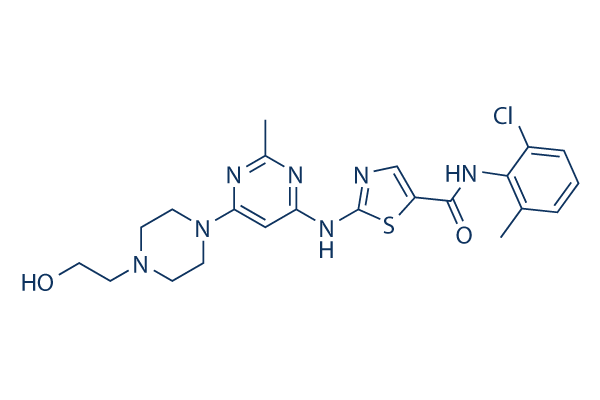
Dasatinib (BMS-354825) Tyrosine Kinase inhibitor
Cat.No.S1021
Quality Control
| Related Targets | EGFR VEGFR JAK FGFR PDGFR HIF FLT3 HER2 FLT Bcr-Abl |
|---|---|
| Other Src Inhibitors | WH-4-023 Saracatinib (AZD0530) PP2 (AGL 1879) SU6656 PP1 Src Inhibitor 1 UM-164 RK 24466 eCF506 Tolimidone (MLR-1023) |
Solubility in DMSO or Water
|
In vitro |
DMSO
: 98 mg/mL
(200.81 mM)
Water : Insoluble Ethanol : Insoluble The solubility data above are all experimental results (not literature values). |
Molarity Calculator
|
In vivo |
|||||
In vivo Formulation Calculator (Clear solution)
Step 1: Enter information below (Recommended: An additional animal making an allowance for loss during the experiment)
Step 2: Enter the in vivo formulation (This is only the calculator, not formulation. Please contact us first if there is no in vivo formulation at the solubility Section.)
Calculation results:
Working concentration: mg/ml;
Method for preparing DMSO master liquid: mg drug pre-dissolved in μL DMSO ( Master liquid concentration mg/mL, Please contact us first if the concentration exceeds the DMSO solubility of the batch of drug. )
Method for preparing in vivo formulation: Take μL DMSO master liquid, next addμL PEG300, mix and clarify, next addμL Tween 80, mix and clarify, next add μL ddH2O, mix and clarify.
Method for preparing in vivo formulation: Take μL DMSO master liquid, next add μL Corn oil, mix and clarify.
Note: 1. Please make sure the liquid is clear before adding the next solvent.
2. Be sure to add the solvent(s) in order. You must ensure that the solution obtained, in the previous addition, is a clear solution before proceeding to add the next solvent. Physical methods such
as vortex, ultrasound or hot water bath can be used to aid dissolving.
Read more about Dasatinib (BMS-354825) solubility in DMSO or water
Working Concentrations for Cell Culture Treatment
Search directly for a cell line, or select a cell line to find matched working concentrations
Read more about Dasatinib (BMS-354825) working concentrations for cell culture treatment
Selectivity & Specificity
Dasatinib (BMS-354825) is a potent inhibitor of EGFRWT (0.041 mM), ABL1 kinase (22.12 nM), SRC kinase (1.2 ± 0.2 nM), Src, BCR-Abl, c-kit, PDGFR, Lck, Fyn, Yes (< 1.0 nmol/L), LCK, Src, Yes kinases (0.4 nM (LCK); 0.5 nM (Src, Yes)), IbW5I= supersomes (0.065 μT), CYP1A2, CYP2A6, CYP2B6, CYPC9, CYP2C19, CYP2D6, CYP2E1 (≥ 35 µM), CYP3A4 (midazolam) (18.0 µM), CYP3A4 (testosterone) (10.0 µM), CYP2C8 (7.2 µM), Abl (purified recombinant protein) (735.1 pM), Src (purified recombinant protein) (466.7 pM), K562 cell lysates (Bcr-Abl) (433.7 pM), EPHA1, ABL2 (EPHA1: 0.0575 µM; ABL2: 0.0055 µM), Abl2 (0.00741 µM), Lck, Fyn, Yes (<1.0 nmol/L), Src kinase (6 nM), p38a kinase (378 nM), Bcr-Abl kinase (0.55 nM), BCR–ABL T315I, V299L mutants (>15 nM), BCR–ABL Y253F, E255 K/V, F317L mutants (5–15 nM), hVEGFR2 (<10 mM), hp38a (<10 mM), hp38b (<10 mM), hp38d (<10 mM), hp38g (<10 mM), hSRC (<10 mM), hEGFR (<10 mM), hPDGFRb (<10 mM), hFGFR1 (<10 mM), hLCK (<10 mM), hKIT (<10 mM), hABL1 (<10 mM), hHER2 (<10 mM), hMEK1 (<10 mM), hMEK2 (<10 mM), hFYN (<10 mM), hYES1 (<10 mM), hCSF1R (<10 mM), hEPHA2 (<10 mM), PDGFR (28 nM), SRC (0.8 nM), LCK (1.1 nM), FYN (0.2 nM), YES (0.41 nM), ABL WT (0.8–1.8 nM), ABL M244V (1.3 nM), ABL G250E (1.8–8.1 nM), ABL Q252H (3.4–5.6 nM), ABL Y253F (6.3–11 nM), ABL Y253H (1.3–10 nM), ABL E255K (5.6–13 nM), ABL E255V (6.3–11 nM), ABL D276G (2.6 nM), ABL E279K (3.3 nM), ABL V299L (15.8–18 nM), ABL F311L (140 nM), ABL T315I (137–>1000 nM), ABL T315A (760 nM), ABL F317L (7.4–18 nM), ABL F317V (17–38 nM), ABL M351T (1.1–1.6 nM), ABL F359V (2.2–2.7 nM), ABL L384M (419.5 nM), ABL L387M (492 nM), ABL H396R (1.3–33 nM), ABL H396P (0.6–21 nM), ABL F486S (5.6 nM), KIT WT (79 nM), KIT D816V (37 nM), KIT V560G (85 nM), KIT V559D (74 nM), PDGFRA WT (13–16 nM), PDGFRA T674I (>500 nM), PDGFRA D842V (62 nM), PDGFRA V561D (59 nM), PDGFRB WT (114 nM), PDGFRB T681I (>1000 nM), AURKA/B/C (4–27 nM), LYN (128 nM), EphA2, VEGF receptor, podocytes (cellular viability) (253±19 nM), podocytes (cell shape and spreading area) (18.5-44.3 nM), podocytes (F-actin stress fibers) (6.1 nM), podocytes (Focal Adhesions) (5.9 nM), podocytes (nuclear architecture) (20.4-21.8 nM), PXN, LIMK1, CFL1, PAK1, SYNPO, Ephrins, AKT, CDKN2A. Dasatinib (BMS-354825) exhibits the greatest inhibitory potency toward FYN (IC50 = 0.2 nM).
Read more about selectivity & specificity
Mechanism of Action
| Information | Dasatinib is a potent ATP-competitive BCR-ABL/SRC inhibitor. It blocks MAPK signaling by binding ATP sites, inducing apoptosis. |
|---|---|
|
Read more about Dasatinib (BMS-354825) IC50 for cell-based and cell-free assays |
|
| Primary Applications and Mechanism of Action | |
Read more about Dasatinib (BMS-354825) Mechanism of Action Clinical Trials
Chemical Information, Storage & Stability
| Molecular Weight | 488.01 | Formula | C22H26ClN7O2S |
Storage (From the date of receipt) | |
|---|---|---|---|---|---|
| CAS No. | 302962-49-8 | Download SDF | Storage of Stock Solutions |
|
|
| Synonyms | BMS-354825 | SMILES | CC1=C(C(=CC=C1)Cl)NC(=O)C2=CN=C(S2)NC3=CC(=NC(=N3)C)N4CCN(CC4)CCO | ||
Read more about storage stability stock solution CAS number SMILES
Tech Support
Tel: +1-832-582-8158 Ext:3
If you have any other enquiries, please leave a message.
Frequently Asked Questions
Question 1:
What’s the difference between S1021 and S7782? Which one is better for in vivo studies?
Answer:
Usually, hydrate will be more stable and dissolve better than free base. But it (S1021) dissolves better in DMSO than hydrate one (S7782).
Question 2:
Can I give it to mice by oral gavage? If so, how to dissolve this compound?
Answer:
Our S1021 in 1% DMSO+30% PEG 300+1% Tween 80 at 30 mg/ml is a suspension which you can administrate to mice via oral gavage. If you want a clear solution, it can be dissolved in 4% DMSO+30% PEG 300+5% Tween 80+ddH2O at 5 mg/ml clearly.

Products are for research use only. Not for human use. We do not sell to patients.
©Copyright 2013 Selleck Chemicals. All Rights Reserved.