
-
 Australia
-
 Austria
-
 Belgium
-
 Brazil
-
 Canada
-
 China
China
-
 Czech Republic
-
 Denmark
-
 Finland
-
 France
-
 Germany
-
 Greece
-
 Hong Kong
-
 Hungary
-
 Iceland
-
 India
India
-
 Ireland
-
 Israel
-
 Italy
Italy
-
 Japan
Japan
-
 Korea
Korea
-
 Luxembourg
-
 Malaysia
-
 Netherlands
-
 New Zealand
-
 Norway
-
 Poland
-
 Qatar
Qatar
-
 Romania
-
 Saudi Arabia
-
 Singapore
-
 Spain
Spain
-
 Sweden
-
 Switzerland
-
 Taiwan
-
 Turkey
-
 United Kingdom
-
 United States
research use only
Protocatechuic acid Apoptosis related chemical
Cat.No.S3975
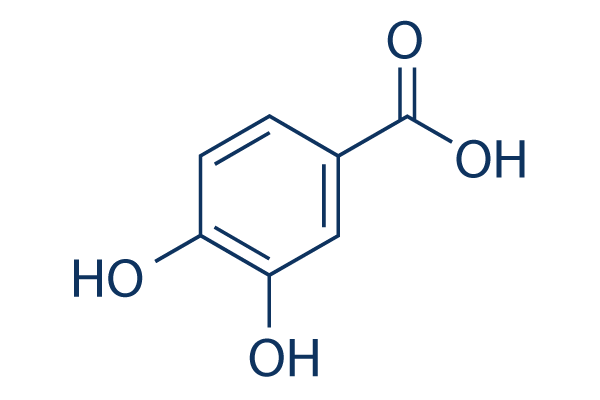
Chemical Structure
Molecular Weight: 154.12
Quality Control
| Related Targets | Bcl-2 Caspase PD-1/PD-L1 Ferroptosis p53 Synthetic Lethality STAT TNF-alpha Ras KRas |
|---|---|
| Other Apoptosis related Inhibitors | Importazole Genipin Pitstop 2 Plumbagin 6-Gingerol Crocin Colcemid Euphorbia factor L3 Sophoridine Pomolic acid |
Solubility
|
In vitro |
DMSO
: 30 mg/mL
(194.65 mM)
|
Molarity Calculator
|
In vivo |
|||||
In vivo Formulation Calculator (Clear solution)
Step 1: Enter information below (Recommended: An additional animal making an allowance for loss during the experiment)
Step 2: Enter the in vivo formulation (This is only the calculator, not formulation. Please contact us first if there is no in vivo formulation at the solubility Section.)
Calculation results:
Working concentration: mg/ml;
Method for preparing DMSO master liquid: mg drug pre-dissolved in μL DMSO ( Master liquid concentration mg/mL, Please contact us first if the concentration exceeds the DMSO solubility of the batch of drug. )
Method for preparing in vivo formulation: Take μL DMSO master liquid, next addμL PEG300, mix and clarify, next addμL Tween 80, mix and clarify, next add μL ddH2O, mix and clarify.
Method for preparing in vivo formulation: Take μL DMSO master liquid, next add μL Corn oil, mix and clarify.
Note: 1. Please make sure the liquid is clear before adding the next solvent.
2. Be sure to add the solvent(s) in order. You must ensure that the solution obtained, in the previous addition, is a clear solution before proceeding to add the next solvent. Physical methods such
as vortex, ultrasound or hot water bath can be used to aid dissolving.
Chemical Information, Storage & Stability
| Molecular Weight | 154.12 | Formula | C7H6O4 |
Storage (From the date of receipt) | |
|---|---|---|---|---|---|
| CAS No. | 99-50-3 | Download SDF | Storage of Stock Solutions |
|
|
| Synonyms | 3,4-Dihydroxybenzoic acid, Protocatechuate | Smiles | C1=CC(=C(C=C1C(=O)O)O)O | ||
Mechanism of Action
| In vitro |
Protocatechuic acid (PCA) inhibits cell migration and invasion at non-cytotoxic concentrations. It down-regulates the Ras/Akt/NF-κB pathway by targeting RhoB activation, which in turn leads to a reduction of MMP-mediated cellular events in cancer cells. In some cancer cells, PCA treatment suppresses cell adhesion and the production of interleukin (IL)-6, IL-8, vascular endothelial growth factor and the intercellular adhesion molecule-1, which would further attenuate angiogenic and metastatic actions. PCA will lower the expression of cleaved caspase-3 and decrease the rate of cardiomyocyte apoptosis induced by hypoxia/reoxygenation. PCA is proven to have the neuroprotective effects in PC12 cells.
|
|---|---|
| In vivo |
Protocatechuic acid (PCA) inhibits metastasis of B16/F10 melanoma cells to the liver in mice. PCA is seen to enhance learning and memory ability, and alleviate oxidative stress, apoptosis and glial proliferation following CIH exposure in rats. In addition, PCA administration also decreases the level of IL-1β in brain and increases the expression of BDNF and SYN. Its administration inhibits apoptosis by decreasing JNK/P38 phosphoryltion and the downstream target including c-fos, Bax and Cleaved Caspase-3 in the hippocampal and prefrontal cortex areas. PCA exerts significant neuroprotective effects in CIH rats.
|
References |
|
Clinical Trial Information
(data from https://clinicaltrials.gov, updated on 2024-05-22)
| NCT Number | Recruitment | Conditions | Sponsor/Collaborators | Start Date | Phases |
|---|---|---|---|---|---|
| NCT06396000 | Not yet recruiting | Anesthesia; Adverse Effect |
Saiqiang Guo|Tongji Hospital |
May 31 2024 | -- |
Tech Support
Tel: +1-832-582-8158 Ext:3
If you have any other enquiries, please leave a message.

Products are for research use only. Not for human use. We do not sell to patients.
©Copyright 2013 Selleck Chemicals. All Rights Reserved.