
-
 Argentina
-
 Australia
-
 Austria
-
 Belgium
-
 Brazil
-
 Canada
-
 China
China
-
 Czech Republic
-
 Denmark
-
 Finland
-
 France
-
 Germany
-
 Greece
-
 Hong Kong
-
 Hungary
-
 Iceland
-
 India
India
-
 Ireland
-
 Israel
-
 Italy
Italy
-
 Japan
Japan
-
 Korea
Korea
-
 Luxembourg
-
 Malaysia
-
 Netherlands
-
 New Zealand
-
 Norway
-
 Poland
-
 Portugal
-
 Qatar
Qatar
-
 Romania
-
 Saudi Arabia
-
 Singapore
-
 Spain
Spain
-
 Sweden
-
 Switzerland
-
 Taiwan
-
 Turkey
-
 United Kingdom
-
 United States
research use only
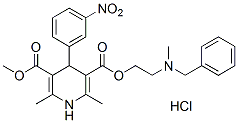
Nicardipine HCl ADC Cytotoxin inhibitor
Cat.No.S4181
Quality Control
| Related Targets | CFTR CRM1 CD markers AChR Calcium Channel Sodium Channel Potassium Channel GABA Receptor TRP Channel ATPase |
|---|---|
| Other ADC Cytotoxin Inhibitors | Triptolide SN-38 Luteolin (+)-Bicuculline Rutin Artemisinin BHQ Pinocembrin Luteoloside Psoralen |
Solubility
|
In vitro |
DMSO
: 100 mg/mL
(193.8 mM)
Water : Insoluble Ethanol : Insoluble |
Molarity Calculator
|
In vivo |
|||||
In vivo Formulation Calculator (Clear solution)
Step 1: Enter information below (Recommended: An additional animal making an allowance for loss during the experiment)
Step 2: Enter the in vivo formulation (This is only the calculator, not formulation. Please contact us first if there is no in vivo formulation at the solubility Section.)
Calculation results:
Working concentration: mg/ml;
Method for preparing DMSO master liquid: mg drug pre-dissolved in μL DMSO ( Master liquid concentration mg/mL, Please contact us first if the concentration exceeds the DMSO solubility of the batch of drug. )
Method for preparing in vivo formulation: Take μL DMSO master liquid, next addμL PEG300, mix and clarify, next addμL Tween 80, mix and clarify, next add μL ddH2O, mix and clarify.
Method for preparing in vivo formulation: Take μL DMSO master liquid, next add μL Corn oil, mix and clarify.
Note: 1. Please make sure the liquid is clear before adding the next solvent.
2. Be sure to add the solvent(s) in order. You must ensure that the solution obtained, in the previous addition, is a clear solution before proceeding to add the next solvent. Physical methods such
as vortex, ultrasound or hot water bath can be used to aid dissolving.
Chemical Information, Storage & Stability
| Molecular Weight | 515.99 | Formula | C26H29N3O6.HCl |
Storage (From the date of receipt) | |
|---|---|---|---|---|---|
| CAS No. | 54527-84-3 | Download SDF | Storage of Stock Solutions |
|
|
| Synonyms | RS-69216,YC-93 | SMILES | CC1=C(C(C(=C(N1)C)C(=O)OCCN(C)CC2=CC=CC=C2)C3=CC(=CC=C3)[N+](=O)[O-])C(=O)OC.Cl | ||
Read more about storage stability stock solution CAS number SMILES
Mechanism of Action
| Targets/IC50/Ki |
Calcium channel
|
|---|---|
| In vivo |
Nicardipine (100 mg/kg) produces a significant transient decrease in retinal blood flow in cats. Nicardipine (100 mg/kg) produces a significant increase in ONH blood flow despite a significant decrease of the mean arterial blood pressure in cats, which suggests that nicardipine could have a beneficial effect on ONH tissue. Nicardipine significantly reduces systolic pressure in the spontaneously hypertensive rats (SHR). Nicardipine significantly reduces the thickness of the tunica media, the media: lumen ratio and increases the luminal area, primarily at the level of small pial arteries and of intracerebral arteries in the spontaneously hypertensive rats (SHR). Nicardipine increases the number of neurones in the frontal cortex and in the occipital cortex of SHR and counters hyperplasia and hypertrophy of GFAP-immunoreactive astrocytes. Nicardipine increases the number of neurones in the CA1 field of the hippocampus and decreases the number and the size of astrocytes of the white matter and grey matter, respectively. Nicardipine (40 mg/kg twice daily for 8 weeks) reduces plaque area by 49.2% in cholesterol-fed rabbits. Nicardipine (40 mg/kg) reduces cholesterol accumulation in the aortic arch by 74.5% in cholesterol-fed rabbits. Nicardipine (5 mg/kg) combined with Nimodipine (80 mg/kg) and Flunarizine(80 mg/kg) results in a significant enhancement of the protective potency of either ethosuximide (50 mg/kg) or valproate (100 mg/kg) against clonic seizures in mice. |
References |
|
Tech Support
Tel: +1-832-582-8158 Ext:3
If you have any other enquiries, please leave a message.

Products are for research use only. Not for human use. We do not sell to patients.
©Copyright 2013 Selleck Chemicals. All Rights Reserved.