
-
 Australia
-
 Austria
-
 Belgium
-
 Brazil
-
 Canada
-
 China
China
-
 Czech Republic
-
 Denmark
-
 Finland
-
 France
-
 Germany
-
 Greece
-
 Hong Kong
-
 Hungary
-
 Iceland
-
 India
India
-
 Ireland
-
 Israel
-
 Italy
Italy
-
 Japan
Japan
-
 Korea
Korea
-
 Luxembourg
-
 Malaysia
-
 Netherlands
-
 New Zealand
-
 Norway
-
 Poland
-
 Qatar
Qatar
-
 Romania
-
 Saudi Arabia
-
 Singapore
-
 Spain
Spain
-
 Sweden
-
 Switzerland
-
 Taiwan
-
 Turkey
-
 United Kingdom
-
 United States
research use only
Brimonidine Tartrate Adrenergic Receptor agonist
Cat.No.S4266
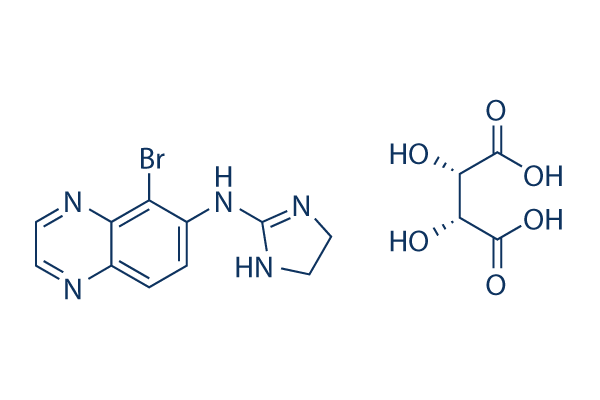
Chemical Structure
Molecular Weight: 442.22
Quality Control
| Related Targets | CXCR Hedgehog/Smoothened PKA AChR 5-HT Receptor Histamine Receptor Dopamine Receptor Ras KRas GPR |
|---|---|
| Other Adrenergic Receptor Inhibitors | Zenidolol (ICI-118551) Hydrochloride L755507 Yohimbine HCl Atipamezole Higenamine hydrochloride Detomidine HCl Naftopidil Demethyl-Coclaurine Buflomedil HCl Fenoterol hydrobromide |
Solubility
|
In vitro |
DMSO
: 88 mg/mL
(198.99 mM)
Water : 22 mg/mL Ethanol : Insoluble |
Molarity Calculator
|
In vivo |
|||||
In vivo Formulation Calculator (Clear solution)
Step 1: Enter information below (Recommended: An additional animal making an allowance for loss during the experiment)
Step 2: Enter the in vivo formulation (This is only the calculator, not formulation. Please contact us first if there is no in vivo formulation at the solubility Section.)
Calculation results:
Working concentration: mg/ml;
Method for preparing DMSO master liquid: mg drug pre-dissolved in μL DMSO ( Master liquid concentration mg/mL, Please contact us first if the concentration exceeds the DMSO solubility of the batch of drug. )
Method for preparing in vivo formulation: Take μL DMSO master liquid, next addμL PEG300, mix and clarify, next addμL Tween 80, mix and clarify, next add μL ddH2O, mix and clarify.
Method for preparing in vivo formulation: Take μL DMSO master liquid, next add μL Corn oil, mix and clarify.
Note: 1. Please make sure the liquid is clear before adding the next solvent.
2. Be sure to add the solvent(s) in order. You must ensure that the solution obtained, in the previous addition, is a clear solution before proceeding to add the next solvent. Physical methods such
as vortex, ultrasound or hot water bath can be used to aid dissolving.
Chemical Information, Storage & Stability
| Molecular Weight | 442.22 | Formula | C15H16BrN5O6 |
Storage (From the date of receipt) | |
|---|---|---|---|---|---|
| CAS No. | 70359-46-5 | Download SDF | Storage of Stock Solutions |
|
|
| Synonyms | UK 1434 Tartrate | Smiles | C1CN=C(N1)NC2=C(C3=NC=CN=C3C=C2)Br.C(C(C(=O)O)O)(C(=O)O)O | ||
Mechanism of Action
| Targets/IC50/Ki |
α2a-adrenergic receptor
0.45 nM(EC50)
|
|---|---|
| In vitro |
Brimonidine reduces the progressive loss of ganglion cells to 26% and 15% at doses of 0.5 mg/kg and 1 mg/kg, respectively. Brimonidine administration initiates 10 days after IOP elevation prevents any further loss of ganglion cells. Brimonidine attenuates the increase in immunoreactivity of GFAP in ocular hypertensive retinas. Brimonidine, but not timolol, shows significant protection of retinal ganglion cells when applied at the time of intraocular pressure (IOP) elevation and prevents further cell loss when applied after intraocular pressure (IOP) is elevated. Brimonidine injected intravitreally into Sprague-Dawley rat eyes increases the number of BDNF-positive RGCs from 55% to 166%. Brimonidine 0.5% given as one drop before, after, or both before and after 360 degrees argon laser trabeculoplasty significantly lowers the incidence of postlaser IOP spikes. Brimonidine 0.2% instilled twice daily offers long-term IOP control comparable with that achieved with timolol 0.5% and better than betatolol 0.25% suspension. |
| In vivo |
Brimonidine (1 mg/kg) significantly protects RGCs from elevated IOP-induced cell death in adult rats. Brimonidine (0.0001%) BMD results in the loss of approximately 37% of the retinal ganglion cell (RGC) population and has no significant neuroprotective effects in adult Sprague-Dawley rats. Brimonidine (0.001% or 0.01%) results in the survival of 76 or 90%, respectively, of the RGC population, and 0.1% Brimonidine fully prevents retinal ganglion cell (RGC) death in the first 7 days after ischemia in adult Sprague-Dawley rats. |
References |
|
Tech Support
Tel: +1-832-582-8158 Ext:3
If you have any other enquiries, please leave a message.
Signaling Pathway Map

Products are for research use only. Not for human use. We do not sell to patients.
©Copyright 2013 Selleck Chemicals. All Rights Reserved.