
-
 Australia
-
 Austria
-
 Belgium
-
 Brazil
-
 Canada
-
 China
China
-
 Czech Republic
-
 Denmark
-
 Finland
-
 France
-
 Germany
-
 Greece
-
 Hong Kong
-
 Hungary
-
 Iceland
-
 India
India
-
 Ireland
-
 Israel
-
 Italy
Italy
-
 Japan
Japan
-
 Korea
Korea
-
 Luxembourg
-
 Malaysia
-
 Netherlands
-
 New Zealand
-
 Norway
-
 Poland
-
 Qatar
Qatar
-
 Romania
-
 Saudi Arabia
-
 Singapore
-
 Spain
Spain
-
 Sweden
-
 Switzerland
-
 Taiwan
-
 Turkey
-
 United Kingdom
-
 United States
research use only
N-Acetylcysteine (NAC chemical, N-Acetyl-L-Cysteine) ROS inhibitor
Cat.No.S1623
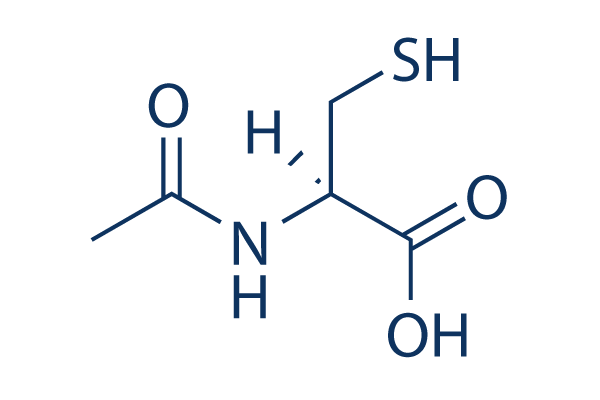
Chemical Structure
Molecular Weight: 163.19
Jump to
Quality Control
Batch:
Purity:
99.95%
99.95
| Related Targets | Bcl-2 Caspase PD-1/PD-L1 Ferroptosis p53 Apoptosis related Synthetic Lethality STAT Ras KRas |
|---|---|
| Other TNF-alpha Inhibitors | R-7050 Cepharanthine Bioymifi JTE-607 Dihydrochloride Corilagin Benpyrine racemate Geraniin CPI-1189 Trionycis Carapax Extract UCB-9260 |
Cell Culture, Treatment & Working Concentration
| Cell Lines | Assay Type | Concentration | Incubation Time | Formulation | Activity Description | PMID |
|---|---|---|---|---|---|---|
| HUVEC cells | Function assay | 10μM | 2h | HUVECs were pretreated with 10 μM NAC for 2 hours, and then treated with 0.5 μM PCB 118. presentce of NAC for 48 hours. | 28592194 | |
| HUVEC cells | Function assay | 2μM,4μM,8μM | 90min | HUVECs that were exposed with serum of P. falciparum and treated with NAC 2 µM,4 µM,8 µM. Supernatant from culture and lysed cells culture were measured for H2O2, GSH and MDA levels. | 21602763 | |
| BL21 (DE3) | Function assay | 30 mins | Inhibition of hexahistidine-tagged IMP-7 (unknown origin) expressed in Escherichia coli BL21 (DE3) cells using fluorocillin as substrate incubated for 30 mins by TECAN fluorescent plate reader analysis, IC50 = 20.7 μM. | 25815530 | ||
| PC12 | Cytotoxicity assay | 24 hrs | Inhibition of 6-hydroxydopamine induced cytotoxicity in rat PC12 cells pretreated for 24 hrs assessed as elevation of intracellular glutathione level | 17158454 | ||
| PC12 | Cytotoxicity assay | 24 hrs | Inhibition of hydrogen peroxide induced cytotoxicity in rat PC12 cells pretreated for 24 hrs assessed as elevation of intracellular glutathione level | 17158454 | ||
| NHBE | Cytotoxicity assay | 1 mM | 18 hrs | Cytoprotective activity in NHBE cells assessed as inhibition of tBHP-induced GSH depletion at 1 mM preincubated for 18 hrs followed by tBHP addition for 4 hrs by thiostar dye based fluorescence assay | 27031670 | |
| HUVEC | Antioxidant assay | 5 mmol/L | 4 hrs | Antioxidant activity against H2O2-induced lipid accumulation in HUVEC cells assessed as reduction in MDA level at 5 mmol/L incubated 4 hrs prior to H2O2 challenge measured after 12 hrs | 22841280 | |
| HUVEC | Antioxidant assay | 5 mmol/L | 4 hrs | Antioxidant activity in HUVEC cells assessed as reduction in H2O2-induced GSH activity at 5 mmol/L incubated 4 hrs prior to H2O2 challenge measured after 12 hrs | 22841280 | |
| HUVEC | Cytotoxicity assay | 5 mmol/L | 4 hrs | Inhibition of H2O2-induced cytotoxicity in HUVEC cells assessed as cell viability at 5 mmol/L incubated 4 hrs prior to H2O2 challenge measured after 12 hrs by MTT assay | 22841280 | |
| HUVEC | Cytotoxicity assay | 5 mmol/L | 4 hrs | Inhibition of H2O2-induced cytotoxicity in HUVEC cells assessed as LDH release at 5 mmol/L incubated 4 hrs prior to H2O2 challenge measured after 12 hrs by LDH assay | 22841280 | |
| SH-SY5Y | Neuroprotective assay | 5 mM | 4 hrs | Neuroprotective activity in H2O2-stimulated human SH-SY5Y cells assessed as upregulation of Bax expression at 5 mM incubated for 4 hrs prior to H2O2 challenge measured after 12 hrs by Western blotting analysis | 23403085 | |
| SH-SY5Y | Neuroprotective assay | 5 mM | 4 hrs | Neuroprotective activity in H2O2-stimulated human SH-SY5Y cells assessed as downregulation of Bcl2 expression at 5 mM incubated for 4 hrs prior to H2O2 challenge measured after 12 hrs by Western blotting analysis | 23403085 | |
| HT22 | Neuroprotective assay | 5 mM | 24 hrs | Neuroprotective activity against glutamate-induced cell death in mouse HT22 cells assessed as increase in cell viability at 5 mM after 24 hrs by MTT assay | 29122481 | |
| HT22 | Neuroprotective assay | 50 uM | 10 to 12 hrs | Neuroprotective activity against glutamate-induced cell death in mouse HT22 cells assessed as reduction in apoptotic cells at 50 uM after 10 to 12 hrs by Annexin V-alexa 488/propidium iodide staining based flow cytometry | 29122481 | |
| HL-7702 | Hepatoprotective assay | 10 uM | 24 hrs | Hepatoprotective activity against APAP-induced cell injury in human HL-7702 cells assessed as increase in survival rate at 10 uM pre-incubated for 24 hrs before APAP addition and measured 6 hrs post APAP challenge by MTT assay | 28729056 | |
| Click to View More Cell Line Experimental Data | ||||||
Solubility
|
In vitro |
DMSO
: 33 mg/mL
(202.21 mM)
Water : 33 mg/mL Ethanol : 33 mg/mL |
Molarity Calculator
Dilution Calculator
Molecular Weight Calculator
|
In vivo |
|||||
In vivo Formulation Calculator (Clear solution)
Step 1: Enter information below (Recommended: An additional animal making an allowance for loss during the experiment)
mg/kg
g
μL
Step 2: Enter the in vivo formulation (This is only the calculator, not formulation. Please contact us first if there is no in vivo formulation at the solubility Section.)
%
DMSO
%
%
Tween 80
%
ddH2O
%
DMSO
+
%
Calculation results:
Working concentration: mg/ml;
Method for preparing DMSO master liquid: mg drug pre-dissolved in μL DMSO ( Master liquid concentration mg/mL, Please contact us first if the concentration exceeds the DMSO solubility of the batch of drug. )
Method for preparing in vivo formulation: Take μL DMSO master liquid, next addμL PEG300, mix and clarify, next addμL Tween 80, mix and clarify, next add μL ddH2O, mix and clarify.
Method for preparing in vivo formulation: Take μL DMSO master liquid, next add μL Corn oil, mix and clarify.
Note: 1. Please make sure the liquid is clear before adding the next solvent.
2. Be sure to add the solvent(s) in order. You must ensure that the solution obtained, in the previous addition, is a clear solution before proceeding to add the next solvent. Physical methods such
as vortex, ultrasound or hot water bath can be used to aid dissolving.
Chemical Information, Storage & Stability
| Molecular Weight | 163.19 | Formula | C5H9NO3S |
Storage (From the date of receipt) | 3 years -20°C powder |
|---|---|---|---|---|---|
| CAS No. | 616-91-1 | Download SDF | Storage of Stock Solutions | Solutions are unstable. Prepare fresh or purchase small, pre-packaged sizes. Repackage upon receipt. | |
| Synonyms | N-acetylcysteine | Smiles | CC(=O)NC(CS)C(=O)O | ||
Mechanism of Action
| Targets/IC50/Ki |
NF-κB
Ferroptosis
ROS
TNF-α
|
|---|---|
| In vitro |
Acetylcysteine (N-Acetylcysteine, NAC) inhibits activation of c-Jun N-terminal kinase, p38 MAP kinase and redox-sensitive activating protein-1 and nuclear factor kappa B transcription factor activities regulating expression of numerous genes. It can also prevent apoptosis and promote cell survival by activating extracellular signal-regulated kinase pathway, a concept useful for treating certain degenerative diseases. This compound directly modifies the activity of several proteins by its reducing activity. It prevents apoptotic DNA fragmentation and maintains long-term survival in the absence of other trophic support in serum-deprived PC12 cells. It also prevents death of PC12 cells and sympathetic neurons. It causes dose-dependent reductions in viability in rat and human aortic smooth muscle cells. It activates the Ras-extracellular signal-regulated kinase (ERK) pathway in PC12 cells. This compound protects neuronal cells from death evoked by withdrawal of trophic support. It increases nitric oxide (NO) release from protein-bound stores in vascular tissue. Its pretreatment of PC12 cells interferes with NGF-dependent signaling and neurite outgrowth, and it was suggested that NAC interferes with redox-sensitive steps in the NGF mechanism. |
| In vivo |
In both the T-maze footshock avoidance paradigm and the lever press appetitive task, N-acetylcysteine (NAC) improves cognition of 12-month-old SAMP8 mice without inducing non-specific effects on motor activity, motivation to avoid shock, or body weight. |
References |
|
Clinical Trial Information
(data from https://clinicaltrials.gov, updated on 2024-05-22)
| NCT Number | Recruitment | Conditions | Sponsor/Collaborators | Start Date | Phases |
|---|---|---|---|---|---|
| NCT04520139 | Not yet recruiting | Ovarian Cancer|Cognitive Impairment |
University of California Irvine|Jarrow Formulas Inc |
December 2024 | Phase 1|Phase 2 |
| NCT06112834 | Not yet recruiting | Botulism |
California Department of Public Health |
June 2024 | Phase 2 |
| NCT06260566 | Not yet recruiting | Biliary Atresia |
Sanjiv Harpavat|Baylor College of Medicine |
May 2024 | Phase 1 |
| NCT06377410 | Not yet recruiting | Chronic Obstructive Pulmonary Disease |
National University of Malaysia |
May 1 2024 | Not Applicable |
| NCT06223568 | Not yet recruiting | Squamous Cell Carcinoma of the Head and Neck|Oropharynx|Human Papillomavirus Viruses|Drug Therapy|Cancer Vaccine |
National Cancer Institute (NCI)|National Institutes of Health Clinical Center (CC) |
May 15 2024 | Phase 2 |
Tech Support
Tel: +1-832-582-8158 Ext:3
If you have any other enquiries, please leave a message.
Signaling Pathway Map

Products are for research use only. Not for human use. We do not sell to patients.
©Copyright 2013 Selleck Chemicals. All Rights Reserved.