
-
 Australia
-
 Austria
-
 Belgium
-
 Brazil
-
 Canada
-
 China
China
-
 Czech Republic
-
 Denmark
-
 Finland
-
 France
-
 Germany
-
 Greece
-
 Hong Kong
-
 Hungary
-
 Iceland
-
 India
India
-
 Ireland
-
 Israel
-
 Italy
Italy
-
 Japan
Japan
-
 Korea
Korea
-
 Luxembourg
-
 Malaysia
-
 Netherlands
-
 New Zealand
-
 Norway
-
 Poland
-
 Qatar
Qatar
-
 Romania
-
 Saudi Arabia
-
 Singapore
-
 Spain
Spain
-
 Sweden
-
 Switzerland
-
 Taiwan
-
 Turkey
-
 United Kingdom
-
 United States
research use only
Chenodeoxycholic Acid FXR agonist
Cat.No.S1843
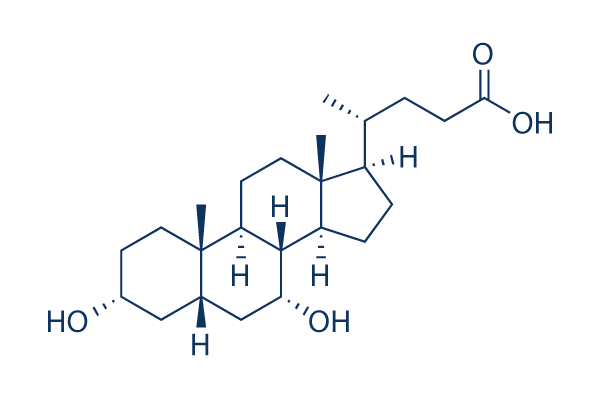
Chemical Structure
Molecular Weight: 392.57
Quality Control
Solubility
|
In vitro |
DMSO
: 79 mg/mL
(201.23 mM)
Ethanol : 79 mg/mL Water : Insoluble |
Molarity Calculator
|
In vivo |
|||||
In vivo Formulation Calculator (Clear solution)
Step 1: Enter information below (Recommended: An additional animal making an allowance for loss during the experiment)
Step 2: Enter the in vivo formulation (This is only the calculator, not formulation. Please contact us first if there is no in vivo formulation at the solubility Section.)
Calculation results:
Working concentration: mg/ml;
Method for preparing DMSO master liquid: mg drug pre-dissolved in μL DMSO ( Master liquid concentration mg/mL, Please contact us first if the concentration exceeds the DMSO solubility of the batch of drug. )
Method for preparing in vivo formulation: Take μL DMSO master liquid, next addμL PEG300, mix and clarify, next addμL Tween 80, mix and clarify, next add μL ddH2O, mix and clarify.
Method for preparing in vivo formulation: Take μL DMSO master liquid, next add μL Corn oil, mix and clarify.
Note: 1. Please make sure the liquid is clear before adding the next solvent.
2. Be sure to add the solvent(s) in order. You must ensure that the solution obtained, in the previous addition, is a clear solution before proceeding to add the next solvent. Physical methods such
as vortex, ultrasound or hot water bath can be used to aid dissolving.
Chemical Information, Storage & Stability
| Molecular Weight | 392.57 | Formula | C24H40O4 |
Storage (From the date of receipt) | |
|---|---|---|---|---|---|
| CAS No. | 474-25-9 | Download SDF | Storage of Stock Solutions |
|
|
| Synonyms | Chenodiol, Chenodesoxycholic acid, Chenocholic acid,CDCA | Smiles | CC(CCC(=O)O)C1CCC2C1(CCC3C2C(CC4C3(CCC(C4)O)C)O)C | ||
Mechanism of Action
| In vitro |
Chenodeoxycholic acid (CDCA) and Deoxycholic acid (DCA) both inhibits 11 beta HSD2 with IC(50) values of 22 mM and 38 mM, respectively and causes cortisol-dependent nuclear translocation and increases transcriptionalactivity of mineralocorticoid receptor (MR). This compound is able to stimulate Ishikawa cell growth by inducing a significant increase in Cyclin D1 protein and mRNA expression through the activation of the membrane G protein-coupled receptor (TGR5)-dependent pathway. This chemical induces LDL receptor mRNA levels approximately 4 fold and mRNA levels for HMG-CoA reductase and HMG-CoA synthase two fold in a cultured human hepatoblastoma cell line, Hep G2. This compound-induced Isc is inhibited (≥67%) by Bumetanide, BaCl2, and the cystic fibrosis transmembrane conductance regulator (CFTR) inhibitor CFTRinh-172. This chemical-stimulated Isc is decreased 43% by the adenylate cyclase inhibitor MDL12330A and it increases intracellular cAMP concentration. This compound treatment activates C/EBPβ, as shown by increases in its phosphorylation, nuclear accumulation, and expression in HepG2 cells. It enhances luciferase gene transcription from the construct containing -1.65-kb GSTA2 promoter, which contains C/EBP response element (pGL-1651). This chemical treatment activates AMP-activated protein kinase (AMPK), which leads to extracellular signal-regulated kinase 1/2 (ERK1/2) activation, as evidenced by the results of experiments using a dominant-negative mutant of AMPKα and chemical inhibitor. |
References |
|
|---|
Clinical Trial Information
(data from https://clinicaltrials.gov, updated on 2024-05-22)
| NCT Number | Recruitment | Conditions | Sponsor/Collaborators | Start Date | Phases |
|---|---|---|---|---|---|
| NCT05130047 | Completed | Chronic Diarrhea|Irritable Bowel Syndrome With Diarrhea|Bile Acid Malabsorption|Bile Acid Diarrhea|Bile Acid Malabsorption Syndrome Type II|Functional Diarrhea |
Michael Camilleri MD|NGM Biopharmaceuticals Inc|Mayo Clinic |
December 1 2021 | Phase 2 |
| NCT03168555 | Completed | Bile Acid Malabsorption|Cholelithiasis |
Zealand University Hospital |
June 22 2017 | Phase 4 |
| NCT01865812 | Completed | Primary Biliary Cirrhosis |
Intercept Pharmaceuticals |
December 3 2013 | Phase 2 |
| NCT01570439 | Unknown status | Anonymous Donors at Blood Donation Center (NUH) |
National University Hospital Singapore |
January 2012 | -- |
Tech Support
Tel: +1-832-582-8158 Ext:3
If you have any other enquiries, please leave a message.

Products are for research use only. Not for human use. We do not sell to patients.
©Copyright 2013 Selleck Chemicals. All Rights Reserved.