
-
 Australia
-
 Austria
-
 Belgium
-
 Brazil
-
 Canada
-
 China
China
-
 Czech Republic
-
 Denmark
-
 Finland
-
 France
-
 Germany
-
 Greece
-
 Hong Kong
-
 Hungary
-
 Iceland
-
 India
India
-
 Ireland
-
 Israel
-
 Italy
Italy
-
 Japan
Japan
-
 Korea
Korea
-
 Luxembourg
-
 Malaysia
-
 Netherlands
-
 New Zealand
-
 Norway
-
 Poland
-
 Qatar
Qatar
-
 Romania
-
 Saudi Arabia
-
 Singapore
-
 Spain
Spain
-
 Sweden
-
 Switzerland
-
 Taiwan
-
 Turkey
-
 United Kingdom
-
 United States
ROS Activators
| Cat.No. | Product Name | Information | Product Use Citations | Product Validations |
|---|---|---|---|---|
| S7873 | Disodium (R)-2-Hydroxyglutarate | Disodium (R)-2-Hydroxyglutarate (D-α-Hydroxyglutaric acid disodium) is a competitive inhibitor of α-ketoglutarate-dependent dioxygenases with Ki of 10.87 ± 1.85 mM. |
|
|
| S3607 | Sarsasapogenin | Sarsasapogenin (SAR, Parigenin) is a steroidal sapogenin. It can provoke the generation of reactive oxygen species and activate unfolded protein response (UPR) signaling pathways. This compound potently inhibits NF-κB and MAPK activation, as well as IRAK1, TAK1, and IκBα phosphorylation in LPS-stimulated macrophages. |
|
|
| E8271New | Sanguinarine citrate | Sanguinarine (gluconate) is a benzophenanthridine alkaloid derived from the root of Sanguinaria canadensis. It activates reactive oxygen species (ROS), c-Jun N-terminal kinase (JNK), and nuclear factor-kappaB (NF-κB) signaling pathways to induce apoptosis in head and neck tumor cells and animal models. It also exhibits potent anti-bacterial and anti-inflammatory activities. | ||
| S7913 | MCB-613 | MCB-613 is a potent steroid receptor coactivator (SRC) stimulator. | ||
| S5263 | Pyrroloquinoline Quinone Disodium Salt | Pyrroloquinoline quinone (methoxatin disodium salt), an aromatic tricyclic o-quinone, is a redox cofactor for bacterial dehydrogenases. It is an efficient electron transfer catalyst from a number of organic substrates to molecular oxygen (O2), constructing quinoprotein model reactions. | ||
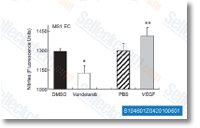
| S1046 | Vandetanib | Vandetanib is a potent inhibitor of VEGFR2 with IC50 of 40 nM in a cell-free assay. It also inhibits VEGFR3 and EGFR with IC50 of 110 nM and 500 nM, respectively. Not sensitive to PDGFRβ, Flt1, Tie-2 and FGFR1 with IC50 of 1.1-3.6 μM. No activity against MEK, CDK2, c-Kit, erbB2, FAK, PDK1, Akt and IGF-1R with IC50 above 10 μM. This compound increases apoptosis and induces autophagy by increasing the level of reactive oxygen species (ROS). |
|
|
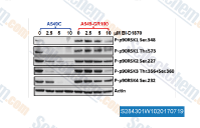
| S2843 | BI-D1870 | BI-D1870 is an ATP-competitive inhibitor of S6 ribosome for RSK1/2/3/4 with IC50 of 31 nM/24 nM/18 nM/15 nM in cell-free assays, respectively; 10- to 100-fold selectivity for RSK than MST2, GSK-3β, MARK3, CK1 and Aurora B. This compound exhibits anticancer attributes including the generation of reactive oxygen species (ROS) and increases in endoplasmic reticulum (ER) stress and autophagy. |
|
|
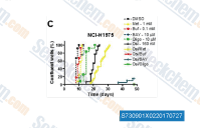
| S7309 | BAY 87-2243 | BAY 87-2243 is a potent and selective hypoxia-inducible factor-1 (HIF-1) inhibitor. This compound inhibits mitochondrial complex I activity, thus triggering a mitophagy-dependent ROS increase leading to necroptosis and ferroptosis. It exerts antitumor activity. Phase 1. |
|
|
| S8661 | CA3 (CIL56) | CA3 (CIL56) has potent inhibitory effects on YAP1/Tead transcriptional activity and primarily targets YAP1 high and therapy-resistant esophageal adenocarcinoma cells endowed with CSC properties. CA3(CIL56) induces ferroptosis and iron-dependent reactive oxygen species (ROS). |
|
|
| S6871 | Sodium oxamate | Sodium oxamate (SO, Aminooxoacetic acid, Oxamic acid) is an inhibitor of lactate dehydrogenase (LDH) that specificly inhibits LDH‑A. This compound induces G2/M cell cycle arrest via downregulation of the CDK1/cyclin B1 pathway and promotes apoptosis through enhancement of mitochondrial ROS generation. |
|
|
| S8615 | Sodium Dichloroacetate (DCA) | DCA (Sodium dichloroacetate), a specific inhibitor of pyruvate dehydrogenase kinase (PDK) with IC50 values of 183 and 80 μM for PDK2 and PDK4 respectively, has been shown to derepress Na+-K+-2Cl- cotransporter and a mitochondrial potassium-ion channel axis. Sodium dichloroacetate increases reactive oxygen species (ROS) generation, triggers apoptosis in cancer cells, and inhibits tumor growth. |
|
|
| S2271 | Berberine chloride | Berberine chloride is a quaternary ammonium salt from the group of isoquinoline alkaloids. This compound activates caspase 3 and caspase 8, cleavage of poly ADP-ribose polymerase (PARP) and the release of cytochrome c. It decreases the expression of c-IAP1, Bcl-2 and Bcl-XL. This chemical induces apoptosis with sustained phosphorylation of JNK and p38 MAPK, as well as generation of the ROS. It is a dual topoisomerase I and II inhibitor. It is also a potential autophagy modulator. |
|
|
| S3238 | Resibufogenin | Resibufogenin (Bufogenin, Recibufogenin), a component of huachansu with anticancer effect, triggers necroptosis through upregulating receptor-interacting protein kinase 3 (RIP3) and phosphorylating mixed lineage kinase domain-like protein at Ser358. This compound exerts cytotoxic effect by inducing reactive oxygen species (ROS) accumulation. It induces apoptosis and caspase-3 and caspase-8 activity. This chemical increases Bax/Bcl-2 expression, and suppresses cyclin D1, cyclin E, PI3K, p-AKT, p-GSK3β and β-catenin protein expression. |
|
|
| S5452 | Sanguinarine chloride | Sanguinarine, a plant alkaloid, is a potent and specific protein phosphatase (PP) 2C inhibitor. Sanguinarine chloride can stimulate apoptosis via activating the production of reactive oxygen species (ROS). Sanguinarine-induced apoptosis is associated with the activation of JNK and NF-κB. |
|
|
| S0056 | (E/Z)-BCI | (E/Z)-BCI (BCI, NSC 150117) is an inhibitor of dual specific phosphatase 1/6 (DUSP1/DUSP6) and mitogen-activated protein kinase with EC50 of 13.3 μM and 8.0 μM for DUSP6 and DUSP1 in cells, respectively. (E)-BCI induces apoptosis via generation of reactive oxygen species (ROS) and activation of intrinsic mitochondrial pathway in H1299 lung cancer cells. | ||
| S0770 | Camalexin | Camalexin, a phytoalexin isolated from Camelina sativa and Arabidopsis (Cruciferae), can induce reactive oxygen species (ROS) production. This compound has antibacterial, antifungal, antiproliferative and anticancer activities. | ||
| S3357 | Elaidic acid |
Elaidic acid is a major trans fatty acid that inhibits cell viability, elevates cell apoptosis by enhancing oxidative stress. This compound can be used as a pharmaceutical solvent. |
||
| S9611 | ABTL-0812 | ABTL0812 (α-Hydroxylinoleic acid, LP-10218, SCLN-0812) inhibits Akt/mTOR axis by inducing the overexpression of TRIB3 and activating autophagy in lung squamous carcinoma cell lines. ABTL0812 also induces AMPK activation and ROS accumulation. | ||
| S5584 | Citronellol | Citronellol (Dihydrogeraniol, (±)-β-Citronellol), a constituent of rose and geranium oils, is used in perfumes and insect repellents. This compound can cause necrotic apoptosis of NCI-H1299 cells by up-regulating TNF-α, RIP1 / RIP3 activities, and down-regulating caspase-3 / caspase-8 activities. It also results in a biphasic increase in ROS production at 1 h and at 12 h in NCI-H1299 cells. | ||
| S4425 | Rifamycin S | Rifamycin S, a quinone and an antibiotic against Gram-positive bacteria (including MRSA), is a clinical drug used to treat tuberculosis and leprosy. This compound generates reactive oxygen species (ROS) and inhibits microsomal lipid peroxidation. |

Products are for research use only. Not for human use. We do not sell to patients.
©Copyright 2013 Selleck Chemicals. All Rights Reserved.