
-
 Australia
-
 Austria
-
 Belgium
-
 Brazil
-
 Canada
-
 China
China
-
 Czech Republic
-
 Denmark
-
 Finland
-
 France
-
 Germany
-
 Greece
-
 Hong Kong
-
 Hungary
-
 Iceland
-
 India
India
-
 Ireland
-
 Israel
-
 Italy
Italy
-
 Japan
Japan
-
 Korea
Korea
-
 Luxembourg
-
 Malaysia
-
 Netherlands
-
 New Zealand
-
 Norway
-
 Poland
-
 Qatar
Qatar
-
 Romania
-
 Saudi Arabia
-
 Singapore
-
 Spain
Spain
-
 Sweden
-
 Switzerland
-
 Taiwan
-
 Turkey
-
 United Kingdom
-
 United States
research use only
TAK-960 PLK inhibitor
Cat.No.S1239
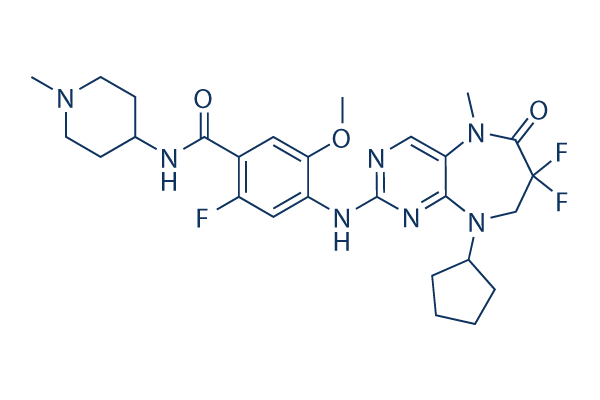
Chemical Structure
Molecular Weight: 561.6
Quality Control
| Related Targets | CDK HSP PD-1/PD-L1 ROCK Wee1 DNA/RNA Synthesis Microtubule Associated Ras KRas Aurora Kinase |
|---|---|
| Other PLK Inhibitors | Volasertib (BI6727) BI 2536 Rigosertib Sodium (ON-01910) GSK461364 Onvansertib (NMS-1286937, NMS-P937) CFI-400945 Ro3280 HMN-214 SBE 13 HCl MLN0905 |
Solubility
|
In vitro |
DMSO
: 13 mg/mL
(23.14 mM)
Ethanol : 3 mg/mL Water : Insoluble |
Molarity Calculator
|
In vivo |
|||||
In vivo Formulation Calculator (Clear solution)
Step 1: Enter information below (Recommended: An additional animal making an allowance for loss during the experiment)
Step 2: Enter the in vivo formulation (This is only the calculator, not formulation. Please contact us first if there is no in vivo formulation at the solubility Section.)
Calculation results:
Working concentration: mg/ml;
Method for preparing DMSO master liquid: mg drug pre-dissolved in μL DMSO ( Master liquid concentration mg/mL, Please contact us first if the concentration exceeds the DMSO solubility of the batch of drug. )
Method for preparing in vivo formulation: Take μL DMSO master liquid, next addμL PEG300, mix and clarify, next addμL Tween 80, mix and clarify, next add μL ddH2O, mix and clarify.
Method for preparing in vivo formulation: Take μL DMSO master liquid, next add μL Corn oil, mix and clarify.
Note: 1. Please make sure the liquid is clear before adding the next solvent.
2. Be sure to add the solvent(s) in order. You must ensure that the solution obtained, in the previous addition, is a clear solution before proceeding to add the next solvent. Physical methods such
as vortex, ultrasound or hot water bath can be used to aid dissolving.
Chemical Information, Storage & Stability
| Molecular Weight | 561.6 | Formula | C27H34F3N7O3 |
Storage (From the date of receipt) | |
|---|---|---|---|---|---|
| CAS No. | 1137868-52-0 | Download SDF | Storage of Stock Solutions |
|
|
Mechanism of Action
| Features |
The discovery of TAK -960 provides an interesting example of how the addition of fluorine atoms during optimization significantly alters the attributes of the leads series.
|
|---|---|
| Targets/IC50/Ki |
PLK1
|
| In vitro |
TAK-960 has shown activity in several tumor cell lines including those that express multidrug resistant protein 1 (MDR1). Consistent with PLK1 inhibition, this compound treatment gives rise to accumulation of G2/M cells, aberrant "polo" mitosis morphology, and increases phosphorylation of histone H3 (pHH3). It inhibits proliferation of multiple cancer cell lines, with mean EC50 values ranging from 8.4 to 46.9 nM, but not in non-dividing normal cells (EC50 >1,000 nM). The mutation status of TP53 or KRAS and MDR1 expression does not correlate with the potency of this chemical in the cell lines tested. |
| Kinase Assay |
Biochemical kinase inhibition assays
|
|
The inhibitory activity of TAK-960 is assessed by the TR-FRET assay, which measures the ATP-dependent phosphorylation of a biotinylated substrate peptide corresponding to residues 2470 through 2488 of the mammalian target of rapamycin protein (Biotin-AGAGTVPESIHSFIGDGLV). A total of 288 kinases are screened for this compound inhibition (1 μM) using HotSpotSM technology and IC50 values for the selected kinases are determined.
|
|
| In vivo |
In animal models, oral administration of TAK-960 increases pHH3 in a dose-dependent manner and significantly inhibits the growth of HT-29 colorectal cancer xenografts. Treatment with once-daily this compound exhibits significant efficacy against multiple tumor xenografts, including an Doxorubicin-resistant xenograft model and a disseminated leukemia model. |
References |
Clinical Trial Information
(data from https://clinicaltrials.gov, updated on 2024-05-22)
| NCT Number | Recruitment | Conditions | Sponsor/Collaborators | Start Date | Phases |
|---|---|---|---|---|---|
| NCT01179399 | Terminated | Advanced Nonhematological Malignancies |
Millennium Pharmaceuticals Inc. |
September 2010 | Phase 1 |
Tech Support
Tel: +1-832-582-8158 Ext:3
If you have any other enquiries, please leave a message.
Signaling Pathway Map

Products are for research use only. Not for human use. We do not sell to patients.
©Copyright 2013 Selleck Chemicals. All Rights Reserved.