
-
 Argentina
-
 Australia
-
 Austria
-
 Belgium
-
 Brazil
-
 Canada
-
 China
China
-
 Czech Republic
-
 Denmark
-
 Finland
-
 France
-
 Germany
-
 Greece
-
 Hong Kong
-
 Hungary
-
 Iceland
-
 India
India
-
 Ireland
-
 Israel
-
 Italy
Italy
-
 Japan
Japan
-
 Korea
Korea
-
 Luxembourg
-
 Malaysia
-
 Netherlands
-
 New Zealand
-
 Norway
-
 Poland
-
 Qatar
Qatar
-
 Romania
-
 Saudi Arabia
-
 Singapore
-
 Spain
Spain
-
 Sweden
-
 Switzerland
-
 Taiwan
-
 Turkey
-
 United Kingdom
-
 United States
research use only
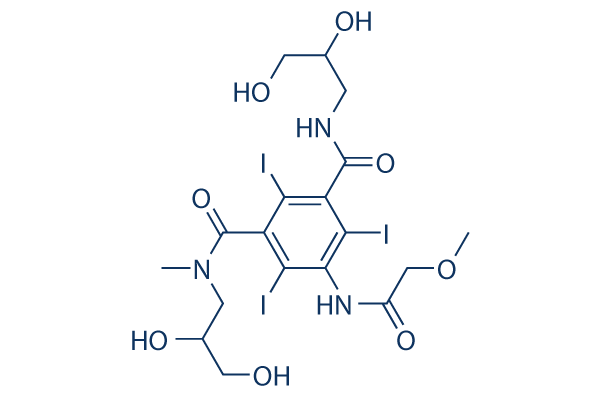
Iopromide
Cat.No.S3207
Quality Control
Solubility
|
In vitro |
DMSO
: 100 mg/mL
(126.4 mM)
Water : 100 mg/mL Ethanol : 100 mg/mL |
Molarity Calculator
|
In vivo |
|||||
In vivo Formulation Calculator (Clear solution)
Step 1: Enter information below (Recommended: An additional animal making an allowance for loss during the experiment)
Step 2: Enter the in vivo formulation (This is only the calculator, not formulation. Please contact us first if there is no in vivo formulation at the solubility Section.)
Calculation results:
Working concentration: mg/ml;
Method for preparing DMSO master liquid: mg drug pre-dissolved in μL DMSO ( Master liquid concentration mg/mL, Please contact us first if the concentration exceeds the DMSO solubility of the batch of drug. )
Method for preparing in vivo formulation: Take μL DMSO master liquid, next addμL PEG300, mix and clarify, next addμL Tween 80, mix and clarify, next add μL ddH2O, mix and clarify.
Method for preparing in vivo formulation: Take μL DMSO master liquid, next add μL Corn oil, mix and clarify.
Note: 1. Please make sure the liquid is clear before adding the next solvent.
2. Be sure to add the solvent(s) in order. You must ensure that the solution obtained, in the previous addition, is a clear solution before proceeding to add the next solvent. Physical methods such
as vortex, ultrasound or hot water bath can be used to aid dissolving.
Chemical Information, Storage & Stability
| Molecular Weight | 791.11 | Formula | C18H24I3N3O8 |
Storage (From the date of receipt) | |
|---|---|---|---|---|---|
| CAS No. | 73334-07-3 | Download SDF | Storage of Stock Solutions |
|
|
| Synonyms | N/A | SMILES | CN(CC(CO)O)C(=O)C1=C(C(=C(C(=C1I)C(=O)NCC(CO)O)I)NC(=O)COC)I | ||
Read more about storage stability stock solution CAS number SMILES
Mechanism of Action
| In vitro |
No toxic effects are detected at the highest tested concentration of Iopromide (10 g/L) in short-term toxicity tests with bacteria (Vibrio fisheri, Pseudomonas putida), algae (Scenedesmus subspicatus), crustaceans (Daphnia magna), and fish (Danio rerio, Leuciscus idus). This compound results in the ratio between the predicted environmental concentration (PEC) and the predicted no-effect concentration (PNEC) of 2 × 10⁻⁴ using an assessment factor of 100. It results in the photocatalytic degradation values k of 0.18 and the coefficient of determination R2 of 0.997 in Milli-Q water with suspended TiO2. The percent removal of this chemical decreases from 97% to 86% when the activity of the nitrifying bacteria is inhibited. This compound results in metabolite of carboxylate formed during the oxidation of the primary alcohol on the side chain of iopromide when the nitrifying bacteria are inhibited. It (0.1 mg/L to 0.27 mg/L) is removed more effectively in the nitrifying activate sludge which has a higher SRT (49 days) than in the conventional activated sludge (SRT of 6 days). This chemical (0.1 mg/L to 0.27 mg/L) is removed more effectively in the nitrifying activate sludge which has a higher SRT (49 days) than in the conventional activated sludge (SRT of 6 days). The percent removal of it in the wastewater treatment plants reaches 61% in nitrifying activated sludge. This compound-dosed plant at 0.1 mg/L, 1 mg/L and 100 mg/L results in the median of DOC-degradation of the synthetic sewage of 88.5%, 90.5%, 88.4% and 85.1%, respectively. It is eliminated to more than 80% in the 100 mg/L concentration after a lag period of 31 days. In the LSTP incubated with 1 mg/L this chemical elimination reaches more than 80% after 38 days. It results in half-life of photodegradation of free amine of 4.21 hours.
|
References |
|
|---|
Clinical Trial Information
(data from https://clinicaltrials.gov, updated on 2024-05-22)
| NCT Number | Recruitment | Conditions | Sponsor/Collaborators | Start Date | Phases |
|---|---|---|---|---|---|
| NCT05778929 | Not yet recruiting | Pancreatitis Chronic |
Peking University People''s Hospital |
2023-04-01 | -- |
| NCT05428397 | Completed | Contrast Enhanced X-ray Based Examination |
Bayer |
2022-06-30 | -- |
| NCT03622801 | Completed | Contrast Medium |
Bayer |
2018-10-12 | -- |
| NCT01580046 | Unknown status | Kidney Failure Chronic |
Yong Huo|Peking University First Hospital |
2012-04 | Phase 4 |
Read more about Clinical Trials
Tech Support
Tel: +1-832-582-8158 Ext:3
If you have any other enquiries, please leave a message.

Products are for research use only. Not for human use. We do not sell to patients.
©Copyright 2013 Selleck Chemicals. All Rights Reserved.