
-
 Australia
-
 Austria
-
 Belgium
-
 Brazil
-
 Canada
-
 China
China
-
 Czech Republic
-
 Denmark
-
 Finland
-
 France
-
 Germany
-
 Greece
-
 Hong Kong
-
 Hungary
-
 Iceland
-
 India
India
-
 Ireland
-
 Israel
-
 Italy
Italy
-
 Japan
Japan
-
 Korea
Korea
-
 Luxembourg
-
 Malaysia
-
 Netherlands
-
 New Zealand
-
 Norway
-
 Poland
-
 Qatar
Qatar
-
 Romania
-
 Saudi Arabia
-
 Singapore
-
 Spain
Spain
-
 Sweden
-
 Switzerland
-
 Taiwan
-
 Turkey
-
 United Kingdom
-
 United States
research use only
GW843682X PLK inhibitor
Cat.No.S2880
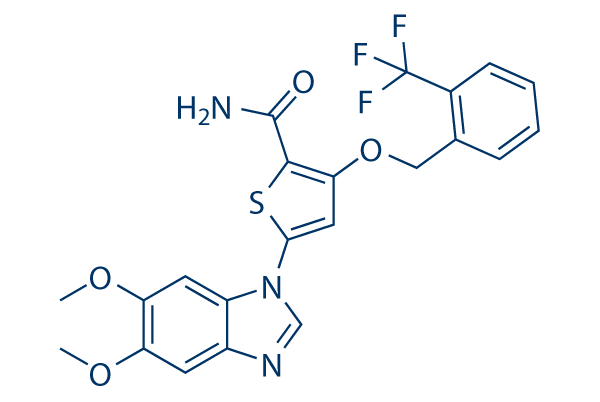
Chemical Structure
Molecular Weight: 477.46
Quality Control
| Related Targets | CDK HSP PD-1/PD-L1 ROCK Wee1 DNA/RNA Synthesis Microtubule Associated Ras KRas Aurora Kinase |
|---|---|
| Other PLK Inhibitors | Volasertib (BI6727) BI 2536 Rigosertib Sodium (ON-01910) GSK461364 Onvansertib (NMS-1286937, NMS-P937) CFI-400945 Ro3280 HMN-214 SBE 13 HCl MLN0905 |
Solubility
|
In vitro |
DMSO
: 95 mg/mL
(198.96 mM)
Ethanol : 3 mg/mL Water : Insoluble |
Molarity Calculator
|
In vivo |
|||||
In vivo Formulation Calculator (Clear solution)
Step 1: Enter information below (Recommended: An additional animal making an allowance for loss during the experiment)
Step 2: Enter the in vivo formulation (This is only the calculator, not formulation. Please contact us first if there is no in vivo formulation at the solubility Section.)
Calculation results:
Working concentration: mg/ml;
Method for preparing DMSO master liquid: mg drug pre-dissolved in μL DMSO ( Master liquid concentration mg/mL, Please contact us first if the concentration exceeds the DMSO solubility of the batch of drug. )
Method for preparing in vivo formulation: Take μL DMSO master liquid, next addμL PEG300, mix and clarify, next addμL Tween 80, mix and clarify, next add μL ddH2O, mix and clarify.
Method for preparing in vivo formulation: Take μL DMSO master liquid, next add μL Corn oil, mix and clarify.
Note: 1. Please make sure the liquid is clear before adding the next solvent.
2. Be sure to add the solvent(s) in order. You must ensure that the solution obtained, in the previous addition, is a clear solution before proceeding to add the next solvent. Physical methods such
as vortex, ultrasound or hot water bath can be used to aid dissolving.
Chemical Information, Storage & Stability
| Molecular Weight | 477.46 | Formula | C22H18F3N3O4S |
Storage (From the date of receipt) | |
|---|---|---|---|---|---|
| CAS No. | 660868-91-7 | Download SDF | Storage of Stock Solutions |
|
|
Mechanism of Action
| Targets/IC50/Ki |
PLK1
(in MTT assay) 2.2 nM
PLK3
(in MTT assay) 9.1 nM
|
|---|---|
| In vitro |
GW 843682X is a submicromolar inhibitor of proliferation of most tumor cells in culture, a notable exception being PC-3, a prostate carcinoma cell line. GW 843682X is also selective for tumor cells compared with normal diploid fibroblasts (HDF), with >10-fold difference in potency. GW 843682X is equipotent (∼200 nmol/L) against MES-SA/DX5 and the parental line MES-SA, suggesting that the compound is not effectively removed by the P-glycoprotein efflux pump in the cell. GW 843682X dose-dependently inhibits the phosphorylation of Ser15-p53 by PLK1 in HeLa cells expressing the tet-inducible chimeric p53-PLK1 protein. GW 843682X enhances HDF cell outgrowth with 30% at 3.3 μM and is able to enhance H460 outgrowth at lowest concentration of 0.37 μM. GW 843682X results in a strong G2-M arrest at 3 μM and very little G2-M arrest is observed at 1 μM in HDF cells. GW 843682X (3 μM) shows a reduced G2-M arrest, but there is an increase in sub-2N DNA content in H460 cells. GW 843682X (0.5 μM) results in cells that are larger in size than the untreated H460 cells and has multiple nuclei. GW 843682X inhibits PLK1, PLK2, PLK3 and PLK4 with Ki values of 4.8 nM, 3.8 nM, 8 nM and 0.163 μM, respectively. GW 843682X (1 μM) interferes with the localization of endogenous MyoGEF at the central spindle in HeLa cells. GW 843682X (1 μM) disrupts the localization of GFP-MyoGEF-wt (GFP-WT), GFP-MyoGEF-T574A (GFP-T574A), and GFP-MyoGEF-T574E (GFP-T574E) to the central spindle in HeLa cell. GW-843682X causes identical premature midzone assembly and protein recruitment, suggesting that the drug effect is specific to Plk1 inhibition. GW 843682X (200 nM) causes microtubule bundling and central spindlin and PRC1 recruitments in equator in HeLa cells. |
| Kinase Assay |
In vitro Kinase Assays
|
|
PLK1 and PLK3 are added to white 384-well assay plates at variable known concentrations in 100% DMSO. DMSO (1–5% final) and EDTA (65 mM) are used as controls. Reaction Mix contains the following components at 22°C: 25 mM HEPES (pH 7.2); 15 mM MgCl2; 1 μM ATP; 0.05 μCi/well [γ-33P]ATP (10 Ci/mmol); 1 μM substrate peptide; 0.15 mg/mL bovine serum albumin; 1 mM DTT; and 2 nM PLK1 kinase domain or 5 nM full-length PLK3. Reaction Mix (10 or 20 μL) is quickly added to each well immediately following addition of enzyme via automated liquid handlers and incubated for 1 to 1.5 h at 22°C. The 20 μL enzymatic reactions are stopped with 50 μL of stop mix [50 mM EDTA, 4.0 mg/mL streptavidin SPA beads in Dulbecco
|
References |
|
Tech Support
Tel: +1-832-582-8158 Ext:3
If you have any other enquiries, please leave a message.
Signaling Pathway Map

Products are for research use only. Not for human use. We do not sell to patients.
©Copyright 2013 Selleck Chemicals. All Rights Reserved.